Showing posts with label 'Our. Show all posts

Wednesday, December 4, 2013

"Our Industry Follows Poverty": Success Threatens A T-Shirt Business

"Our Industry Follows Poverty": Success Threatens A T-Shirt Business
http://media.npr.org/assets/img/2013/11/28/noreli_0201_wide-00e091294a21557096414c9fd89435dc1d3f22f1-s6-c30.jpg


Noreli Morales (right) works on the Planet Money women’s T-shirt at a factory in Medellin, Colombia.


Joshua Davis for NPR
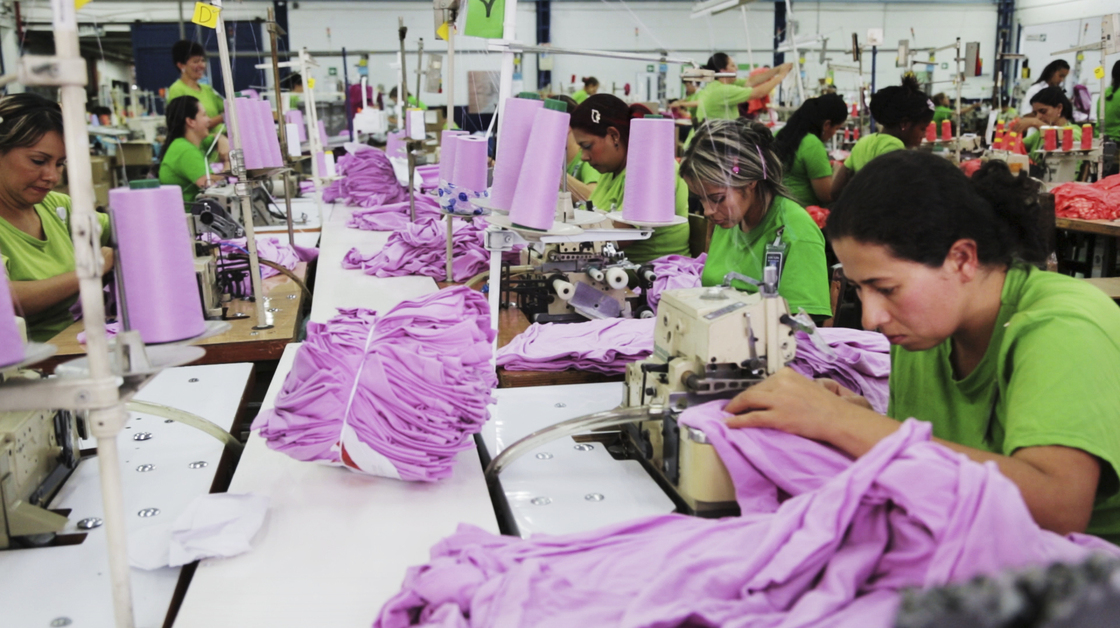


Noreli Morales (right) works on the Planet Money women’s T-shirt at a factory in Medellin, Colombia.


Joshua Davis for NPR


The Planet Money men’s T-shirt was made in Bangladesh, by workers who make about $ 3 a day, with overtime. The Planet Money women’s T-shirt was made in Colombia, by workers who make roughly $ 13 a day, without overtime.


The wages in both places are remarkably low by U.S. standards. But the gap between them is huge. Workers in Colombia make more than four times what their counterparts make in Bangladesh. In our reporting, we saw that the workers in Colombia have a much higher standard of living than the workers in Bangladesh.


Noreli Morales, a Colombian worker who helped make our women’s T-shirt, lives with her mom and her daughter in an apartment that has a kitchen and a bathroom. Shumi and Minu, Bangladeshi sisters who worked on our men’s T-shirt, share a single room with Minu’s husband. There’s no running water, no kitchen. Noreli sends her daughter to daycare; Minu can’t afford daycare, so her daughter lives back in the village, with her parents.


PLANET MONEY MAKES A T-SHIRT: The world behind a simple shirt, in five chapters


NPR


The workers in both places are doing essentially the same thing: Sewing T-shirts together. So why the big difference in their wages?


With a long tradition of apparel manufacturing and better technology, the Colombians can make T-shirts much, much faster than the Bangladeshis. In Bangladesh, on one sewing line for our T-shirt, 32 people can make about 80 shirts per hour. One sewing line in Colombia has eight people and can make about 140 T-shirts per hour. The two lines aren’t perfectly parallel — the Bangladeshi workers are completing a few more details of the shirt than the Colombians. But the difference is striking nevertheless.


It’s not just the sewing machine operators who are more efficient in Colombia. The cotton for the men’s shirt was spun into yarn in Indonesia, then shipped to Bangladesh to be knit, cut and sewn. Crystal, the Colombian company that made the women’s shirts, does everything — from spinning the cotton into yarn to knitting the yarn into cloth to stitching sleeves on a shirt. That makes the process much faster and easier for Jockey, the company that coordinated the production of our T-shirt.


Colombia’s economy has been growing like crazy for the past decade, and wages have been rising. That’s good for the country as a whole, but it may wind up driving away the T-shirt industry.


“There is a saying that is going to sound horrible,” Crystal’s CEO, Luis Restrepo, told me. “Our industry follows poverty.” It’s an industry “on roller skates,” he said, rolling from Latin America to China, to Bangladesh — wherever costs are lowest.


No matter how good Crystal is, Restrepo said, the break-up call from a big client can come at any moment.


PLANET MONEY MAKES A T-SHIRT: The Lives Of The Workers Who Made Our Shirt


PLANET MONEY MAKES A T-SHIRT: The Lives Of The Workers Who Made Our Shirt


NPR


“You are one phone call away,” he told me.


When I visited the factory in Colombia, there was a rumor going around that Jockey, one of Crystal’s most important clients, was going to cut its ties with the company. People were really worried. “Who are they gonna let go first?” a worker named Lina Maria Tascón said. “The people who worked on Jockey, of course.”


When I got back to the U.S., I asked Marion Smith, a senior vice president at Jockey, about the rumors. He said they’re true: He decided to put a stop to orders from Crystal. “We both like each other a lot,” Smith said. “They’ve got great principles, they have great capabilities.” The companies are trying to negotiate some new kind of deal, he said.


But the growth of Colombia’s economy means it’s getting expensive to make simple products like T-shirts there. “Wages continue to go up, costs continue to go up,” Smith said. Jockey plans to move production to several other countries, where its cost per shirt will be 20 to 30 percent lower, according to Smith.


The loss of Jockey will be a blow to Crystal. But as Colombia’s economy has grown, Crystal has been transforming itself from a manufacturer of low-end clothes into a company that sells higher-end clothes under its own brands. The company has already opened 160 of its own stores across Latin America, and has plans for more.


“We decided we want to control our own destiny,” Restrepo said.


News


Read more about "Our Industry Follows Poverty": Success Threatens A T-Shirt Business and other interesting subjects concerning NSA at TheDailyNewsReport.com

Monday, September 23, 2013

Obama, on Navy Yard: "Our tears are not enough"

President Barack Obama pauses as he speaks during a memorial service for the victims of the Washington Navy Yard shooting at Marine Barracks Washington, Sept. 22. | AP Photo

‘It ought to obsess us, it ought to lead to some sort of transformation,’ he says. | AP Photo


The best way to memorialize the 12 killed at the Navy Yard massacre, President Barack Obama said Sunday, is by enacting the new gun control laws he seeks.


Speaking at a memorial service at the Marine Barracks in Southeast D.C., Obama said Monday’s shootings, along with the other gun massacres during his presidency, “ought to lead to some sort of transformation” like those that have taken place in other nations that have restricted access to guns in the wake of mass shootings.


“Our tears are not enough. Our words and our prayers are not enough,” Obama said. “If we really want to honor these 12 men and women, if we really want to be a country where we can go to work, go to school and walk our streets free from senseless violence without so many lives being stolen with a bullet from a gun, then we’re going to have to change.”


(PHOTOS: Shooting at Navy Yard)


Obama addressed the nation’s growing immunity to shock at mass shootings and the lack of a fresh gun control push on Capitol Hill last week.


“It ought to be a shock to all of us as a nation and as a people,” Obama said. “It ought to obsess us, it ought to lead to some sort of transformation — that’s what happened in other countries when they experienced similar tragedies.”


And as he did beginning in January with his post-Newtown gun control push, Obama acknowledged that members of Congress will not back any new gun control laws without being forced to do so by their constituents. So far, Obama’s allies have been unsuccessful in efforts to use that tactic to move votes on major issues in Congress.


(Also on POLITICO: Obama vows to continue gun push)


“By now it’s clear that the change we need will not come from Washington, even when the tragedy strikes Washington,” Obama said. “Change will come the only way it’s ever come, and that is from the American people.”


As Obama noted, the Navy Yard service marked the fifth time as president he has appeared at a similar event in the wake of a mass shooting. At Tucson in January 2011, he celebrated the lives of six people who died at a congressional event for then-Rep. Gabrielle Giffords (D-Ariz.).


At Newtown in December 2012, he elicited sobs from the crowd while reading the list of 20 first-grade students gunned down, then kicked off his administration’s gun control push.


(Transcript: President Obama’s remarks at Navy Yard shooting memorial service)


And at the Marine Barracks Sunday, the president and First Lady Michelle Obama met with families of the 12 people — all civilian employees — who were killed Monday morning by Aaron Alexis, a military contractor with a history of mental illness.


As he did at the other memorials, Obama ticked through brief biographies of the victims, painting them in the most ordinary terms while describing the work they did at the Navy Yard as integral to the nation’s security.


“What troubles us so deeply is how the senseless violence in the Navy Yard echoes other tragedies,” Obama said.


Navy Secretary Ray Mabus and other military speakers who preceded Obama Sunday stressed that those killed Monday — patriots, Mabus said — were integral to the nation’s military success.


“That is what they are,” Mabus said. “Heroes, ordinary people facing extraordinary circumstances.”


Obama’s call for new gun laws Sunday followed the case he made Saturday night at a Congressional Black Caucus awards dinner.


“We fought a good fight earlier this year, but we came up short,” Obama said Saturday night. “And that means we’ve got to get back up and go back at it. Because as long as there are those who fight to make it as easy as possible for dangerous people to get their hands on a gun, then we’ve got to work as hard as possible for the sake of our children.”


Speaking before Obama Sunday, Washington, D.C., Mayor Vincent Gray put it in more succinct terms.


“There is one lesson that is already abundantly clear,” Gray said. “Our country is drowning in a sea of guns.”


POLITICO – TOP Stories


Obama, on Navy Yard: "Our tears are not enough"