Showing posts with label Hawks. Show all posts

Friday, March 28, 2014

How Deficit Hawks Are Trying to Pit Millennials Against Seniors to Attack Social Security and Medicare


A Tea Party congressman calls out greedy Wall Streeters for the ruse.


Generational grievances pitting struggling young millennials against supposedly better-off seniors is creeping back into American politics, fanned by a new wave of deficit hawks who want to undermine public confidence in Social Security and Medicare—as the first step in cutting the social insurance programs.


A string of recent examples—rants from MSNBC’s wealthy young commentator, a notorious elderly-attacking House candidate, think tanks promoted on NPR—generational warfare cheerleaders are proclaiming that America is heading toward an epic and immoral conflict as better-off seniors are robbing millennials of shrinking federal dollars because retirement programs cost too much. That’s simply false, as Social Security is solvent through 2033, and spending as a percentage of GDP is close to where it’s been since 1975, at 21 percent. 


This line of attack isn’t in a political vacuum. It comes as some Democrats are reframing the debate on Social Security and campaigning for increased benefits. Nor is it a new argument, as a right-wing club of libertarians, Wall Street bankers and deficit hawks have tried for decades to undermine and privatize the program. Amazingly, the generational warmongers are not just irking progressives who see shifting political winds; they"re scaring at least one Republican congressman who called out the generational warfare ruse and game plan in fundraising letter.        


Pennsylvania Republican Tom Marino is a former U.S. Attorney and conservative two-term incumbent. His re-election website boasts he is anti-Obamacare, pro-gun, pro-fracking and anti-gay marriage. Yet, the top news item on his website is a letter from Vivian Mae Marino, “to let all of you know that my son, Tom Marino, will save Medicare and strengthen Social Security.”


Why is a 62-year-old Tea Partier calling on mom? Because a generational antagonist bent on sounding “the alarm of gerontocracy, or rule by the elderly,” may run against Marino as an independent in 2014. That self-proclaimed Paul Revere for millennials is Nick Troiano, 24, who co-founded a group supposedly representing young Americans who are losing sleep because they feel Congress is stealing their future by spending on seniors. Never mind that his deficit hawk group spectacularly imploded last month, after e-mails revealed that it couldn’t balance its budget, and had burned through funds from Wall Street billionaire Pete Peterson, the leading Social Security privateer.


“As a college student in Washington, D.C., this individual [Troiano] founded a group called The Can Kicks Back,” Marino’s appeal said. “The Can Kicks Back claimed to be concerned about our nation’s debt and deficit. In reality, it is just another front group funded by Wall Street billionaire Pete Peterson.” Marino’s letter did what Republicans almost never do—unmask other Republicans’ real agenda. “Why are Pete Peterson and Kick The Can Back so dangerous?” he wrote. “Their goal is to increase tax loopholes for the largest corporations in the country and they plan to pay for this corporate giveaway to the Fortune 500 by cutting Social Security benefits for older Americans.”


Marino didn’t stop there. “One commentator recently suggested that The Can Kicks Back’s strategy was, ‘to attempt the enlistment of millennial (young Americans age 18 to 25) in the effort to impoverish their grandparents,” he said. “Within just a day of his announcement, this individual considering running against me claimed that he had already raised $ 10,000. How much of that do you think was from Peterson and other Wall Street fat cats who want to get their hands on your Social Security benefits.”


This spat captures the contours of an old and still looming political fight where centrist Democrats and most Republicans refuse to fortify America’s most popular and widely used social insurance programs by a mix of simple tax increases and more realistic cost-of-living increases. More than 80 percent of Social Security benefits go to people with incomes of less than $ 30,000—and most average less than $ 12,000 a year. Yet faces are appearing on America’s airwaves posing a false analysis and choice: that federal finances are a mess; and that the only fix is depriving seniors of earned social insurance benefits so those funds could be diverted to struggling youths. 


Abby Huntsman, the poised 27-year-old daughter of multi-millionaire 2012 GOP presidential candidate, Jon Huntsman, and a co-host of MSNBC’s millennial-targeted show, “The Cycle,” is a prime example. Two weeks ago, she went into an on-air tizzy about how Social Security would disappear for her peers if older Americans kept getting all the benefits. “At the rate we are spending, the system will be bankrupt by the time you and I are actually eligible to get these benefits,” she declared, citing new Pew Research Center research. “Would you rather have 80 percent of what you have today, or nothing at all?” 


Baby boomers will have to forgive Huntsman for plagiarizing the Beatles—she calls her TV commentary Abby’s Road. But they shouldn’t let her off the hook for wild inaccuracies, Los Angeles Times business columnist Michael Hiltzik noted. Telling her peers that they will get zero when the retire, which is incorrect, so that they will accept a budget deal that would instead lower their eventual retirement benefits, is not looking out for her generation.


On Thursday, Huntsman hit back at Hiltzik, flashing his column on the air, and declaring, “entitlement reform is the most pressing long-term budget decision we have to make as a country. Come on, man! It isn’t about me. It’s about the major problem.” Her solution, needless to say, was cutting Social Security, screening incomes of Medicare recipients, and postponing the onset of that program from age 65 to 67.


The problem is that Huntsman doesn’t understand the real problem—and refuses to consider other options besides spending cuts, as Hiltzik said in a Friday piece. “That’s where she really goes off the rails,” he said, citing her remarks no one is discussing serious options. “We have been debating those options, for years.”


Huntsman is not alone in resurrecting a generational warfare meme. Comedian Bill Maher recited the same incorrect clichés in jokes on his TV show. But more serious is the Pew Research Center report—and a new related book—cited by Huntsman, from ex-Washington Post reporter turned Pew research czar Paul Taylor.


Taylor’s book, The Next America: Boomers, Millennial and The Looming Generational Showdown, is a full-throttled Pew production. It’s packed with facts, figures, graphs, and dire-sounding analysis to support a particular conclusion, which Taylor told NPR. Speaking of Social Security and Medicare, he said, “Everybody who looks at the demographics knows that those systems are going broke within 15 or 20 years and the longer you wait, the more the burden of the solution is going to fall on millennials.”


It’s worth noting that this is the same line that U.S. News and World Report, the pro-business weekly magazine, took in its November 5, 1984 editorial, after President Ronald Reagan, the conservative Republican, and Democratic House Speaker Tip O’ Neill, put together a bill modifying but not privatizing Social Security—as right-wingers had hoped. The magazine called it “nothing less than a massive transfer of wealth from the young, many of them struggling, to the elderly, many of them living comfortably.”


Fast-forward 30 years and Paul Taylor is making the same case on NPR—as an information broker to its educated, influential audience. “I leave this book thinking we have very serious demographically driven challenges,” he said on March 4. “We’ve got to rebalance the social safety net so it’s fair to all generations.” 


Pew isn’t the disinterested wise observer that’s NPR presents. It and the right-wing Laura and John Arnold Foundation have lead a tag team effort to cut back government employee pensions. They recite austerity frames—talking about slashing spending and avoiding other options where wealthy interests would pay more. Taylor is a bit too black and white when he says “everyone” in Washington knows that a retirement safety net crisis will explode in 15 or 20 years. That’s not how liberal economists see it.


“It is striking that NPR is willing to focus so much more attention on the threat to the living standards of millennials presented by a 2-3 percentage point increase in payroll taxes,” blogged Dean Baker, at Washington’s Center for Economic and Policy Research after Taylor’s appearance. That focus ignores the “policies that could lead to much or all of the benefits of productivity growth over the next three decades going to those at the top, as has been the case for the last three decades,” he said, referring to America’s wage and income stagnation.  


When you peel back the details, what’s going on here is simple and not new. Right-wingers—starting at the libertarian Cato Institute which doesn’t want federal social insurance programs to work, going next to Wall Street firms that see a gold mine from privatizing Social Security, and continuing to today’s spokespeople for these interests—want to undermine public confidence in government and push for-profit substitutes. They know that seniors and near-retirees won’t buy into any of this, which is why they have tried for decades—as Republican Congressman Marino’s fundraising letter noted—to create generational grievances pitting America’s young against its elderly.


“I’m not quite a believer in cabals, but that’s sort of what happened,” said Eric Kingson, Syracuse University Professor of Social Work and co-director of Social Security Works, the national advocacy organization. “It [generational warfare] doesn’t take off when people see their parents and their grandparents struggling on fairly minimal income.”


Right Wing History Repeats Itself


Experts who have studied America’s social insurance programs for decades know that cutting Social Security would cause more poor seniors in the future—including today’s millennials. That is because smaller baseline benefits would yield smaller future monthly checks, even after cost-of-living increases. How do they know that? Because in the early 1980s, when Social Security faced a funding shortfall in a bad economy, Congress’s fix ended up shrinking payments to today’s retirees by more than 20 percent, compared to what they would have been if left alone. Three factors did that: increasing income taxes on Social Security benefits, delaying annual cost of living increases every year by six months, and eventually raised the retirement age from 65 to 67.


The losers in that political fight—lead by the Cato Institute and anti-tax Wall Streeters—have been fighting to privatize Social Security ever since. Their best strategy, as laid out in the fall 1983 Cato Journal, was seen as fomenting a generational divide fighting for a shrinking slice of the federal pie. At the same time, they also began to push businesses to replace employee pensions with individual retirement accounts, which, as AlterNet’s Lynn Stuart Parramore has described in detail, have produced far less for retirees.


“We must prepare the political ground so that the fiasco of the last 18 months is not repeated,” Cato Journal’s influential 1983 article, “Achieving A “Leninist” Strategy,” began. “We must begin to divide this [pro-Social Security] coalition and cast doubt on the picture of reality it presents to the general public.” Cato knew who it wanted on its team. It “should consist not only of those who will reap benefits from the IRA-based private system [that a lawyer and columnist Peter J.] Ferrara has proposed, but also the banks, insurance companies, and other institutions that will gain from providing such plans to the public.” 


And Cato knew its target. “The young are the most obvious constituency for reform and a natural ally for the private alternative,” it said. “The overwhelming majority of people in this group have stated repeatedly that they have little or no confidence in the present Social Security system.” Youthful indignation and grievance could be powerful, Cato said, fantasizing about its coming revolution. “Younger workers… would see just how much of a loss they are taking by participating in the program… assuming, for the sake of argument, that they would ever have received those benefits.” 


Needless to say, Social Security has not collapsed as Cato forecast—even though today’s generational warfare arguments are basically repeating 30-year-old rhetoric. The program is solvent under promised benefits through 2033—a half-century after Congress reformed it. Social Security advocates say such longevity is a sign of its great success. But, as was the case in 1983, federal law requires Social Security to pay out only what it takes in. The next funding shortfall is predicted to come in 2033, when benefits would be cut by about 20 percent to Baby Boomers and GenXers if no revenue changes were made. But modest increases in payroll taxes—fifty cents a week for most workers, and raising the cap on how much of one’s annual income is subject to Social Security taxes (the first $ 117,000) would more than offset 2033’s predicted shortfall.


Those simple options, needless to say, are almost never discussed by Cato’s narrative or by its more modern descendents. Cato’s generational warfare script had another dark thread that was developed in a second article the same issue of the Cato Journal, where it suggested that elderly people were more likely to be greedy when the government was signing the check, which amounted to taking money from younger people’s pockets. That feeds rightwing scripts that seniors are immorally stealing federal funds from the young. 


“If transfers to aged parents were purely a family decision, I doubt those among today’s elderly who have accumulated significant wealth would be willing to ask their children for a significant portion of their income,” Marilyn Flowers wrote. “Yet these same individuals seemingly have no qualms about using their political clout to demand through Social Security what is, in an objective sense, the same thing.”   


Back To Reality


There have been many fact-filled rebuttals to these frames—that seniors are taking too large a slice of America’s limited public resources—even as this pro-austerity script has evolved under the more recent deficit hawk banner. It’s key to note what these right-wingers aren’t calling for. They don’t want to cut corporate subsidies or defense spending, nor do they want to pay more in taxes—such as taxing investment income. They’ll cite big numbers on how much is spent on safety nets to scare people, but they don’t mention the even bigger sums spent on corporate welfare. That’s was the striking takeaway from David Sirota’s investigate report on the joint Arnold Foundation and Pew attack on pensions for The Institute for America’s Future and PandoDaily, which prompted WNET, New York City’s largest public television station, to return Arnold’s $ 3.5 million grant and cancel a “Pension Peril” series.   


Social Security defenders like Kingson know that the right’s arguments are simplistic while real life is more complicated. It’s almost impossible to quantify how much money flows from one generation to the next over a lifetime—such as parents raising children and paying for college, helping with a first home down payment or bailing out a child’s bad business decision; to elderly people on the other end not being paid at all for their care giving as their life partners age in their own homes. This reality points to Kingson’s biggest disappointment with today’s political leaders—they aren’t noting how American of all ages are facing intertwined economic struggles.


“Obama’s failure is not building on his promise of we’re in all in this together,” Kingson said. “The concept of all of us being connected and being together leads to policies of compassion, citizenry, decency, dignity. It leads to form social structures that support human beings throughout life. And we as a country aren’t seeing ourselves as being in it together, and nobody is speaking out for that with moral force today.”


“Instead, there’s moral force that’s being exerted from the right in a negative way,” he continued. “They have a narrative that government is falling apart, too much money is being spent, you’re being screwed—and we thought that Obama was going to do this—counter that.”    


But a funny thing is happening as today’s generational warmongers—MSNBC’s Abby Huntsmen, prospective GOP House candidate Nick Troiano, Pew research czar Paul Taylor—are that saying generational conflict is America’s fate.


“What’s so fascinating is there isn’t any tension at the moment,” Taylor told NPR. “You have a generation coming in that isn’t wagging its finger with blame at mom or grandma. In fact, they’re living with mom and grandma… and maybe that’s the best basis upon which to go forward and rebalance our books on Social Security and Medicare.”


In other words, there’s no real generational warfare. There are just new faces touting an old line, which is an opportunistic political attack for sponsors to line their pockets or hobble effective government programs—which is exactly what Republican Rep. Tom Marino wrote in his edgy March 10 fundraising appeal unmasking this rhetorical red herring.


“You will not believe the length to which this community organizer and his Wall Street friends will go to buy a seat in Congress,” Marino’s letter began. It ended, “We’ll let the billionaires know that we mean business when we tell them to keep their hands off the Social Security benefits we have earned.”


Related Stories


AlterNet.org Main RSS Feed


How Deficit Hawks Are Trying to Pit Millennials Against Seniors to Attack Social Security and Medicare

How Deficit Hawks Are Trying to Pit Millennials Against Seniors to Attack Social Security and Medicare
At A Political Statement, the privacy of our visitors is of extreme importance to us (See this article to learn more about Privacy Policies.). This privacy policy document outlines the types of personal information is received and collected by A Political Statement and how it is used.

Log Files

Like many other Web sites, A Political Statement makes use of log files. The information inside the log files includes internet protocol (IP) addresses, type of browser, Internet Service Provider (ISP), date/time stamp, referring/exit pages, and number of clicks to analyze trends, administer the site, track user"s movement around the site, and gather demographic information. IP addresses, and other such information are not linked to any information that is personally identifiable.

Cookies and Web Beacons

A Political Statement does use cookies to store information about visitors preferences, record user-specific information on which pages the user access or visit, customize Web page content based on visitors browser type or other information that the visitor sends via their browser.

DoubleClick DART Cookie

  • Google, as a third party vendor, uses cookies to serve ads on A Political Statement.
  • Google"s use of the DART cookie enables it to serve ads to users based on their visit to A Political Statement and other sites on the Internet.
  • Users may opt out of the use of the DART cookie by visiting the Google ad and content network privacy policy at the following URL - http://www.google.com/privacy_ads.html.

These third-party ad servers or ad networks use technology to the advertisements and links that appear on A Political Statement send directly to your browsers. They automatically receive your IP address when this occurs. Other technologies ( such as cookies, JavaScript, or Web Beacons ) may also be used by the third-party ad networks to measure the effectiveness of their advertisements and / or to personalize the advertising content that you see.

A Political Statement has no access to or control over these cookies that are used by third-party advertisers.

You should consult the respective privacy policies of these third-party ad servers for more detailed information on their practices as well as for instructions about how to opt-out of certain practices. A Political Statement"s privacy policy does not apply to, and we cannot control the activities of, such other advertisers or web sites.

If you wish to disable cookies, you may do so through your individual browser options. More detailed information about cookie management with specific web browsers can be found at the browser"s respective websites.


How Deficit Hawks Are Trying to Pit Millennials Against Seniors to Attack Social Security and Medicare

Monday, October 28, 2013

Deficit Hawks "Have No Monopoly On Morality," Summers Says

Deficit Hawks "Have No Monopoly On Morality," Summers Says
http://isbigbrotherwatchingyou.com/wp-content/uploads/2013/10/488f3__summers282way-df6d0ddfd199f4739b94a4d9d08122dde5ce7f3b-s6-c30.jpg


Republican Rep. Paul Ryan and others from the GOP have spoken with NPR in recent years about why they believe the federal debt is the nation’s “No. 1″ problem.


Lawrence Summers on deficit reduction, investment and morality


And in Ryan’s view, as he told us in 2011, lawmakers have “a moral obligation … to put up solutions to fix this problem.”


Morning Edition plans to air a view from the Democratic side on Tuesday. We listened in on host Steve Inskeep’s conversation with Lawrence Summers, who was Treasury secretary in the final years of the Clinton administration and was a top White House economic adviser during President Obama’s first term.


Here is Summers on another way to look at the moral issues:


“If we were to cut the deficit on the back of deferring maintenance on our infrastructure, on the back of short-changing investments in providing educational opportunity, on the back of cutting back basic measures in science, on the back of failing to protect the environment, that would be doing our children no favor.


“If we were to leave our children in a situation where because we had slashed away at entitlement programs they lived their lives in the shadow of a need to take care of us during our retirement, in the shadow of a need to protect their parents from the vicissitudes of high health care costs, that would be doing our children no favor.


“The deficit alarmists have no monopoly on morality. Their arguments, in fact, by short-changing economic growth, put our moral obligation to succeeding generations at risk.


“Yes, we do need to make budget adjustments. Yes, once we get this economy growing there are important changes that are necessary.


“But for now, a political process that cannot focus on very much at a time and has great difficulty getting anything done needs to focus its energy and the right focus for its energy is on economic growth.”


Economic growth, Summers argues (including in a recent Washington Post op-ed) can be boosted by spending on education, infrastructure, science and technology — spending that’s going to be done at some point anyway and can arguably do the most immediate good when the economy is sluggish. What’s more, as he wrote in the Post, “spurring growth has a multiplicity of benefits” that include deficit-reduction.


Much more from the conversation with Summers, as we said, is due on Tuesday’s Morning Edition. Click here to find an NPR station that broadcasts or streams the show. After the interview airs, it will be posted on the show’s webpage.


A related from September: Summers Pulls Out Of Running To Be Federal Reserve Chief.


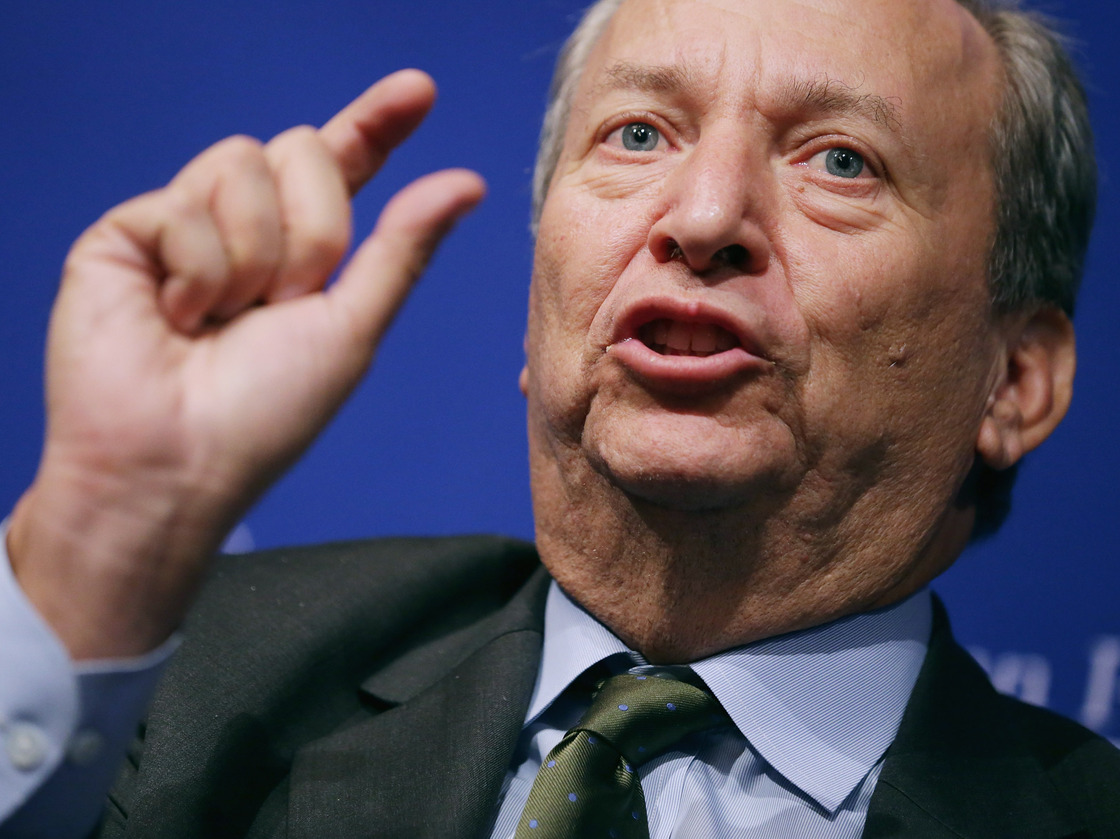
Clinton-era Treasury secretary and former Obama economic adviser Lawrence Summers last week in Washington, D.C.


Chip Somodevilla/Getty Images

Clinton-era Treasury secretary and former Obama economic adviser Lawrence Summers last week in Washington, D.C.


Clinton-era Treasury secretary and former Obama economic adviser Lawrence Summers last week in Washington, D.C.


Chip Somodevilla/Getty Images


News


Read more about Deficit Hawks "Have No Monopoly On Morality," Summers Says and other interesting subjects concerning NSA at TheDailyNewsReport.com

Wednesday, September 4, 2013

The "Signal Hawks" and Their Dubious Theory of International Relations


L2F1 / Flickr


War is expensive. 


War is unpredictable.


War is hell. 


That’s why many people believe that war ought to be avoided whenever possible: that it’s foolhardy to enter a war of choice if you can safely avoid doing so. 


There isn’t any one rule that can guide a nation in all circumstances. Perhaps the U.S. ought to have intervened to stop the genocide in Rwanda, though we could avoid doing so. But a strong case can be made that the “go to war only if you must” rule of thumb would’ve served America well even it would’ve been applied inflexibly for the whole postwar era. Imagine a world where the 58,000 Americans who needlessly died in Vietnam were still alive, and the 5,000 Americans who died in Iraq were around too. We’d also be a few trillion dollars richer, and have hundreds of thousands fewer people suffering from missing limbs or PTSD. (Then again, we wouldn’t enjoy the fruits of having invaded Grenada.) 


Imprudent wars are so catastrophic that even a small risk of one just isn’t worth it. Most Americans don’t quite believe that war should only be entered by necessity. But their instinct to apply the “only if you must” rule is enduringly strong.


What I don’t understand is another sort of American – a particular kind of foreign policy hawk. They frequently urge interventions, like Senator John McCain, but their interventionism isn’t rooted, like his, in the valorization of martial values. Nor is it rooted in Samantha Power style beliefs about stopping atrocities.


The hawks I don’t understand are the ones who urge war not to achieve a “kinetic” end, but to send a signal. President Obama wants to intervene in Syria not to topple the regime or give the rebels a decisive advantage, but to send a signal about chemical weapons use. I suppose I can almost wrap my brain around that attitude, though I doubt striking Syria will impact future use of chemical weapons. 


From there, the Signal Hawks start to totally mystify me.


Professor Carrie Cordero of Georgetown also wants to intervene in Syria in order to send signals, but a different set of signals than the ones Obama wants to send.


Here’s how she put it at Lawfare:


…there is the pragmatic question of whether intervention is in the United States’ national security interests. There are strong arguments that it is, but it does not sound as if the Administration has made that case yet to Congress, or to the public.


In short, punishing the Syrian regime by means of military force, and more broadly, intervening in the Syrian civil war, is in the United States’ national security interests because the world is watching. And what the world, and particularly those governments or terrorist organizations that act contrary to U.S. interests will see in our actions, our resolve*, will affect their behavior in the future. Accordingly, it is in our interests:


  • For the Syrian civil war to resolve, sooner rather than later.

  • For the Syrian civil war to not spread further and destabilize what is left of governments with whom we can at least have an open dialogue on Middle East issues, such as Jordan.

  • To send a message to the world’s rogue regimes-like North Korea and Iran-that we will not tolerate the use of chemical weapons.

  • To demonstrate to the Arab street that we have compassion for their children, too, and that we will back that compassion with strength to defend and protect the most vulnerable.

  • To see that the Assad regime falls, and that we have deeper insight into who will make up the new leadership of Syria, and that we will have a channel through which to dialogue and work with that leadership.


With all due respect to Professor Cordero, almost every time I encounter this attitude toward international affairs I can’t help but suspect that it is totally lacking in rigor.


Let’s probe some of her arguments.


Is a military attack on another country in the Middle East really the only way, the best way, or an effective way to show that we have compassion for the region’s children? There are certainly ways other than an act of war to send that signal. For example, we could help the child refugees who’ve been streaming out of Syria. Even if we did, the people of the region would still be well aware that Americans are willing to incidentally kill faraway Muslim children in drone strikes if they believe that those strikes will make Americans infinitesimally safer from terrorism. Is a Yemeni, aware of innocents we’ve killed, or an Iraqi, aware of our sanctions regime, or anyone familiar with the totality of U.S. policy really going to conclude, after a cruise missile strike, that the U.S. really does care about their children? “The Americans are bombing Syria – it must be because they have a high regard for the lives of Syrian children,” exactly no one will think. 


Now consider another signal intervention would allegedly send. 


Imagine that we fire cruise missiles into Syria. Would that really send a signal to North Korea that we would not tolerate their use of chemical weapons? Whatever one thinks about an American attack on Syria, it is unlikely to lead to a nuclear war on the Korean peninsula, or the deaths of thousands of American troops stationed in South Korea, or a potentially catastrophic confrontation with China, all of which could happen if we attacked North Korea after it used chemical weapons on its own people. And the North Koreans surely understand that the strategic calculus used to attack Syria for chemical weapons use would be different from the factors President Obama would weigh if it were North Korea. Signal hawks often act as if foreigners will be totally oblivious to the obvious. 


Despite all the talk about red lines and the “necessity” of responding to the use of chemical weapons with force, everyone in the United States and the world understands that the United States would not go to war with Russia, or China, or North Korea, or Pakistan, if one of those countries used chemical weapons on their own people. No foreign government is so simpleminded as to think, “The Americans responded to chemical weapons in Syria by striking the country, so they’re obviously going to respond in exactly the same way to any other country.”


Whether or not we attack Syria, “rogue regimes” will know, as well as we do ourselves, that “getting away with” future use of chemical weapons depends not on precedent, but on the offending country, its international alliances, its military strength, the president at the time and his or her priorities, and three dozen other factors. The faith of Signal Hawks in absolute transitivity is as strong as it is baffling.


Arguments that turn on signal-sending so often adopt assumptions about the signal that would be sent that are highly questionable at best, and that are, at worst, simplistic, naive, and totally lacking in rigor. Their advocates never seem to look back and notice the signals that don’t work. The Iraq invasion was predicated in part on the fact that Saddam Hussein gassed his own people, and the belief that he had chemical weapons. Yet neither the Iraq invasion nor the execution of Saddam Hussein stopped chemical weapons from being used in Syria. 


And what are we to make of the argument that we must intervene because “the world is watching”? That might make sense as a hawkish talking point if most of the world decidedly favored intervention, but that is far from true. The parliament of our closest ally, along with the British people, think intervention is a bad idea. Neither the UN nor NATO will endorse intervention, and it’s hard to imagine that, say, Brazil or Canada or India will change its attitudes toward America in any salutary way if and only if we send cruise missiles or bombs into Syria.


The world is always watching, and parts of the world, like the Israelis, may be eager for America to intervene in Syria. Of course, disappointing the Israelis by failing to intervene, even though they’re watching, wouldn’t do any damage to the United States. Nor is America’s relationship with the hawkish French likely to suffer in any profound way if we stay out of Syria. Meanwhile, there are many parts of the world who are watching President Obama and thinking to themselves, “Are those fool Americans so arrogant as to launch another war in the Middle East?” The signal hawks often invoke “the world watching” in a way that is totally disconnected from actual world opinion and perceptions of the conflict in question – as if global observers broadly share hawkish notions of credibility. 


Ignored are the many salutary signals that would just as plausibly be sent by doing the opposite of what the hawks want. The United States must not intervene in Syria, because the U.N. has not approved a strike, and the United States must signal that it respects international law so that we have credibility in the future.  Why isn’t that the relevant signal? America must send a signal to anti-regime forces in the Muslim world that they won’t get our help if al Qaeda friendly factions are among their ranks. Why isn’t that the relevant signal? I don’t accept the notion that signals are as important as the Signal Hawks say, but if they were, the Signal Hawks never offer any argument about why the particular signal that they focus on is operative or most important — as best I can tell, it’s an unexamined assumption that is never fleshed out or defended.


Different Signal Hawks typically believe that credibility is conferred by bellicose rhetoric (neocons) or military strikes against much weaker countries (internationalist liberals), and erroneously believe that everyone else in the world will react to American intervention by respecting us more forever after. Going to war to send signals is always a dubious enterprise that shows insufficient respect for the seriousness of war. It is especially foolish when there’s no reason to believe that the signal being sent is the one Signal Hawks want to send. 


_____


*”What does getting deployed mean, mommy?”


“It means they’re sending your dad very far away for awhile.”


“Will he have to kill people?”


“Maybe.”


“Why did they send daddy far away to go kill people?”


“Well, America has to signal resolve, so that other countries will know we have it in the future.”


Master Feed : The Atlantic


The "Signal Hawks" and Their Dubious Theory of International Relations

Saturday, July 27, 2013

GOP hawks: This will not stand, Rand


Rand Paul is shown. | AP Photo

They’re nearing a critical mass of impatience with what some call ‘Rand-ism.’ | AP Photo


The Republican Party’s hawks are finally saying it out in the open: This aggression will not stand, Rand.


After three years of watching the GOP’s non-interventionist wing gather strength, there are mounting signs that a more combative set of national security conservatives have reached their breaking point. Now, prominent conservative leaders in what used to be considered the Bush-Cheney mold are increasingly taking the offensive against their intra-party rivals.


New Jersey Gov. Chris Christie publicly challenged libertarian Republicans Thursday to explain their skepticism about government surveillance to the families of 9/11 victims, declaring at a Republican Governors Association event: “I want them to come to New Jersey and sit across from the widows and the orphans and have that conversation.”


(PHOTOS: Rand Paul’s career)


New York Rep. Peter King said this week that he will explore a 2016 presidential run to wrest control of the defense debate from small-government advocates such as Sens. Rand Paul of Kentucky and Ted Cruz of Texas, and warned that an America-first candidate would stand little chance of defeating Hillary Clinton.


Perhaps the most dramatic provocation to Paul-aligned conservatives came earlier this month, when Republican national security activist Liz Cheney – the former vice president’s daughter – announced a primary challenge to Wyoming Sen. Mike Enzi, a low-key incumbent backed by Paul and a number of other Senate colleagues.


(PHOTOS: 2016: Who’s next?)


Republican hawks say these developments amount to something less than a coordinated counteroffensive. But no one disputes that they’re nearing a critical mass of impatience with what some call “Rand-ism” – resistance to foreign entanglements and deep, confrontational skepticism about the expansion of the federal defense apparatus, particularly in the areas of surveillance and drone warfare.


“I want a strong national defense and I don’t want Rand Paul to be the face of the Republican Party,” King said in an interview. “I’ve felt this way for a while [and] once it gets out there, people say, ‘God, this is wrong, we’re killing ourselves. This is not the Republican Party.’”


Former Pennsylvania Sen. Rick Santorum, who was a vocal and at times caustic critic of Rand Paul’s father, former Texas Rep. Ron Paul, during the 2012 primaries, called it a welcome development that “people are starting to push back.”


“There was a lot of talk, particularly during the Republican primary last year, of, ‘Well, we don’t want to alienate these voters,” Santorum said, recalling that he’d been criticized as “too bellicose” and “too warlike. “I can tell you, the Paulistas who were active on the state level in 2012 were not interested in the Republican Party as it now exists. They are interested in a very different kind of model.”


(PHOTOS: Highlights from Rand Paul’s filibuster)


King acknowledged that public opinion has turned against some Bush-era security policies, such as the ongoing war in Afghanistan. But he suggested that it doesn’t take much to jolt voters from their sense of complacency.


“I see every time there’s a terror attack, or even a thwarted terror attack, people’s views change dramatically,” the Long Island lawmaker said, conceding: “They want out after 12 years in Afghanistan, and really after President Obama not explaining for the last five years why we’re there.”


For the emboldened phalanx of defense-minded conservatives, it remains to be seen how difficult a task they’ll have in turning the tide of the GOP’s national security conversation. Republican hawks say they are firmly confident that the party is, in its heart, more sympathetic to the George W. Bush agenda of expanding freedom and fighting terrorism, than to the Rand-style focus on limiting the government’s security powers that many congressional Republicans have recently embraced.


That’s certainly true of most national Republican elites. In some Republican donor and operative circles, there’s active talk of whether the GOP’s strong-on-defense wing may need new infrastructure and organizations to promote their priorities during primary season in 2014 and beyond.


Among those groups, optimistic Republicans argue that the GOP base cheers for tirades against drones and the NSA out of hostility toward the Obama administration, rather than the actual substance of those issues. They point out that the GOP-held House defeated an amendment this week offered by libertarian Rep. Justin Amash, which would have sharply curtailed the NSA’s domestic spying powers (though about two in five Republicans supported the measure.)


Amid the continuing Edward Snowden saga, there have been few Republican voices sympathetic to the NSA leaker outside the Paul family.


“I’m honestly not too worried,” said Weekly Standard editor William Kristol, the influential foreign policy conservative. “I’m confident the Reagan Republicans will prevail over the Snowden Republicans.”


Alluding to hawkish Arkansas Rep. Tom Cotton, an Iraq war vet and potential 2014 Senate candidate, Kristol quipped: “I think Christie-Cotton is much more likely in 2016 than Paul-Amash.”


POLITICO – TOP Stories


GOP hawks: This will not stand, Rand