Showing posts with label Informants. Show all posts

Friday, December 27, 2013

FBI allowed informants to commit more crimes in 2012 than in previous year


AFP Photo / Emmanuel Dunand


The FBI allowed its informants to break the law in 2012 on even more occasions than it did the previous year, according to a new report.


In a letter sent to the US Justice Department, FBI officials revealed that their nationwide offices permitted at least 5,939 instances of law violations during 2012. The letter was obtained by the Huffington Post via a Freedom of Information Act request, and the numbers represent a five percent increase from 2011’s officially sanctioned crimes.


In August, a separate FBI report obtained by USA Today showed that informants were allowed to break the law at least 5,658 times in 2011, ranging from violations such as acts of violence and selling drugs to bribing government officials.


The new report did not categorize the types of crimes that were authorized, nor did it detail how many crimes were permitted by each field office.


Although the FBI does not consider these actions ideal, officials have said before that it is simply part of the process by which they investigate criminal organizations.


“It sounds like a lot, but you have to keep it in context,” former top FBI official Shawn Henry told USA Today in August. “This is not done in a vacuum. It’s not done randomly. It’s not taken lightly.”


When RT reported on the FBI-sanctioned crimes in 2011, we found that the FBI document indicated that the violations were Tier I and Tier II infractions.


According to the Justice Department, a Tier I violation is “any activity that would constitute a misdemeanor or felony under federal, state, or local law if engaged in by a person acting without authorization and that involves the commission or the significant risk of the commission of certain offenses, including acts of violence; corrupt conduct by senior federal, state, or local public officials; or the manufacture, importing, exporting, possession, or trafficking in controlled substances of certain quantities.”


Meanwhile, a Tier II crime covers the same range of crimes but is carried out only with the permission of a senior FBI field manager – not that of a federal prosecutor.


Ever since it was revealed that Boston mobster James “Whitey” Bulger was allowed to continue running his crime ring in exchange for other information, the FBI has been required to document the criminal activity it authorizes. But while the FBI has done this for over a decade, other law enforcement agencies – the Drug Enforcement Administration and the Bureau of Alcohol, Tobacco, Firearms, and Explosives – still do not.


Source: RT


End the Lie – Independent News


FBI allowed informants to commit more crimes in 2012 than in previous year

Tuesday, June 4, 2013

In Gaza, Hamas Targets Palestinian Informants In Crackdown


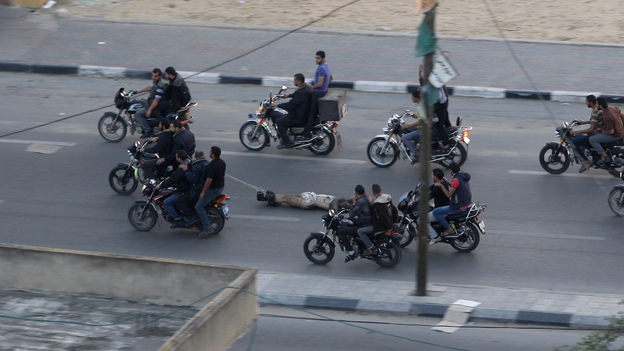
Palestinian gunmen drag a man from a motorcycle in Gaza City on Nov. 20. He was one of six men killed that day on suspicion of collaborating with Israel. The Hamas government in the Gaza Strip denied responsibility, though it has executed others judged to be working with Israel’s security forces.


Hatem Moussa/AP


Life was already grim in the Gaza Strip when fighting raged between Israel and Hamas last November. Then Khulud Badawi got unexpected bad news about her husband.


“I was at home when my son came in and said, ‘Mom, they killed Dad.’ I said, ‘Who?’ He said, ‘Hamas.’ I asked him, ‘Where?’ He said, ‘Next to the gas station,’” she recalls.


Badawi’s husband, Ribhi Badawi, was in prison in Gaza City. He was supposed to go to court that day for a final appeal of charges that he had collaborated with Israel against Hamas, which runs the Gaza Strip.


But Ribhi Badawi was taken from prison and executed in public, along with five other inmates. They were all accused of being collaborators, or informants, working for Israel.


“In this case, what was remarkable was that these men were not executed in anything resembling legislative authority or the penal authority of the Hamas government, but by armed men,” says Sarah Leah Whitson, who directs the Middle East division of Human Rights Watch.


“How they managed to get these men out of prison, and then how they managed to shoot them dead in broad daylight and drag their corpses around the street is a very big question mark,” she adds.


Israel’s Informant Network


For decades, Israel’s security forces has relied heavily on Palestinian informants to track and keep tabs on wanted Palestinians. The standard practice is for Israel to pay the informants in exchange for the information. But if uncovered, the informants are treated as traitors to the Palestinian cause and can expect to face harsh judgment in the Palestinian courts, or in some cases, through vigilante justice.


Hamas, which has been in control of Gaza since 2007, has executed people judged to be collaborators. But in the six deaths last Nov. 20, the Hamas-run government said it was not responsible.


“What happened was against the law,” Islam Shawan, a spokesman for Gaza’s Interior Ministry, says. “We had a high-level committee investigate, and it handed down tough punishments to security officials who failed to do their jobs.”


Shawan won’t name names, give ranks or offer any other information, but he claims that four people working in the prison system were punished. One was fired, one was transferred, one was jailed and one lost any chance at promotions.


He has no progress to report on tracking down the people who actually did the killings, but he does claim progress in cracking down on collaboration.


Hamas’ Campaign Against Collaborators


Three months after those accused collaborators were killed, Hamas started an anti-collaboration campaign in Gaza.


TV ads played scary music with pictures of a young man being dragged to the gallows by Hamas security forces. The video storyline shows he was coerced into collaboration by doing things that could set him up for blackmail — drinking, taking drugs, searching for sex online.


Shawan says this campaign was aimed at everyone in Gaza.


“This was a national campaign — not just directed at collaborators,” he says. “It was designed to educate and protect society by showing people how Israelis recruit.”


People were offered a chance to turn themselves in. Shawan won’t say how many did, but claimed one example: an engineering student who allegedly gave Israel information about his neighbors, his professors and student politicians. The young man wasn’t punished, Shawan says, but quietly re-educated.


There was no “re-education” offered by Hamas in the case of Khulud Badawi’s husband, who was a member of a rival militant group.


“I don’t believe in this campaign,” she says. “My husband used to tell me that people who were collaborators would confess immediately, but people who weren’t would be tortured for months and never confess because they were innocent.”


Just last week, two accused spies were given death sentences, suggesting that tough punishment is just as important in Hamas’ efforts to crack down on collaboration as education and amnesty.


News


In Gaza, Hamas Targets Palestinian Informants In Crackdown