Showing posts with label PALESTINIAN. Show all posts

Saturday, March 29, 2014

​Israel demands free entry of citizens into US, amid standoff over Palestinian settlements

At Alternate Viewpoint, the privacy of our visitors is of extreme importance to us (See this article to learn more about Privacy Policies.). This privacy policy document outlines the types of personal information is received and collected by Alternate Viewpoint and how it is used.


Log Files


Like many other Web sites, Alternate Viewpoint makes use of log files. The information inside the log files includes internet protocol (IP) addresses, type of browser, Internet Service Provider (ISP), date/time stamp, referring/exit pages, and number of clicks to analyze trends, administer the site, track user"s movement around the site, and gather demographic information. IP addresses, and other such information are not linked to any information that is personally identifiable.


Cookies and Web Beacons


Alternate Viewpoint does use cookies to store information about visitors preferences, record user-specific information on which pages the user access or visit, customize Web page content based on visitors browser type or other information that the visitor sends via their browser.


DoubleClick DART Cookie


  • Google, as a third party vendor, uses cookies to serve ads on Alternate Viewpoint.

  • Google"s use of the DART cookie enables it to serve ads to users based on their visit to Alternate Viewpoint and other sites on the Internet.

  • Users may opt out of the use of the DART cookie by visiting the Google ad and content network privacy policy at the following URL - http://www.google.com/privacy_ads.html.

These third-party ad servers or ad networks use technology to the advertisements and links that appear on Alternate Viewpoint send directly to your browsers. They automatically receive your IP address when this occurs. Other technologies ( such as cookies, JavaScript, or Web Beacons ) may also be used by the third-party ad networks to measure the effectiveness of their advertisements and / or to personalize the advertising content that you see.


Alternate Viewpoint has no access to or control over these cookies that are used by third-party advertisers.


You should consult the respective privacy policies of these third-party ad servers for more detailed information on their practices as well as for instructions about how to opt-out of certain practices. Alternate Viewpoint"s privacy policy does not apply to, and we cannot control the activities of, such other advertisers or web sites.


If you wish to disable cookies, you may do so through your individual browser options. More detailed information about cookie management with specific web browsers can be found at the browser"s respective websites.


​Israel demands free entry of citizens into US, amid standoff over Palestinian settlements

Monday, January 20, 2014

Kerry to meet Israeli, Palestinian negotiators


United States Secretary of State John Kerry holds a news conference with Canada’s Foreign Minister John Baird and Mexico’s Foreign Secretary Jose Antonio Meade (not pictured) at the State Department in Washington January 17, 2014.


Credit: Reuters/Gary Cameron


Reuters: Politics


Kerry to meet Israeli, Palestinian negotiators

Monday, January 13, 2014

A Palestinian view of Ariel Sharon"s legacy

At Not Just The News, the privacy of our visitors is of extreme importance to us (See this article to learn more about Privacy Policies.). This privacy policy document outlines the types of personal information is received and collected by Not Just The News and how it is used.


Log Files


Like many other Web sites, Not Just The News makes use of log files. The information inside the log files includes internet protocol (IP) addresses, type of browser, Internet Service Provider (ISP), date/time stamp, referring/exit pages, and number of clicks to analyze trends, administer the site, track user"s movement around the site, and gather demographic information. IP addresses, and other such information are not linked to any information that is personally identifiable.


Cookies and Web Beacons


Not Just The News does use cookies to store information about visitors preferences, record user-specific information on which pages the user access or visit, customize Web page content based on visitors browser type or other information that the visitor sends via their browser.


DoubleClick DART Cookie


  • Google, as a third party vendor, uses cookies to serve ads on Not Just The News.

  • Google"s use of the DART cookie enables it to serve ads to users based on their visit to Not Just The News and other sites on the Internet.

  • Users may opt out of the use of the DART cookie by visiting the Google ad and content network privacy policy at the following URL - http://www.google.com/privacy_ads.html.

These third-party ad servers or ad networks use technology to the advertisements and links that appear on Not Just The News send directly to your browsers. They automatically receive your IP address when this occurs. Other technologies ( such as cookies, JavaScript, or Web Beacons ) may also be used by the third-party ad networks to measure the effectiveness of their advertisements and / or to personalize the advertising content that you see.


Not Just The News has no access to or control over these cookies that are used by third-party advertisers.


You should consult the respective privacy policies of these third-party ad servers for more detailed information on their practices as well as for instructions about how to opt-out of certain practices. Not Just The News"s privacy policy does not apply to, and we cannot control the activities of, such other advertisers or web sites.


If you wish to disable cookies, you may do so through your individual browser options. More detailed information about cookie management with specific web browsers can be found at the browser"s respective websites.


A Palestinian view of Ariel Sharon"s legacy

Tuesday, December 24, 2013

Two Palestinian Civilians in Gaza, Including 3-Year-Old Girl, and Israeli Soldier Killed, in Attacks

Two Palestinian Civilians in Gaza, Including 3-Year-Old Girl, and Israeli Soldier Killed, in Attacks

December 24, 2013


Two Palestinian Civilians in Gaza, Including 3-Year-Old Girl, and Israeli Soldier Killed, in Attacks, December 24, 2013


Two Palestinian Civilians in Gaza, Including 3-Year-Old Girl, and Israeli Soldier Killed, in Attacks, December 24, 2013


Including A Child, Two Killed By Israeli Shells In Gaza


Tuesday December 24, 2013 17:44 by Saed Bannoura – IMEMC & Agencies


Medical sources said that Hala Ahmad Al-Boheiry, 3 years old, was killed by an Israeli missile in central Gaza, and four were wounded in the shelling, one of them in a critical condition.


The sources added that Hala’s mother, her brothers Bilal, 3, and Mohammad, 6, were injured when the army bombarded a house near a chicken farm east of the Al-Maghazy refugee camp, in central Gaza.


Furthermore, a young man was also killed when the Israeli Air Force fired missiles into Beit Lahiya town, in northern Gaza. Another Palestinian was moderately in the attack, the Palestine News Network (PNN) has reported.


Dr. Ahmad Al-Bohairy, spokesperson of the Ministry Of Health In Gaza, has reported that an 18-year-old young man was shot in the leg, and was moved to a local hospital.


Furthermore, several Israeli military vehicles invaded, on Tuesday at noon, a Palestinian area, close to the Nahal Oz military base, and another area east of the Shuja’iya area, and opened fire at open areas; no injuries were reported.


Israeli Military Engineer Killed Near Gaza Border


Tuesday December 24, 2013 17:37 by IMEMC & Agencies


Israeli sources said the engineer is employed by the Israeli Defense Ministry, and that the shot that killed him came from Gaza.


Israeli daily Haaretz has reported the no Palestinian armed group claimed responsibility for the attack that killed the engineer, near the Nahal Oz settlement. The engineer is from Rahat, south of the country, a town mainly inhabited by Bedouin Palestinian Arabs.


The Israeli army said it appears a sharpshooter carried out the attack and fled the scene, and that no clashes took place following the shooting.


The military engineer was moved to the Soroka Medical Center in Be’er Al-Saba’a (Be’er Sheva), where he died of his serious wounds.


Baby girl killed in series of Israeli airstrikes on Gaza


[ 24/12/2013 - 03:58 PM ]


GAZA, (PIC)–


Israeli warplanes launched on Tuesday afternoon several air raids on different areas in the Gaza Strip killing a baby girl and wounding several others.


Three-year-old Hala Abu Sbaikha was killed while her mother and sister were injured in the ongoing aerial raids, medical sources said.


Dr. Ashraf Al-Qudra, the health ministry spokesman in Gaza, told the PIC reporter that the air raids so far killed a three-year-old baby girl and wounded seven others.


According to earlier statistics, four citizens were injured by the Israeli shelling on east of Maghazi in central Gaza, while another citizen was seriously wounded after being shot by Israeli gunfire north of the town of Beit Lahiya in northern Gaza and was transferred to Shifa Hospital.


The Israeli airstrikes had reportedly hit two bases of the Qassam Brigades, the armed wing of Hamas, in Khan Younis and Bureij, while the IOF artillery targeted citizens in the neighborhood of Shaja’ia east of Gaza City.


The attacks came hours after the death of an Israeli soldier who was shot in the heart by a Palestinian sniper near the border area east of Gaza.


Palestinian sources said that a Palestinian sniper on Tuesday afternoon opened fire at an Israeli soldier near the border fence between the Gaza Strip and the 1948 occupied Palestinian land.


They added that after the shooting, the occupation troops and military vehicles were deployed in the area and launched a search.


Meanwhile, local sources said that IOF warplanes bombed a deserted land west of the city of Rafah in southern Gaza Strip.


They said that the IOF artillery shelled citizens’ lands east of Maghazi refugee camp in central Gaza and areas east of Gaza City.


Gaza Gov’t: Israel’s aggression on Gaza proves its confusion


[ 24/12/2013 - 05:22 PM ]


GAZA, (PIC)–


Palestinian government in Gaza Strip said that the Israeli occupation’s airstrikes on the enclave Tuesday evening  prove its weakness and confusion, holding the occupation full responsibility for consequences of its aggression.


In a brief statement, the government’s spokesman Ihab al-Ghussain held the Israeli occupation authority (IOA) fully responsible for its continued crimes in the West Bank and Gaza Strip, calling on the international community to bridle the IOA and to prosecute it for its crimes and aggressions against the unarmed Palestinian people.


The Palestinian government stressed the Palestinian resistance’s readiness to defend the people of Gaza in face of any aggression, and praised the media’s role in covering the events.


Israeli warplanes launched on Tuesday afternoon several air raids on different areas in the Gaza Strip killing a baby girl and wounding several others.


Seven Palestinians kidnapped in IOF campaign in Nablus


[ 24/12/2013 - 03:14 PM ]


NABLUS, (PIC)–


The Israeli occupation forces (IOF) on Monday evening kidnapped seven Palestinians in Nablus city.


Eyewitnesses told the Palestinian information center (PIC) reporter in the city that the IOF raided several homes and kidnapped five Palestinian citizens.


According to the reporter, sounds of explosions and gunfire were heard in different neighborhoods of the city during the Israeli campaign.


Meanwhile, IOF soldiers tightened their security measures last night at checkpoints around Nablus and kidnapped two young men. The IOF also intercepted Palestinian vehicles and searched them at Za’atara checkpoint, especially those travelling from Nablus to Ramallah.


In a separate incident, the IOF placed notices on some walls in Al-Aroub refugee camp threatening to take action against specified fathers if they did not stop their sons’ activities against the occupation.


The wall warnings were sealed by the Israeli army and contained pictures and names of nine Palestinian parents whose sons were accused of carrying out attacks against Israeli settlers.


Israeli police assault al-Aqsa Mosque guard


[ 24/12/2013 - 03:10 PM ]


OCCUPIED JERUSALEM, (PIC)–


Israeli police forces assaulted Monday night one of Al-Aqsa Mosque guards in Jerusalem as part of their brutal assaults and attacks against Jerusalemites.


Eyewitnesses confirmed that Israeli police have provoked al-Aqsa Mosque guard Murad Hamad, who was on his duty at the Mosque, before attacking and beating him severely.


They added, however, that his colleagues intervened and managed to prevent the police from arresting him.


Following the attack, large numbers of worshipers gathered inside and outside al-Aqsa Mosque.


This site contains copyrighted material the use of which has not always been specifically authorized by the copyright owner. We are making such material available in our efforts to advance understanding of environmental, political, human rights, economic, democracy, scientific, and social justice issues, etc. We believe this constitutes a ‘fair use’ of any such copyrighted material as provided for in section 107 of the US Copyright Law. In accordance with Title 17 U.S.C. Section 107, the material on this site is distributed without profit to those who have expressed a prior interest in receiving the included information for research and educational purposes. For more information go to: http://www.law.cornell.edu/uscode/17/107.shtml. If you wish to use copyrighted material from this site for purposes of your own that go beyond ‘fair use’, you must obtain permission from the copyright owner.


WHAT REALLY HAPPENED


Two Palestinian Civilians in Gaza, Including 3-Year-Old Girl, and Israeli Soldier Killed, in Attacks

Tuesday, November 26, 2013

Israel’s War on Palestinian Children


palestinian child israeli soldier


Israel is a serial human rights abuser. It’s one of the world’s worst. It’s war on Palestinian children alone reflects it.


They’re systematically abused unjustly. Up to 700 are arrested annually. Most are lawlessly charged with stone-throwing. Children young as five are terrorized. They’re too young to know why.


They’re abusively treated during arrests, transfers and interrogations. They’re denied fundamental rights.


In 1991, Israel ratified the 1989 UN Convention on the Rights of the Child (CRC). It didn’t matter. It brazenly violates its provisions.


Article 37 states in part:


“No child shall be subjected to torture or other cruel, inhuman or degrading treatment or punishment.”


“No child shall be deprived of his or her liberty unlawfully or arbitrarily.”


“The arrest, detention or imprisonment of a child shall be in conformity with the law and shall be used only as a measure of last resort and for the shortest appropriate period of time.”


“Every child deprived of liberty shall be treated with humanity and respect for the inherent dignity of the human person, and in a manner which takes into account the needs of persons of his or her age.”


“Every child deprived of his or her liberty shall have the right to prompt access to legal and other appropriate assistance, as well as the right to challenge the legality of the deprivation of his or her liberty before a court or other competent, independent and impartial authority, and to a prompt decision on any such action.”


Principle 1 of the 1959 UN Declaration of the Rights of the Child states:


“Every child, without exception whatsoever, shall be entitled to (fundamental human and civil) rights, without distinction or discrimination on account of race, colour, sex, language, religion, political or other opinion, national or social origin, property, birth or other status, whether of himself or of his family.”


They’re entitled to special protections and opportunities to develop physically, mentally, morally, spiritually, and socially under conditions of freedom and dignity.


Not in Occupied Palestine. Israel treats them mercilessly. It treats them like adults. Arrests are lawless and violent. Homes are broken into unannounced pre-dawn.


Property is damaged or stolen. Children are blindfolded, shackled, and beaten. They’re thrust into jeeps. Sometimes it’s face down.


At detention centers, they’re interrogated harshly. They’re painfully shackled. They’re denied access to family members and legal counsel for days.


They’re threatened, terrorized, beaten, slapped, kicked, denied food and water for prolonged periods, and deprived of sleep.


Confessions are forcibly extracted. They’re forced to sign them in Hebrew they don’t understand. Many become traumatized. Hundreds of complaints are filed. Doing so does no good.


Israel is the only nation trying children in military courts. Palestinians aren’t afforded the same rights as Jews. Failure to do so is blatantly discriminatory.


Under international law, adulthood begins at age 18. Israel considers children aged 16 and over adults. Military order 378 permits up to 20 years imprisonment for stone-throwing.


Fourth Geneva’s Article 147 requires fair trials. Israeli military courts are rigged to convict. Kangaroo court justice prevails.


Netanyahu and most other Israeli officials call criticism of flagrant state human rights abuses “anti-Israeli bias.”


Israel operates extrajudicially. Palestinian children endure some of its worst abuses.


On November 19, Defence for Children International Palestine discussed July through September Israeli violations. Increased violence occurred.


Mohammad A (aged 14) “was shot in the leg by live ammunition.” Laith E (aged 8) “was shot in the forehead and injured by a rubber-coated metal bullet.”


So was Basel S (aged 15). Live ammunition wounded Muhammad G (aged 16). Musab S (aged 6) “was shot in the eye with a rubbed-coated metal bullet as he was walking next to his mother.”


Israel bears full responsibility for these type incidents. They repeat with disturbing regularity. Arrests and brutal treatment follow.


Since the start of the September 2000 second Intifada, Israel arrested and brutalized over 9,000 Palestinian children.


Illegitimate military orders authorize them. They violate core international law provisions. Arrests are lawless and violent. Evidence is contrived to convict.


Forced confessions are used to pressure defense lawyers to accept plea bargains. The alternative is much longer sentences.


Israel takes full advantage. Plea bargains extract a high price. So does bail when authorized. Israel profits hugely. Collective punishment pays well.


Addameer addressed the issue. In October, it headlined “Economic Exploitation of Children in the Military Courts.”


It’s been following Ofer and Salem Military Courts cases. It found a disturbing trend. Arbitrary detentions result in “exorbitantly high fine(s) or bail.”


Economic exploitation is official Israeli policy. Palestinians face enormous financial burdens. Children given plea bargains or released on bail follow lawless arrests.


No evidence exists to convict them. Some are arrested randomly. Israel does it to harass and intimidate. Training exercises include breaking into Palestinian homes violently.


Terrorizing residents follows. Children are treated like adults. They’re processed through lawless military courts. According to Addameer, 27 children’s rights international conventions are violated.


During arrest and detention, “children are put under military and police interrogation which includes aspects amounting to torture, including:


physical assault, stress positions, sleep deprivation, sensory deprivation, verbal threats, isolation in two meter by two meter cells, and denied access to parents or lawyers.”


Innocence is no defense. Forced confessions are extracted. They’re used against them. They extort huge penalties from parents.


Bail when granted can be up 4,000 NIS (around $ 1,000) or higher. Most Palestinians are poor. Many are deeply impoverished. They struggle to get by. Any fine or bail amount is unaffordable.


Parents are forced to borrow, if able, or deprive family members of basic needs.


“An often overlooked consequence is the psychological affects it has on the family who are under financial burden despite the child’s innocence and arbitrary arrest,” said Addameer.


On September 29, Qusai Z (aged 17) was arrested. He was accused of stone-throwing and participating in a demonstration. Peaceful protests are considered illegal. Palestinians are denied all fundamental rights.


Military Order 101 prohibits gatherings of more than 10 Palestinians without advance IDF authorization. Violators are subject to up to 10 years imprisonment, heavy fines or both.


Qusai was innocent. Charges against him were bogus. Ofer’s military court judge ordered him released on 2,500 NIS bail. He did so after 11 days in detention.


Qusai’s family is poor. His mother told Addameer:


“My husband died six years ago, and I support my four children by myself, so I had to borrow 1,000 NIS from my neighbors.”


Qusai’s older brother was arrested three months earlier.


“This financial exploitation practiced against Palestinian prisoners and detainees in occupation prisons is a systematic policy to put pressure on the Palestinian society,” said Addameer.


It “takes advantage of the impoverished financial situation and helps the occupation (evade its) financial responsibilities towards the Palestinian prisoners and detainees.”


Addameer calls it “emotional blackmail.” It’s economic and financial extortion. It’s ruthless exploitation.


It steals from people with barely enough to live on. Some have too little. It does so based on lies. Innocence is no protection. Occupation harshness persists.


Osama R was lawlessly arrested coming home from school. He was falsely charged with stone-throwing. No evidence proved it. He was released on 1,500 NIS bail. After his hearing, his father said:


“What the occupation is doing is emotional blackmail. Israeli police called me a number of times, telling me to go to the police station in Kiryat Arba Settlement to pay my son’s bail, using statements such as:


‘Your child is very young. It is sad if he stays in prison. Your son needs to spend Eid vacation with his family,’ and other statements to make me pay the bail.”


“We will not accept financial and emotional blackmail, despite the fact that I support my family of twelve, and I am unable to pay this amount of money. I refuse to pay by force. I refuse financial blackmail.”


Mohammad F was arrested. He was falsely charged with stone-throwing. His lawyer arranged a plea bargain.


He remains imprisoned. His family is financially unable to make bail. “Despite this,” said Addameer, “he is expected to receive a month or month and a half extension if his family does not pay” the required amount.


Israeli extortion costs Palestinians up to 15 million NIS annually. It’s money they can’t afford. Israeli ruthlessness extracts it.


Profiting on Palestinian misery is official Israeli policy. It’s longstanding. It’s unrelenting. Western media ignore it. Pro-Israeli bias is longstanding.


The Palestinian Ministry of Prisoners’ Affairs “made an important step towards confronting the occupation’s economic exploitation policies by announcing that they will stop assisting in paying the fines as a way to choke the military court system,” said Addameer.


It’s “a necessary step to support the Palestinian prisoners movement and its struggle to confront” Israel’s ruthless military judicial system.


Stephen Lendman lives in Chicago. He can be reached at [email protected]


His new book is titled “Banker Occupation: Waging Financial War on Humanity.”


http://www.claritypress.com/LendmanII.html


Visit his blog site at sjlendman.blogspot.com. 


Listen to cutting-edge discussions with distinguished guests on the Progressive Radio News Hour on the Progressive Radio Network.


It airs Fridays at 10AM US Central time and Saturdays and Sundays at noon. All programs are archived for easy listening.


http://www.progressiveradionetwork.com/the-progressive-news-hour


WHAT REALLY HAPPENED


Israel’s War on Palestinian Children

Saturday, September 21, 2013

Palestinian "abducts and kills" Israeli soldier in West Bank – security service


Published time: September 21, 2013 13:59


An Israeli soldier has been kidnapped and killed by a Palestinian in the West Bank, reports Israel’s Shin Bet security agency.


A resident of the Palestinian city of Qalqilya, in the West Bank, allegedly lured an Israeli Defense Force (IDF) soldier to the scene of the murder, killed him and then hid the dead body in a well, reports the Jerusalem Post (JP). The incident happened on Friday, but the announcement from security forces came on Saturday.


DETAILS TO FOLLOW


RT – News


Palestinian "abducts and kills" Israeli soldier in West Bank – security service

Monday, August 26, 2013

Israeli Raid on Palestinian Camp Turns Deadly


JERUSALEM — Israeli security forces shot and killed three Palestinian men early Monday when violent clashes broke out during a raid in the Qalandia refugee camp, between Jerusalem and the West Bank city of Ramallah, according to witnesses and Wafa, the official Palestinian news agency.


The raid was the deadliest episode in the West Bank in months and came less than a week after a Palestinian man was killed in the Jenin refugee camp in the northern West Bank when troops on a similar mission encountered violent protests.


The continuing arrests of Palestinians suspected of planning terrorist acts and the deadly confrontations underlined the volatility of the West Bank, even as Israeli and Palestinian negotiators have embarked on a new round of talks to try to resolve the long-running conflict and establish an independent Palestinian state in the areas occupied by Israel in the 1967 Middle East war.


The Israeli military said that its troops were in Qalandia to secure an operation by security forces who were seeking to arrest a resident identified by the military only as a “terror operative.”


Hundreds of residents threw rocks and various other items at the security forces and soldiers were called in to aid them. Security personnel then “resorted to using live fire in self-defense,” the military said in a statement.


Witnesses in the camp said that a unit of special forces had intended to arrest Yusuf Khatib, who was released last year from an Israeli prison. Mr. Khatib tried to flee to a neighbor’s house, the witnesses said, and residents began throwing rocks, firebombs, bricks and iron bars at the forces and the troops who arrived in Jeeps to reinforce them. Hundreds of residents then came out of their homes and joined the riot, eyewitnesses and the military said.


Initial reports in the Palestinian news media identified those killed on Monday as Robin al-Abed, Yunis Jahjouh and Jihad Asslan, all in their 20s or early 30s. At least 15 others were reported wounded.


Witnesses said that two of the dead had been participating in the riot but that one of those killed was a bystander.


“Large, violent crowds such as this, which significantly outnumber the security forces, leave no choice but to resort to live fire in self-defense,” said Lt. Col. Peter Lerner, a spokesman for the Israeli military.


Isabel Kershner reported from Jerusalem, and Said Ghazali from Qalandia refugee camp, West Bank.


NYT > Global Home


Israeli Raid on Palestinian Camp Turns Deadly

Sunday, August 11, 2013

Birth of a Palestinian City Is Punctuated by Struggles


Rina Castelnuovo for The New York Times


Rawabi under construction in the West Bank, on Thursday.


RAWABI, West Bank — Two students came up with Rawabi, the Arabic word for hills, in a competition to name this new Palestinian city, the first to have been planned from the ground up. The developers rejected suggestions — like Arafat City and Jihad City — that evoked a more chaotic past.


“The new generation is building this city,” said Bashar Masri, 52, the Palestinian businessman who has headed this ambitious project and says he will be moving into a duplex penthouse in the town center once it is completed.


“Every Palestinian has a duty to participate in nation building,” he told reporters on a tour of the site last week.


Halfway between Jerusalem and Nablus, Rawabi is a short commute from Ramallah, the Palestinian Authority’s bustling administrative capital in the West Bank.


Palestinian flags fluttered from the tractors and cranes, and a huge one flew outside the tasteful sales office, a symbol that was clearly visible from Ateret, a Jewish settlement of 100 families on a nearby hilltop.


But like a microcosm of the Palestinian state in the making, the building of Rawabi is a continual struggle. Its future growth depends on a precarious political environment and the cooperation of Israel. Because of Rawabi’s location, Mr. Masri says, he and his colleagues spend about 70 percent of their time on issues like water and obtaining permits. Promised funds from the Palestinian Authority never materialized, posing an additional challenge.


The sales team began marketing apartments here a few months ago, aiming at middle- to upper-middle-class Palestinian buyers. The developers say the first phase of more than 600 apartments has already sold out and will be ready for occupancy early next year. The master plan comprises 6,000 apartments and ultimately up to 40,000 people.


The buildings, faced in locally quarried stone with features like archways, are organized along quiet cul-de-sacs in orderly neighborhoods to be linked by green walkways and outer ring roads. The slopes offer views of the surrounding countryside. In addition to offices, plans for the city center include shopping arcades, cafes, restaurants, movie theaters and a convention center built around a central piazza.


The political ambiguity of the area has, however, caused endless complications. Amir Dajani, deputy managing director of the Bayti Real Estate Investment Company, which is building the city, said the company had spent $ 80 million to $ 100 million a year in Israel on know-how and materials like cement, which he called “a true example of an economy for peace.” But there is no airport or port in the Palestinian Authority territories, meaning that all imports have to come by way of Israel.


“We still have to deal with the Israeli occupation,” Mr. Dajani said, referring to the division of the West Bank into different areas of authority under the overall rule of the Israeli military.


Although the project was announced in 2007 and construction began two years ago, it took until June 2012 to secure a temporary permit from Israel, renewable annually, for a narrow, winding access road to the site. That is because a mile-long segment of the road passes through a part of the West Bank that remains under full Israeli control.


There have also been problems with water, which Israel provides through the Palestinian Water Authority. The developers say that the current water supply is insufficient and that they are working feverishly to ensure adequate water by the time residents move in.


Israeli security officials said that part of the problem was that the developers wanted to transfer water through territory under full Israeli control rather than that of the Palestinian Authority and that discussions were under way to resolve the issue.


The project has also come under attack from the Palestinian Boycott, Divestment and Sanctions National Committee, which opposes any normal ties with Israel. The committee has accused Mr. Masri of promoting his private interests at the expense of Palestinian rights and of whitewashing the Israeli occupation.


The developers say they prefer to use Palestinian products wherever possible.


NYT > Global Home


Birth of a Palestinian City Is Punctuated by Struggles

Monday, July 29, 2013

Israel and Palestinian teams leave for US talks


FILE – In this May 25, 2006 file photo, an Israeli with a flag on his back takes a picture of Arab residents as they are being prevented by police to cross the road around Jerusalem’s Old City, in the Muslim quarter, during the Israeli celebration of the Jerusalem Day. The U.S. on Sunday, July 28, 2013 announced the resumption of Israeli-Palestinian talks following years of stalemate, after Israel’s Cabinet agreed to release 104 Palestinian prisoners convicted of deadly attacks. The return to direct contacts between the sides gave U.S. Secretary of State John Kerry his first concrete achievement after months of shuttle diplomacy. (AP Photo/Enric Marti, File)


FILE – In this May 25, 2006 file photo, an Israeli with a flag on his back takes a picture of Arab residents as they are being prevented by police to cross the road around Jerusalem’s Old City, in the Muslim quarter, during the Israeli celebration of the Jerusalem Day. The U.S. on Sunday, July 28, 2013 announced the resumption of Israeli-Palestinian talks following years of stalemate, after Israel’s Cabinet agreed to release 104 Palestinian prisoners convicted of deadly attacks. The return to direct contacts between the sides gave U.S. Secretary of State John Kerry his first concrete achievement after months of shuttle diplomacy. (AP Photo/Enric Marti, File)


FILE – In this May 8, 2013 file photo Israelis and Palestinians wave flags as Israelis march celebrating Jerusalem Day outside Damascus Gate in Jerusalem’s old city. The U.S. on Sunday, July 29 announced the resumption of Israeli-Palestinian talks following years of stalemate, after Israel’s Cabinet agreed to release 104 Palestinian prisoners convicted of deadly attacks. The return to direct contacts between the sides gave U.S. Secretary of State John Kerry his first concrete achievement after months of shuttle diplomacy. (AP Photo/Sebastian Scheiner, File)


FILE – In this Dec. 14, 2007 file photo, a Palestinian man argues with an Israeli soldier during a demonstration against Israel’s separation barrier at the village of Bilin, near the West Bank city of Ramallah. The U.S. on Sunday, July 28, 2013 announced the resumption of Israeli-Palestinian talks following years of stalemate, after Israel’s Cabinet agreed to release 104 Palestinian prisoners convicted of deadly attacks. The return to direct contacts between the sides gave U.S. Secretary of State John Kerry his first concrete achievement after months of shuttle diplomacy. (AP Photo/Sebastian Scheiner, File)


Buy AP Photo Reprints


(AP) — Israeli and Palestinian teams headed to Washington on Monday for preliminary talks on resuming formal negotiations after five years of stalemate.


Both sides emphasized that many obstacles stand between them and a final deal on setting up a Palestinian state alongside Israel.


Talks will be complex, said Israel’s chief negotiator, Tzipi Livni. She said she was heading to the Washington meetings, which are to begin later Monday, “cautiously, but also with hope.”


Hanan Ashrawi, a Palestinian spokeswoman, said the upcoming talks are being held under more difficult conditions than previous negotiations. She cited the Palestinian political split, with Western-backed moderates and Islamic militants running rival governments, and the more hawkish positions of Israel’s prime minister, Benjamin Netanyahu, compared to his predecessor.


“But I think there is a recognition of the urgency,” she said. “If we don’t move fast and decisively, things could fall apart.”


The preliminary talks in Washington were made possible after Israel’s Cabinet on Sunday agreed in principle to release 104 long-held Palestinian prisoners, convicted of offenses including the killing or wounding of Israelis and the killing of suspected Palestinian collaborators.


The prisoners are to be released in four stages, with each release linked to progress in negotiations.


The resumption of direct Israeli-Palestinian contacts was a result of six months of shuttle diplomacy by U.S. Secretary of State John Kerry.


Associated Press


Top Headlines


Israel and Palestinian teams leave for US talks

Saturday, July 20, 2013

Israel to free Palestinian prisoners


Israel says it will release a number of Palestinian prisoners as part of an agreement made with US Secretary of State John Kerry to resume peace talks.


Yuval Steinitz, minister responsible for international relations, said it would involve “heavyweight prisoners in jail for decades”.


Mr Kerry announced on Friday that initial talks would be held in Washington “in the next week or so”.


The Israeli minister’s remarks are the first details of the deal.


Powered By WizardRSS.com | Full Text RSS Feed | Amazon Affiliate software for Amazon Store websites | Android Forums | WordPress Tutorials

BBC News – Home

Israel to free Palestinian prisoners

Friday, July 19, 2013

Kerry meets Palestinian negotiator about talks


Palestinian President Mahmoud Abbas attends a meeting of the Palestinian leadership in the West Bank city of Ramallah, Thursday, July 18, 2013. Abbas convened a special gathering of top Palestinian officials for what could be a make-or-break decision on U.S. Secretary of State John Kerry’s latest efforts to relaunch peace talks with Israel. (AP Photo/Majdi Mohammed)


Palestinian President Mahmoud Abbas attends a meeting of the Palestinian leadership in the West Bank city of Ramallah, Thursday, July 18, 2013. Abbas convened a special gathering of top Palestinian officials for what could be a make-or-break decision on U.S. Secretary of State John Kerry’s latest efforts to relaunch peace talks with Israel. (AP Photo/Majdi Mohammed)


Buy AP Photo Reprints


(AP) — After Palestinian leaders demanded further guarantees before restarting talks with Israel, U.S. Secretary of State John Kerry discussed his ideas with the chief Palestinian negotiator in Amman on Friday.


A stormy, high-level meeting of senior Palestinian leaders called to discuss U.S Kerry’s latest peace proposal ended with a decision early Friday to demand that Israel agree on the general border of a future Palestinian state, officials said.


The demand casts a cloud of uncertainty over months of U.S. mediation efforts because Israel rejects preconditions.


Hoping to push Israelis and Palestinians toward talks, President Barack Obama asked Israeli Prime Minister Benjamin Netanyahu to work with Kerry “to resume negotiations with Palestinians as soon as possible,” according to a statement released by the White House late Thursday.


No details were immediately available about Kerry’s meeting with Erekat, which lasted about an hour. After a short break, they resumed their discussions.


The Palestinians demand is that the starting point for border talks must be the cease-fire line that held from 1949 until the 1967 war, when Israel captured the West Bank. Gaza Strip and east Jerusalem. Israel withdrew from Gaza in 2005.


Palestinians claim those territories for their future state, with modifications reached through agreed land swaps that could allow major Jewish settlement blocs built in the West Bank becoming part of Israel proper, in exchange for territories in Israel.


Previous Israeli governments twice negotiated on the basis of the 1967 lines, but no peace accord was reached.


Palestinian official Wasel Abu Yussef said Erekat would ask for more clarifications from Kerry on what Israel expects from negotiations.


Abu Yussef said Palestinians did not want to reject Kerry’s efforts to restart negotiations outright.


The Palestinians did not bring up their often-repeated demand that Israel stop building in Jewish settlements in the West Bank and east Jerusalem before talks could resume. One official said that if Israel accepts the 1967 lines as a basis, that would make most of the settlements illegitimate.


While Kerry has not publicized details of his plan, the Arab League’s decision Wednesday to endorse his proposal raised speculation that the Palestinians would agree. Abbas traditionally has sought the blessing of his Arab brethren before making any major diplomatic initiative.


U.S. officials played down hopes that negotiations would begin soon.


“There are currently no plans for an announcement on the resumption of negotiations,” Jen Psaki, a spokeswoman for Kerry, told reporters in Jordan. An Israeli Cabinet minister said no deal was imminent.


Kerry has been shuttling for months in search of a formula to allow resumption of talks after a nearly five-year break. Talks have been stalled since late 2008.


Ahmed Majdalani, a PLO executive committee member, said Kerry has proposed holding talks for six to nine months focusing on the key issues of borders and security arrangements.


He said Kerry would endorse the 1967 lines as the starting point of negotiations and assured the Palestinians that Israel would free some 350 prisoners gradually in the coming months. The prisoners would include some 100 men that Israel convicted of crimes committed before interim peace accords were signed in 1993. Israel has balked at freeing these prisoners in the past because many were convicted in deadly attacks.


Although the plan does not include a settlement freeze, it was not clear whether Israel would accept any reference to the 1967 lines.


Israeli Cabinet minister Yair Lapid said it was “too early to say” whether Kerry had found a formula for talks.


“Secretary Kerry has done a tremendous job in trying to put both sides together,” he told The Associated Press. “Of course Israel is more than willing and has expressed its agreement to go back to the negotiation table, but apparently it’s going to take a little more time.”


While Israel has balked at Palestinian demands, the international community has largely rallied behind the Palestinian position on borders and Jewish settlements.


___


Daraghmeh reported from Ramallah, West Bank.


Associated Press


Top Headlines


Kerry meets Palestinian negotiator about talks

Kerry meets Palestinian negotiator about talks


Palestinian President Mahmoud Abbas attends a meeting of the Palestinian leadership in the West Bank city of Ramallah, Thursday, July 18, 2013. Abbas convened a special gathering of top Palestinian officials for what could be a make-or-break decision on U.S. Secretary of State John Kerry’s latest efforts to relaunch peace talks with Israel. (AP Photo/Majdi Mohammed)


Palestinian President Mahmoud Abbas attends a meeting of the Palestinian leadership in the West Bank city of Ramallah, Thursday, July 18, 2013. Abbas convened a special gathering of top Palestinian officials for what could be a make-or-break decision on U.S. Secretary of State John Kerry’s latest efforts to relaunch peace talks with Israel. (AP Photo/Majdi Mohammed)


Buy AP Photo Reprints


(AP) — After Palestinian leaders demanded further guarantees before restarting talks with Israel, U.S. Secretary of State John Kerry discussed his ideas with the chief Palestinian negotiator in Amman on Friday.


A stormy, high-level meeting of senior Palestinian leaders called to discuss U.S Kerry’s latest peace proposal ended with a decision early Friday to demand that Israel agree on the general border of a future Palestinian state, officials said.


The demand casts a cloud of uncertainty over months of U.S. mediation efforts because Israel rejects preconditions.


Hoping to push Israelis and Palestinians toward talks, President Barack Obama asked Israeli Prime Minister Benjamin Netanyahu to work with Kerry “to resume negotiations with Palestinians as soon as possible,” according to a statement released by the White House late Thursday.


No details were immediately available about Kerry’s meeting with Erekat, which lasted about an hour.


The Palestinians demand is that the starting point for border talks must be the cease-fire line that held from 1949 until the 1967 war, when Israel captured the West Bank. Gaza Strip and east Jerusalem. Israel withdrew from Gaza in 2005.


Palestinians claim those territories for their future state, with modifications reached through agreed land swaps that could allow major Jewish settlement blocs built in the West Bank becoming part of Israel proper, in exchange for territories in Israel.


Previous Israeli governments twice negotiated on the basis of the 1967 lines, but no peace accord was reached.


Palestinian official Wasel Abu Yussef said Erekat would ask for more clarifications from Kerry on what Israel expects from negotiations.


Abu Yussef said Palestinians did not want to reject Kerry’s efforts to restart negotiations outright.


The Palestinians did not bring up their often-repeated demand that Israel stop building in Jewish settlements in the West Bank and east Jerusalem before talks could resume. One official said that if Israel accepts the 1967 lines as a basis, that would make most of the settlements illegitimate.


While Kerry has not publicized details of his plan, the Arab League’s decision Wednesday to endorse his proposal raised speculation that the Palestinians would agree. Abbas traditionally has sought the blessing of his Arab brethren before making any major diplomatic initiative.


U.S. officials played down hopes that negotiations would begin soon.


“There are currently no plans for an announcement on the resumption of negotiations,” Jen Psaki, a spokeswoman for Kerry, told reporters in Jordan. An Israeli Cabinet minister said no deal was imminent.


Kerry has been shuttling for months in search of a formula to allow resumption of talks after a nearly five-year break. Talks have been stalled since late 2008.


Ahmed Majdalani, a PLO executive committee member, said Kerry has proposed holding talks for six to nine months focusing on the key issues of borders and security arrangements.


He said Kerry would endorse the 1967 lines as the starting point of negotiations and assured the Palestinians that Israel would free some 350 prisoners gradually in the coming months. The prisoners would include some 100 men that Israel convicted of crimes committed before interim peace accords were signed in 1993. Israel has balked at freeing these prisoners in the past because many were convicted in deadly attacks.


Although the plan does not include a settlement freeze, it was not clear whether Israel would accept any reference to the 1967 lines.


Israeli Cabinet minister Yair Lapid said it was “too early to say” whether Kerry had found a formula for talks.


“Secretary Kerry has done a tremendous job in trying to put both sides together,” he told The Associated Press. “Of course Israel is more than willing and has expressed its agreement to go back to the negotiation table, but apparently it’s going to take a little more time.”


While Israel has balked at Palestinian demands, the international community has largely rallied behind the Palestinian position on borders and Jewish settlements.


___


Daraghmeh reported from Ramallah, West Bank.


Associated Press


Top Headlines


Kerry meets Palestinian negotiator about talks

Tuesday, June 4, 2013

In Gaza, Hamas Targets Palestinian Informants In Crackdown


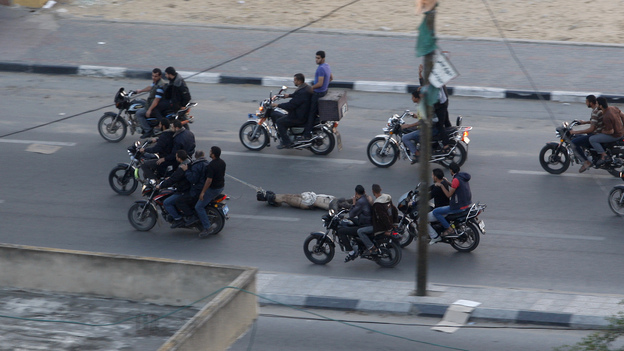
Palestinian gunmen drag a man from a motorcycle in Gaza City on Nov. 20. He was one of six men killed that day on suspicion of collaborating with Israel. The Hamas government in the Gaza Strip denied responsibility, though it has executed others judged to be working with Israel’s security forces.


Hatem Moussa/AP


Palestinian gunmen drag a man from a motorcycle in Gaza City on Nov. 20. He was one of six men killed that day on suspicion of collaborating with Israel. The Hamas government in the Gaza Strip denied responsibility, though it has executed others judged to be working with Israel’s security forces.


Hatem Moussa/AP


Life was already grim in the Gaza Strip when fighting raged between Israel and Hamas last November. Then Khulud Badawi got unexpected bad news about her husband.


“I was at home when my son came in and said, ‘Mom, they killed Dad.’ I said, ‘Who?’ He said, ‘Hamas.’ I asked him, ‘Where?’ He said, ‘Next to the gas station,’” she recalls.


Badawi’s husband, Ribhi Badawi, was in prison in Gaza City. He was supposed to go to court that day for a final appeal of charges that he had collaborated with Israel against Hamas, which runs the Gaza Strip.


But Ribhi Badawi was taken from prison and executed in public, along with five other inmates. They were all accused of being collaborators, or informants, working for Israel.


“In this case, what was remarkable was that these men were not executed in anything resembling legislative authority or the penal authority of the Hamas government, but by armed men,” says Sarah Leah Whitson, who directs the Middle East division of Human Rights Watch.


“How they managed to get these men out of prison, and then how they managed to shoot them dead in broad daylight and drag their corpses around the street is a very big question mark,” she adds.


Israel’s Informant Network


For decades, Israel’s security forces has relied heavily on Palestinian informants to track and keep tabs on wanted Palestinians. The standard practice is for Israel to pay the informants in exchange for the information. But if uncovered, the informants are treated as traitors to the Palestinian cause and can expect to face harsh judgment in the Palestinian courts, or in some cases, through vigilante justice.


Hamas, which has been in control of Gaza since 2007, has executed people judged to be collaborators. But in the six deaths last Nov. 20, the Hamas-run government said it was not responsible.


“What happened was against the law,” Islam Shawan, a spokesman for Gaza’s Interior Ministry, says. “We had a high-level committee investigate, and it handed down tough punishments to security officials who failed to do their jobs.”


Shawan won’t name names, give ranks or offer any other information, but he claims that four people working in the prison system were punished. One was fired, one was transferred, one was jailed and one lost any chance at promotions.


He has no progress to report on tracking down the people who actually did the killings, but he does claim progress in cracking down on collaboration.


Hamas’ Campaign Against Collaborators


Three months after those accused collaborators were killed, Hamas started an anti-collaboration campaign in Gaza.


TV ads played scary music with pictures of a young man being dragged to the gallows by Hamas security forces. The video storyline shows he was coerced into collaboration by doing things that could set him up for blackmail — drinking, taking drugs, searching for sex online.


Shawan says this campaign was aimed at everyone in Gaza.


“This was a national campaign — not just directed at collaborators,” he says. “It was designed to educate and protect society by showing people how Israelis recruit.”


People were offered a chance to turn themselves in. Shawan won’t say how many did, but claimed one example: an engineering student who allegedly gave Israel information about his neighbors, his professors and student politicians. The young man wasn’t punished, Shawan says, but quietly re-educated.


There was no “re-education” offered by Hamas in the case of Khulud Badawi’s husband, who was a member of a rival militant group.


“I don’t believe in this campaign,” she says. “My husband used to tell me that people who were collaborators would confess immediately, but people who weren’t would be tortured for months and never confess because they were innocent.”


Just last week, two accused spies were given death sentences, suggesting that tough punishment is just as important in Hamas’ efforts to crack down on collaboration as education and amnesty.


News


In Gaza, Hamas Targets Palestinian Informants In Crackdown