Showing posts with label Mountain. Show all posts

Wednesday, January 8, 2014

Why China Wants to ‘Strike the Mountain’ and ‘Kill the Chicken’

Why China Wants to ‘Strike the Mountain’ and ‘Kill the Chicken’
http://pixel.quantserve.com/pixel/p-89EKCgBk8MZdE.gif


Understanding two critical strategies for Beijing, one internal and one external.


By for The Diplomat


Chinese leaders are engaging in a dual strategy of “strike the mountain to shock the tiger” and “kill the chicken to scare the monkey.” The first strategy is an internal approach designed to take down a few powerful leaders to scare the lesser ones. The second strategy is an external approach in which leaders go after lesser powers to diminish the role or prevent the involvement of a greater power.


The internal strategy aims to remove formidable leaders who previously headed powerful institutions in key segments of the Chinese system, namely the state security apparatus, the military establishment, and the oil sector. These leaders pursued their own agendas and jockeyed for power at the highest levels before, during, and after the current leadership’s transition period that occurred nearly two years prior. The external strategy concerns the United States, the greater power, as well as Japan, the Philippines, and to a lesser extent, Vietnam, collectively referred to as the lesser powers. These observations lead to some salient questions. What are the major internal and external drivers of these ongoing strategies? Why are Chinese leaders pursuing these two strategies? And what is their overall intent?


What Are the Main Drivers of the Strategies?


The prime drivers of the leadership’s strategies consist of two internal factors and one external factor. The internal factors are best explained by the “crisis theory.” This means the leadership is attempting to manage domestic crises that pose challenges to the current leadership’s new authority and threaten the stability of the state. Presently, crises are unfolding in the economic arena, and, to a lesser extent now, the political arena. The external driver comprises ongoing structural changes occurring in the regional architecture and the security domain in particular; this regional transformation is driven in large part by the U.S. leadership. Both the internal and external factors have push-pull effects; meaning, China’s internal situation shapes its external policies and actions and, at the same time, the external situations feedback into China’s domestic system and affect the internal situation.


In the economic arena, the leaders are dealing with slowing economic growth. According to Charlene Chu, Senior Director of Fitch Ratings China, and a recent report produced by Fitch Ratings on Chinese Banks, “a key macro financial concern since the global financial crisis of 2008 has been the inability of China’s economic growth to get any lasting traction without considerable credit extension.” What’s more, “credit/GDP will have risen an estimated 87 percentage points in the five years ending in 2013, nearly twice that observed in other countries prior to financial sector stress.” The concerns “relate less to the level of credit/GDP – figures in the region of 200 percent are not unheard of in Asia or developed markets – and more to the very rapid rise in such a short time.”


The leadership however might be competent in managing a vast economy on the verge of a gradual economic slowdown by introducing policies to continue extending substantial credit and to liberalize capital controls in order to boost domestic consumption, for example. But these policies hold obvious risks. Extending more credit accelerates the rapid rise of credit/GDP levels in a short time, while lifting capital controls might make China vulnerable to capital flight. More crucially, the leaders are facing a potential crisis unfolding in the banking and finance sector and, as Chu has pointed out elsewhere, in the shadow banking system in particular. In this case, the leadership might be less capable of managing a sudden collapse of a major banking institution or of shadow banking institutions and the residual effects from such unexpected failures, such as social instability.


For the Chinese leadership, an economic slowdown or a banking and finance crisis, or some combination thereof, is dangerous on many levels. Conventional wisdom suggests the leaders predicate the Party’s legitimacy on economic development and growth, so a major economic setback or sudden crisis might undermine the new Party leadership’s authority. More importantly, however, is the unconventional wisdom. Every leadership since the 14th Party Congress perceives that economic weakness might make the state vulnerable to foreign influence and manipulation. Chinese history is replete with negative examples of how a debilitated Chinese economy made China more susceptible to foreign forces and resulted in considerable adverse consequences for the state and society. And when the CPC established the PRC in 1949 it staked its reputation on strengthening China against foreign influences and control as well as maintaining national sovereignty. For these reasons China’s economic reforms – in the banking and finance sector in particular – have entered a complex phase for the party, the state, and society.


Current economic reforms are made more complex because of the ongoing but seemingly diminishing complications in the political arena resulting from what appears to be the final stages of China’s leadership transition. Contrary to popular opinion that the current leadership has consolidated power rapidly, the leaders are still untangling and addressing an intricate internal faction. This faction consisted of influential individuals who occupied, and in some cases still occupy, powerful positions in major institutions, namely the state security apparatus, the state oil sector, and the military establishment. The matter is convoluted because the institutions are tightly connected: the security apparatus is connected to the military establishment; and the military establishment and the state oil industries have been closely linked in large part due to the Sino-Soviet split in the 1960s that resulted in oil shortages and imperiled China’s military. Because of this reality, unraveling the faction in its entirety and removing each and every player are unachievable objectives.


The Diplomat


Read more about Why China Wants to ‘Strike the Mountain’ and ‘Kill the Chicken’ and other interesting subjects concerning Asia at TheDailyNewsReport.com

Friday, September 13, 2013

Apple issues final non-security update for OS X Mountain Lion


Computerworld – Apple on Thursday updated OS X Mountain Lion to version 10.8.5, likely the final refresh of the 14-month-old operating system
before the company supersedes it with OS X Mavericks.


The update, a combination of security, stability and compatibility fixes, patched a total of 30 vulnerabilities in Mountain
Lion. It was accompanied by security-only updates for 2011′s OS X 10.7, aka Lion, and 2009′s OS X 10.6, known as Snow Leopard.
This was the first time since early June that Apple refreshed Mountain Lion.


Apple called out several non-security fixes inside 10.8.5, including ones that addressed a bug that blocked the bundled Mail email client
from displaying messages, improved file transfer performance and reliability over Wi-Fi and Ethernet networks, and tweaked
connections between Macs and Apple’s Xsan storage area network.


On the security side, 10.8.5 patched 30 vulnerabilities, including 7 labeled with the line “may lead to … arbitrary code execution,” which is Apple’s way of saying that they’re
critical. The fixes quashed bugs in several open-source components integrated with Mountain Lion, such as Apache (4 patches);
Bind (5), the most widely-used DNS (domain name system) software for routing Internet requests to the correct addresses; OpenSSL
(3); and PHP (4), the server-side scripting language.


Also included in the update were patches to stymie attacks using rogue PDF documents, one to fix a problem with Macs coming
out of sleep to a locked state, and another to plug a hole in QuickTime, Apple’s often-buggy media playing software.


One of the patches was for a several-months-old vulnerability in the Unix component known as “sudo,” which lets users gain
super-user or “root” rights. By resetting the system clock, hackers who have already managed to grab limited control of a
Mac can sidestep the need for the root-access password.


The sudo flaw had been identified in OS X in March, but attracted more attention two weeks ago after Metasploit, the popular
open-source penetration toolkit, added a module that made it easy to exploit the bug.


Also published Thursday was an update to Safari 5, the Apple browser for Snow Leopard; the separate update patched a pair
of vulnerabilities, including one revealed at the September 2012 Mobile Pwn2Own hacking contest by a Dutch team who used it
to exploit iOS. Apple had patched the same bugs in the newer Safari 6 last year.


OS X 10.8.5 and Security Update 2013-003 — the latter targets OS X Snow Leopard and OS X Lion, which at this point receive only security fixes — can be retrieved by selecting “Software Update…” from the Apple menu,
or by opening the Mac App Store application and clicking the Update icon at the top right. The updates can also be downloaded manually from Apple’s support site.


Apple has not yet revealed a release date for OS X Mavericks, the successor to Mountain Lion, but it will probably ship in
the second half of next month.


Gregg Keizer covers Microsoft, security issues, Apple, Web browsers and general technology breaking news for Computerworld. Follow Gregg
on Twitter at @gkeizer, or subscribe to Gregg’s RSS feed . His email address is gkeizer@ix.netcom.com.


Read more about mac os x in Computerworld’s Mac OS X Topic Center.


Netflash


Apple issues final non-security update for OS X Mountain Lion

Tuesday, September 3, 2013

VIDEO: Lea Michele Takes Some Time Out in a Thoughtful Mountain Snap


Lea Michele looks pensive as she admires the view during a road trip with her former Glee co-star Jonathan Groff.


Thanks for checking us out. Please take a look at the rest of our videos and articles.


To stay in the loop, bookmark our homepage.


VIDEO: Lea Michele Takes Some Time Out in a Thoughtful Mountain Snap

Thursday, August 22, 2013

A Theory of Mountain Flying

Here is my theory of mountain flying: I don’t like it.


This incredible video, from Peru, will give you an idea of the kind of thing I have nightmares about. For me, the most “have to look away” moments are the ten seconds starting around time 1:30, although 0:30 and 0:45 are pretty frightening too.


I don’t like mountain flying because it’s objectively dangerous, and it’s subjectively frightening. The winds are often turbulent, so you’re bouncing around with all that granite nearby. In the summer you often have thunderstorms, and in the winter you often have ice or snow. You worry about the narrowing gap between how high you have to go to clear the terrain, and how low you have to stay to avoid the clouds. I have taken mountain-flight training, and I’ve flown across the Rockies several times, in summer and winter, and the Sierra a few times. But … why?


Thus, as a guide for our current journey, we’re using multi-modal travel: fly, then drive. If we have to get to Sun Valley, Idaho? Instead fly to Twin Falls, Idaho — a great big runway in a big, flat valley — and drive from there. Atlantic events in Aspen? Fly to Boulder and drive. Right now we are at a meeting in Jackson, Wyoming. There is an airport here, but it involves mountains, and while they’re not that ominous the weather is not so great. I’d spend all night worrying before the flight in and the flight out. Instead, fly to Pinedale — a great big runway in a big, flat (although high, 7000-ft) valley — and drive from there, as we have done. Hence our route from Rapid City, SD to Pinedale, WY strategically avoiding the high ground of the Black Hills and the Wind River range along the way. The blue is the flying part, the dotted-red is the rental-car driving.


No larger point, except (a) to give a link to the amazing video above and (b) as ongoing real-time chronicle of Aeronautical Decision Making. 


Also: Yesterday, when leaving Rapid City, we had a chance to fly by Mount Rushmore and do a North by Northwest reprise.  Instead I veered off when we were about 10 miles away, too far for any interesting pictures. Rain was building in the area, and the winds were gusty, and several tourist helicopters were reporting turbulence, and I thought, another time. So we will not have our update to the scene below:


Master Feed : The Atlantic


A Theory of Mountain Flying

Monday, August 5, 2013

To Join "63 March On Washington: "Like Climbing A Mountain"


Jack Hansan, who made signs for the March on Washington, and his wife Ethel now live in Northern Virginia. They are both still moved to tears when they recall the day of the march.


Erica Yoon/NPR

Jack Hansan, who made signs for the March on Washington, and his wife Ethel now live in Northern Virginia. They are both still moved to tears when they recall the day of the march.


Jack Hansan, who made signs for the March on Washington, and his wife Ethel now live in Northern Virginia. They are both still moved to tears when they recall the day of the march.


Erica Yoon/NPR


For the Month of August, Morning Edition and The Race Card Project are looking back at a seminal moment in civil rights history: The March on Washington for Jobs and Freedom, where the Rev. Martin Luther King Jr., delivered his iconic “I Have A Dream Speech” on Aug. 28, 1963. Approximately 250,000 people descended on the nation’s capitol from all over the country for the mass demonstration.


Through The Race Card Project’s six-word stories, we’ll meet some of the people who witnessed that history and hear their memories and reflections on race relations in America today.


Throughout 1963, American TV screens had been filled with images of non-violent demonstrations that turned ugly, with Southern police officers unleashing dogs and fire hoses on protesters. There were broad concerns all the way up to the top levels of government about the March on Washington. How large would the crowd be? Might there be violence?


But Jack Hansan of Cincinnati was not concerned about all that. A white man who’d been working on civil rights in Ohio, he wanted to be in that number, however large or small the gathering.


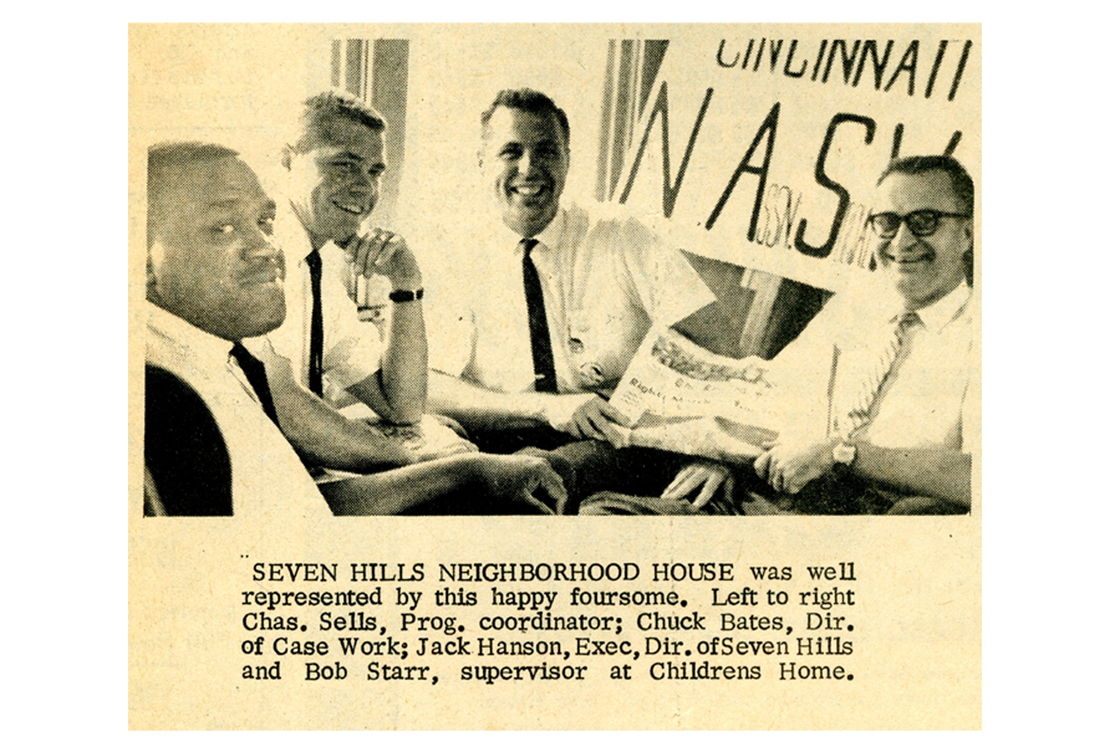
A newspaper clipping from The Cincinnati Herald on Sept. 14, 1963, included a picture of Jack Hansan and other members of the Cincinnati delegation.


Courtesy of Jack Hansan

A newspaper clipping from The Cincinnati Herald on Sept. 14, 1963, included a picture of Jack Hansan and other members of the Cincinnati delegation.


A newspaper clipping from The Cincinnati Herald on Sept. 14, 1963, included a picture of Jack Hansan and other members of the Cincinnati delegation.


Courtesy of Jack Hansan


“We had to get rid of this — I don’t know how you would say it — this discrimination that was so prevalent in communities like our education system, our churches,” Hansan says. “So participating in the march was like climbing a mountain, and for us, we wanted to be on the top.”


That did not sit well with Jack Hansan’s father. He wrote a letter pleading for his son to stay put.


“He lived in Kansas City, Mo., and his message was, ‘I wish you wouldn’t go,’ ” Hansan explains. “And he said, ‘Your real responsibility is to your family, your sons.’ But you know, that was him.”


Hansan was one of 500 Cincinnati businessmen and civic activists who took a special train to D.C., leaving Cincinnati at 5 p.m. “We rode two nights on a train, one up and one back. There was no club car, but it was fun,” he laughs. The group spent the night talking and schmoozing. “We were all dressed politely, like we were going to an office — shirts and ties.”


That attire was no accident. Marchers were advised by the local organizing committee to look clean and sharp, dressed as if they were in D.C. to close a deal.


Once they got to the city, Hansan says he had never seen a crowd that large and integrated. “I do remember the songs and listening to the entertainers … I remember Peter, Paul, And Mary,” he laughs. “I remember the songs more than I do the speeches.”


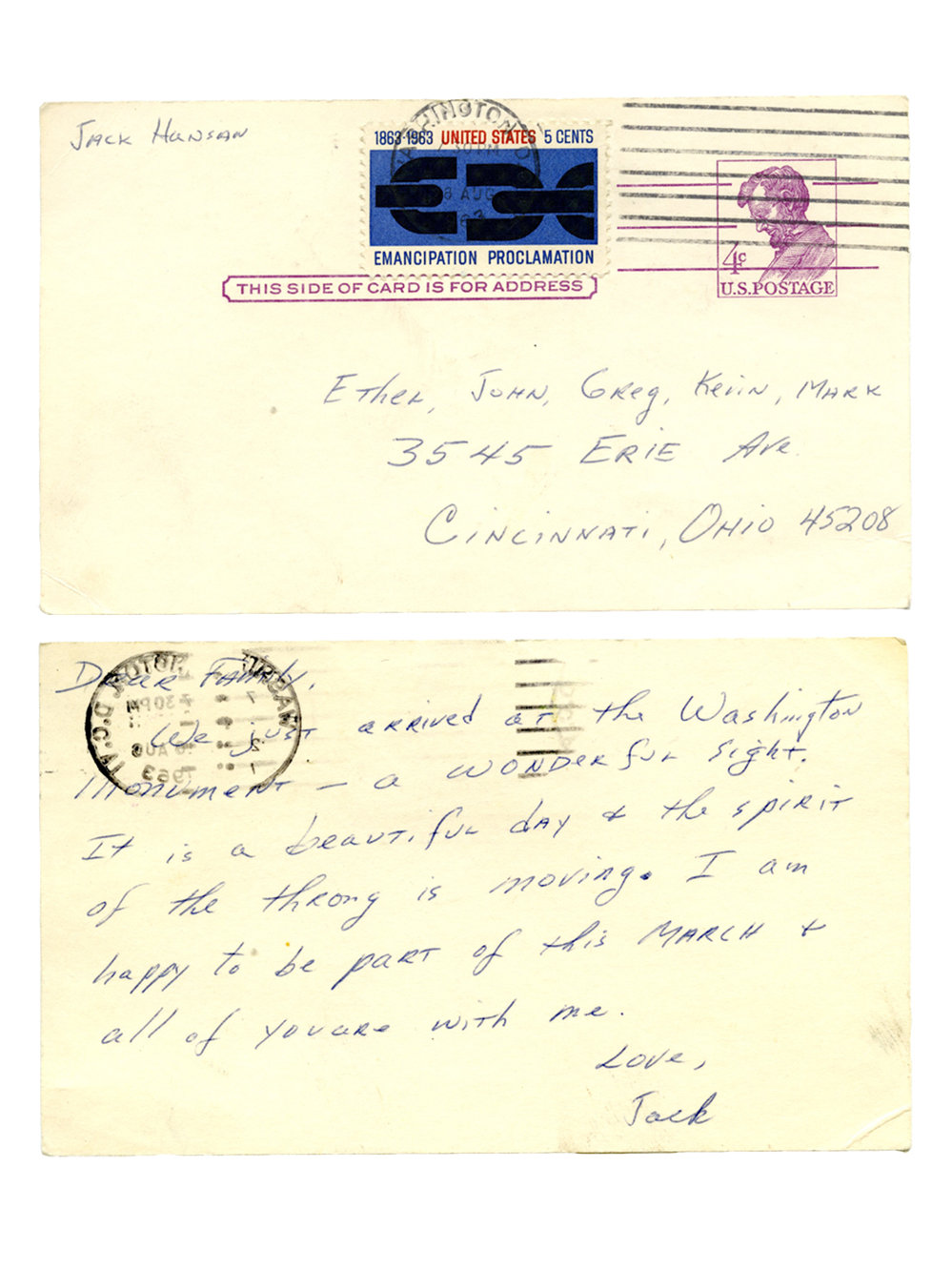
Even so, Hansan knew he was witnessing history that day and wanted to tell his wife and four young sons about it. He grabbed a plain postcard, stamped with a Lincoln 4-cent stamp, and jotted down a few words. Hansan, who still has the postcard, chokes up as he reads his note aloud.


Hansan sent his wife and four sons a postcard on the day of the march. Back in Ohio, his wife says she was “living it vicariously” via the television broadcast.


Courtesy of Jack Hansan


Hansan sent his wife and four sons a postcard on the day of the march. Back in Ohio, his wife says she was “living it vicariously” via the television broadcast.


Courtesy of Jack Hansan


As Hansan reads, his wife, Ethel, looks on and weeps. Her husband’s trip — and the uncertainty over what might happen at the march — was very stressful, she says. “Just listening to him talk about it, it did bring me to tears remembering back on what it felt to be left back with the little ones and not really knowing what was happening there.


“Fortunately, we did have a television set and they were broadcasting it, so I was kind of living it vicariously,” she continues. “But the little kids were ignored and not properly taken care of most of the day, because I sat in front of the television watching it with a great deal of trepidation.”


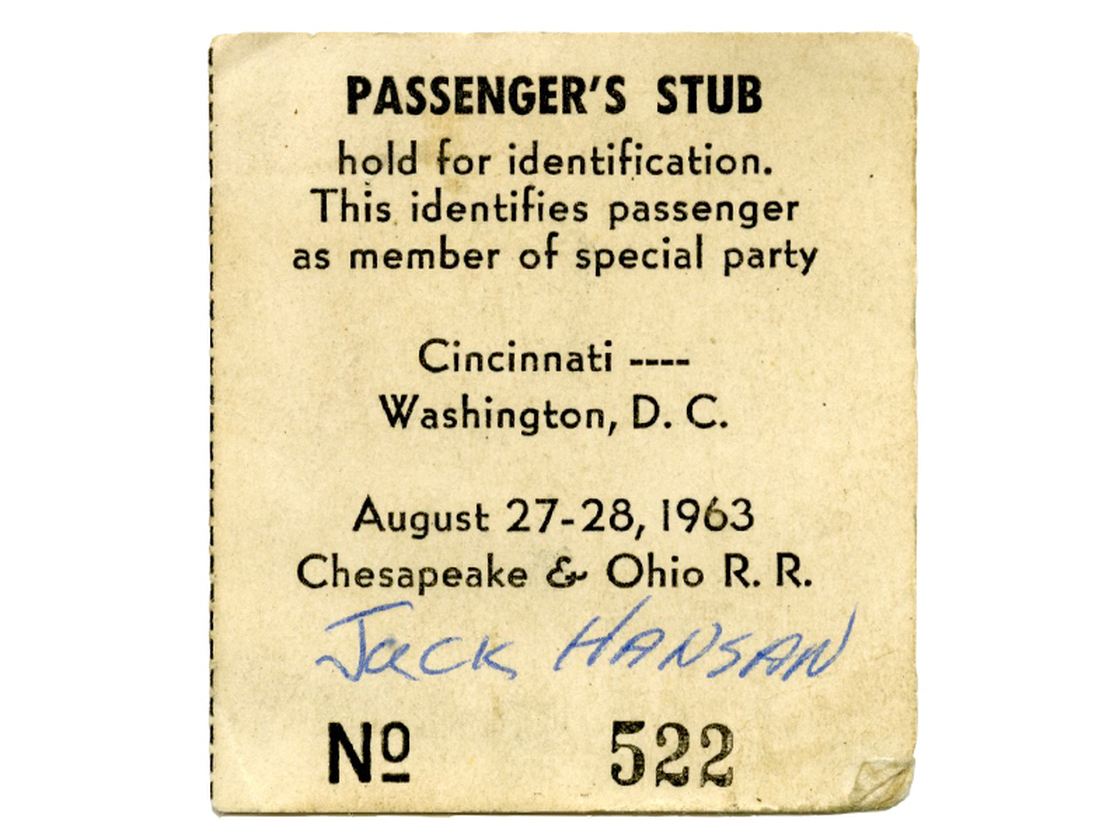
Hansan rode a chartered train to the capital with 500 other members of the Cincinnati Committee for the March On Washington. Fifty years later, he still has his ticket stub.


Courtesy of Jack Hansan

Hansan rode a chartered train to the capital with 500 other members of the Cincinnati Committee for the March On Washington. Fifty years later, he still has his ticket stub.


Hansan rode a chartered train to the capital with 500 other members of the Cincinnati Committee for the March On Washington. Fifty years later, he still has his ticket stub.


Courtesy of Jack Hansan


Rev. King’s speech was very moving, Ethel Hansan says. And even today, she cries when she hears the song, “We Shall Overcome.” “That was very moving for me, when they were all holding hands and they were singing.”


Ethel and Jack Hansan, who now live in Northern Virginia, are proud of their memories. He’s Catholic and she’s Jewish, and the pair has spent a lifetime working on building bridges of all kinds. They’ve kept a treasure trove of mementos from the march.


When asked to share their own six-word stories on race relations in America today, Jack Hansan says, “We all need to keep trying.”


“That’s it,” he says. “You know, it’s not been done. And the March on Washington was just one of the starting events, but it’s still not complete.”


Ethel had a harder time settling on just six words. “But what I would like to impart to people who are persecuted is to rise above it,” she says. “You know, don’t let it drag you down.


“Because I think that’s the tendency, when you have all that negative stuff thrown at you, that you tend to believe it,” she says. “Don’t believe it. You’re better than that … You’re better than that and you know it. You should know it.”


You can find more of Jack Hansan’s memories and mementos from the March on Washington at The Social Welfare History Project, a website he founded to educate the public about the history of social welfare in America.


News


To Join "63 March On Washington: "Like Climbing A Mountain"

Friday, July 19, 2013

Wildfire still looms over S. Calif. mountain town


A female inmate hand crew from Puerta La Cruz and firefighters in an engine company with them set fire to reinforce the line to stave off part of the Mountain Fire burning up a hill toward them on Tuesday, July 16, 2013 off Apple Canyon Road near Lake Hemet, Calif. Tuesday, July 17th, 2013. Officials say the wildfire in the mountains west of Palm Springs has destroyed three houses and three mobile homes and is threatening dozens more residences. (AP Photo/The Desert Sun, Crystal Chatham) RIVERSIDE PRESS-ENTERPRISE OUT; NO SALES; NO FOREIGN


A female inmate hand crew from Puerta La Cruz and firefighters in an engine company with them set fire to reinforce the line to stave off part of the Mountain Fire burning up a hill toward them on Tuesday, July 16, 2013 off Apple Canyon Road near Lake Hemet, Calif. Tuesday, July 17th, 2013. Officials say the wildfire in the mountains west of Palm Springs has destroyed three houses and three mobile homes and is threatening dozens more residences. (AP Photo/The Desert Sun, Crystal Chatham) RIVERSIDE PRESS-ENTERPRISE OUT; NO SALES; NO FOREIGN


Helicopter crews work the Mountain Fire as it burns in the wilderness near Lake Hemet, Calif. Tuesday, July 17th, 2013. Officials say the wildfire in the mountains west of Palm Springs has destroyed three houses and three mobile homes and is threatening dozens more residences. (AP Photo/The Desert Sun, Jay Calderon) RIVERSIDE PRESS-ENTERPRISE OUT; NO SALES; NO FOREIGN


What remains of a home destroyed by the Mountain Fire smolders Tuesday, July 16, 2013, in Pine Springs Ranch, Calif. The fast-moving wildfire in the mountains west of Palm Springs nearly doubled in size Tuesday, prompting the evacuation of about 50 homes. (AP Photo/The Desert Sun, Marilyn Chung) RIVERSIDE PRESS-ENTERPRISE OUT; NO SALES; NO FOREIGN


A member of the Big Bear Hot Shots works the fire line on Apple Valley Rd. near Lake Hemet, Calif. Tuesday, July 17th, 2013. Officials say the wildfire in the mountains west of Palm Springs has destroyed three houses and three mobile homes and is threatening dozens more residences. (AP Photo/The Desert Sun, Jay Calderon) RIVERSIDE PRESS-ENTERPRISE OUT; NO SALES; NO FOREIGN


An air tanker fighting the Mountain Fire near Mountain Center drops fire retardant on Tuesday morning, July 16, 2013. A fast-moving wildfire in the mountains west of Palm Springs nearly doubled in size Tuesday, prompting the evacuation of about 50 homes. (AP Photo/The Press-Enterprise, Kurt Miller) NO SALES; MAGS OUT; MANDATORY CREDIT


Buy AP Photo Reprints


IDYLLWILD, Calif. (AP) — Longtime resident Dave Jones was back in his Southern California home a day after evacuating, but remained ready to leave as a huge wildfire fire threatened to top a ridge near his mostly empty mountain town.


The walls were bare in the home where he’s lived for the past 40 years after the 64-year-old and his wife stowed the valuable mementos, along with more practical items, like clothes, jewelry, medicines and the computer hard drive before heading to their son’s home in nearby Hemet.


“The fire came right up by the ridge yesterday afternoon, gave everybody a pretty good scare that it was going to come down the hill,” Jones said Thursday night.


The last time he evacuated for a fire it was 1997, and he stayed away for four days. Jones said he considered the order he got Wednesday “a light evacuation” and wasn’t afraid because he knows of a controlled dirt road to use as “an escape route” if fire does come down that ridge.


Forest Service spokesman John Miller said firefighters had made “great progress” by late Thursday night given the tough conditions and terrain, and evacuations were called off for a small handful of the thousands under orders to leave.


But the 35-square-mile blaze remained just 15 percent contained and had been growing in an atypical manner. The majority of the 3,300 fire fighters are on the western flank of the fire, near Idyllwild.


“Usually it cools down at night and we get more humidity. That hasn’t happened,” said Tina Rose, a spokeswoman for the California Department of Forestry and Fire Protection. “It’s been burning like it’s daytime for 72 hours in a row.”


Temperatures were expected to dip into the 60s overnight before creeping up into the 80s on Friday.


“What we’re concerned about is what you see right here,” said U.S Forest Service Fire Chief Jeanne Pincha-Tulley, pointing to a hazy sky. “When you get a column that puts out this much smoke, embers get into the column and can drop anywhere.”


She added the column was expected to go right over Idyllwild for the next two days. While authorities said only 5 percent of the town rebuffed evacuating, they cautioned they might not be able to help those who remain if conditions worsen.


“We cannot guarantee your safety if the fire runs into town,” Idyllwild Fire Protection District Chief Patrick Reitz said.


The 22,800-acre fire spread in three directions through thick brush and trees. Roughly 4,000 houses, condos, cabins and several hotels in Idyllwild and surrounding communities were threatened. Fire crews struggled to carve fire lines around the town to block the towering flames.


Authorities said the fire was “human-caused” but they wouldn’t say whether it was accidental or intentional. There have been no reports of any injuries.


Idyllwild, the small town on the other side of the mountains that tower over the desert community of Palm Springs is known for the arts and is surrounded by national forest popular with hikers and flanked by two large rocks that are favorites for climbers. Popular campgrounds, hiking trails and a 30-mile section of the Pacific Crest Trail that runs 2,650 miles from the Mexican border to Canada were closed.


“That’s going right down the middle of the fire,” U.S. Forest Service spokesman Norma Bailey said of the trail.


The evacuation center was alive with music Thursday as four teenage French horn players from Idyllwild Arts Academy rehearsed a piece by Austrian composer Anton Bruckner in a courtyard behind the cafeteria. They said they found it relaxing to play in an uncertain moment. On the other side of the building in the shade, a group of counselors picked at guitars and a ukulele.


“There were a lot of people practicing last night. I took out my piccolo and played a little bit,” said Sophia Yurdin, 16, of Los Angeles.


Grayson Hall, 17, a counselor at a Center for Spiritual Life camp that rents space from Camp Buckhorn said campers were aware a fire had been burning and were surprisingly calm when first told they had to leave.


“We had just done an emotional exercise about acknowledging your emotional baggage and letting it go. And right after we finished that, we got word that we had to evacuate. And we had to literally release our baggage,” he said.


The blaze that began Monday destroyed three houses, damaged another and destroyed three mobile homes, a cabin, a garage and about a half-dozen vehicles, the Forest Service said. Five commercial buildings, 11 other buildings and several smaller structures were also lost.


The fire was about 12 miles from the site of the 2006 Esperanza wildfire that killed five U.S. Forest Service firefighters and destroyed 34 homes and burned an area that hadn’t burned in many years.


___


AP reporters Raquel Maria Dillon in Idyllwild and Shaya Tayefe Mohajer in Los Angeles contributed to this report.


Associated Press


Top Headlines


Wildfire still looms over S. Calif. mountain town