Showing posts with label Climbing. Show all posts

Monday, August 5, 2013

To Join "63 March On Washington: "Like Climbing A Mountain"


Jack Hansan, who made signs for the March on Washington, and his wife Ethel now live in Northern Virginia. They are both still moved to tears when they recall the day of the march.


Erica Yoon/NPR

Jack Hansan, who made signs for the March on Washington, and his wife Ethel now live in Northern Virginia. They are both still moved to tears when they recall the day of the march.


Jack Hansan, who made signs for the March on Washington, and his wife Ethel now live in Northern Virginia. They are both still moved to tears when they recall the day of the march.


Erica Yoon/NPR


For the Month of August, Morning Edition and The Race Card Project are looking back at a seminal moment in civil rights history: The March on Washington for Jobs and Freedom, where the Rev. Martin Luther King Jr., delivered his iconic “I Have A Dream Speech” on Aug. 28, 1963. Approximately 250,000 people descended on the nation’s capitol from all over the country for the mass demonstration.


Through The Race Card Project’s six-word stories, we’ll meet some of the people who witnessed that history and hear their memories and reflections on race relations in America today.


Throughout 1963, American TV screens had been filled with images of non-violent demonstrations that turned ugly, with Southern police officers unleashing dogs and fire hoses on protesters. There were broad concerns all the way up to the top levels of government about the March on Washington. How large would the crowd be? Might there be violence?


But Jack Hansan of Cincinnati was not concerned about all that. A white man who’d been working on civil rights in Ohio, he wanted to be in that number, however large or small the gathering.


A newspaper clipping from The Cincinnati Herald on Sept. 14, 1963, included a picture of Jack Hansan and other members of the Cincinnati delegation.


Courtesy of Jack Hansan
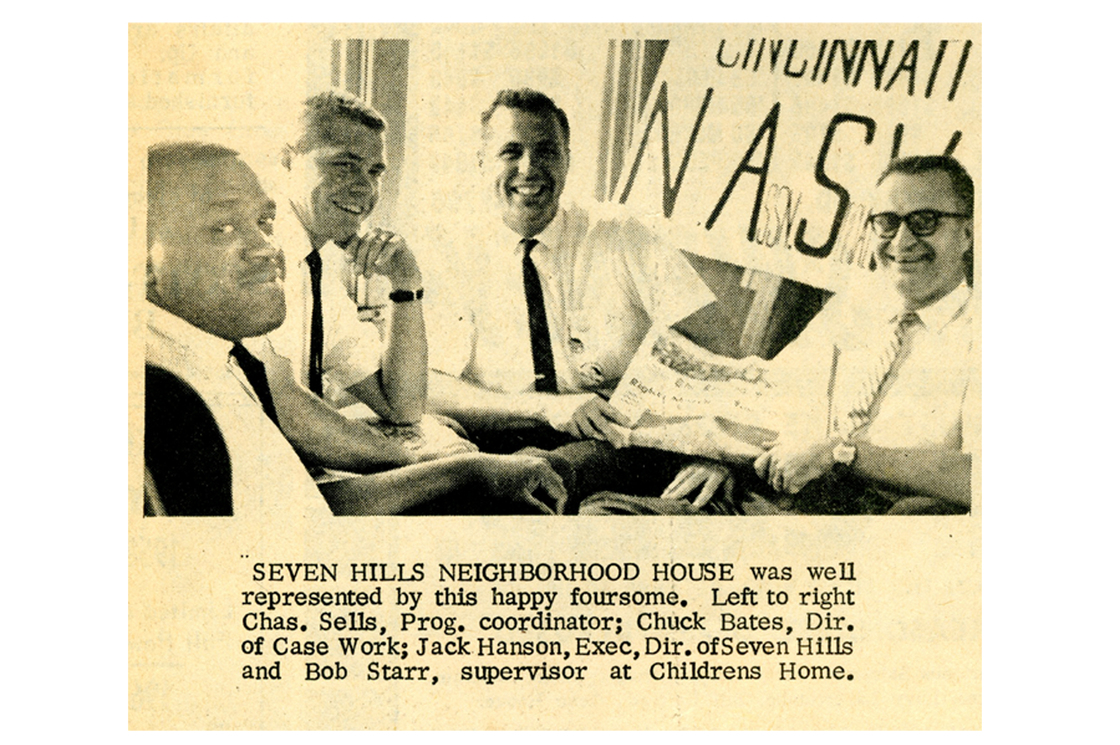
A newspaper clipping from The Cincinnati Herald on Sept. 14, 1963, included a picture of Jack Hansan and other members of the Cincinnati delegation.


A newspaper clipping from The Cincinnati Herald on Sept. 14, 1963, included a picture of Jack Hansan and other members of the Cincinnati delegation.


Courtesy of Jack Hansan


“We had to get rid of this — I don’t know how you would say it — this discrimination that was so prevalent in communities like our education system, our churches,” Hansan says. “So participating in the march was like climbing a mountain, and for us, we wanted to be on the top.”


That did not sit well with Jack Hansan’s father. He wrote a letter pleading for his son to stay put.


“He lived in Kansas City, Mo., and his message was, ‘I wish you wouldn’t go,’ ” Hansan explains. “And he said, ‘Your real responsibility is to your family, your sons.’ But you know, that was him.”


Hansan was one of 500 Cincinnati businessmen and civic activists who took a special train to D.C., leaving Cincinnati at 5 p.m. “We rode two nights on a train, one up and one back. There was no club car, but it was fun,” he laughs. The group spent the night talking and schmoozing. “We were all dressed politely, like we were going to an office — shirts and ties.”


That attire was no accident. Marchers were advised by the local organizing committee to look clean and sharp, dressed as if they were in D.C. to close a deal.


Once they got to the city, Hansan says he had never seen a crowd that large and integrated. “I do remember the songs and listening to the entertainers … I remember Peter, Paul, And Mary,” he laughs. “I remember the songs more than I do the speeches.”


Even so, Hansan knew he was witnessing history that day and wanted to tell his wife and four young sons about it. He grabbed a plain postcard, stamped with a Lincoln 4-cent stamp, and jotted down a few words. Hansan, who still has the postcard, chokes up as he reads his note aloud.


Hansan sent his wife and four sons a postcard on the day of the march. Back in Ohio, his wife says she was “living it vicariously” via the television broadcast.


Courtesy of Jack Hansan
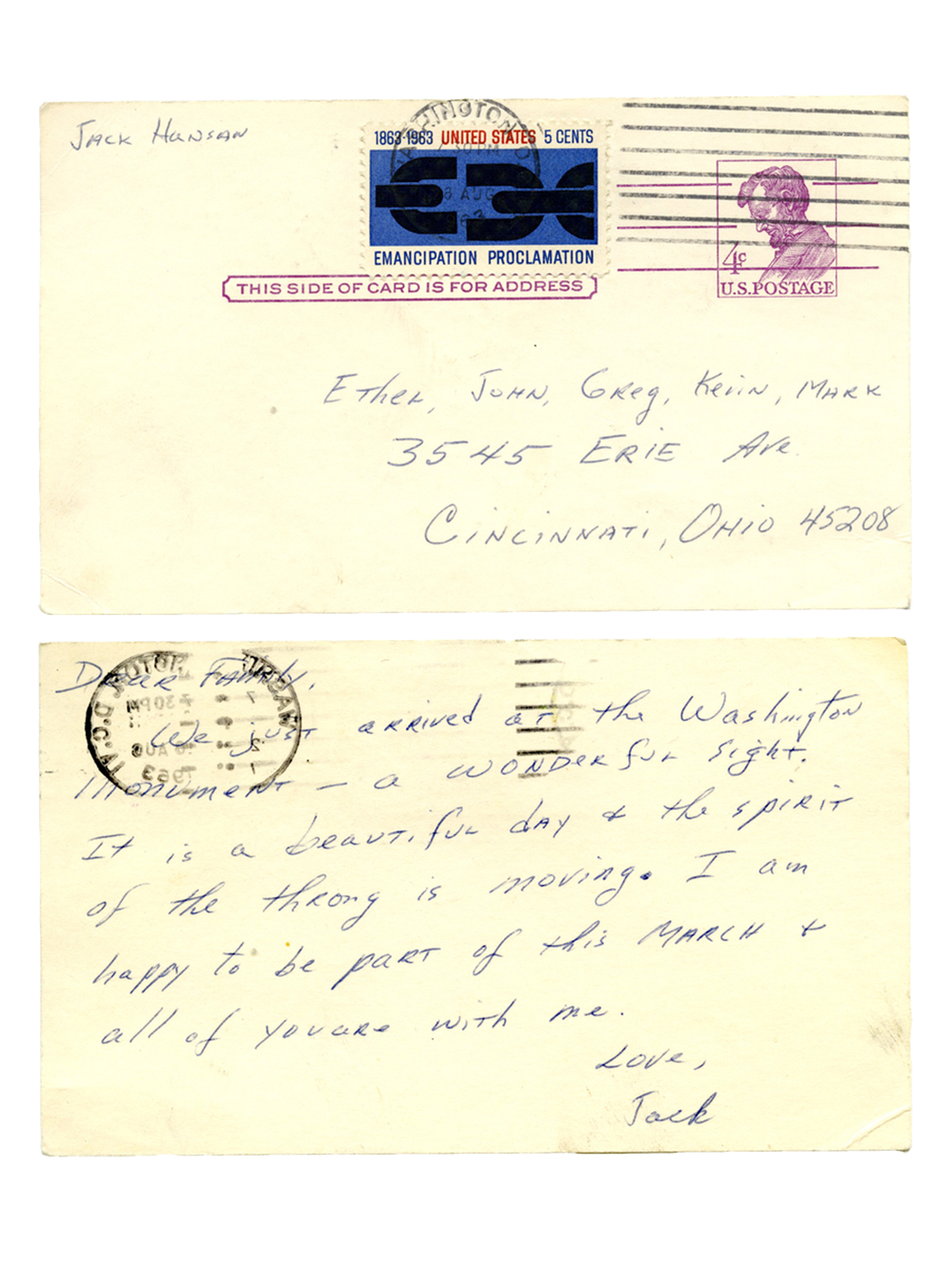


Hansan sent his wife and four sons a postcard on the day of the march. Back in Ohio, his wife says she was “living it vicariously” via the television broadcast.


Courtesy of Jack Hansan


As Hansan reads, his wife, Ethel, looks on and weeps. Her husband’s trip — and the uncertainty over what might happen at the march — was very stressful, she says. “Just listening to him talk about it, it did bring me to tears remembering back on what it felt to be left back with the little ones and not really knowing what was happening there.


“Fortunately, we did have a television set and they were broadcasting it, so I was kind of living it vicariously,” she continues. “But the little kids were ignored and not properly taken care of most of the day, because I sat in front of the television watching it with a great deal of trepidation.”


Hansan rode a chartered train to the capital with 500 other members of the Cincinnati Committee for the March On Washington. Fifty years later, he still has his ticket stub.


Courtesy of Jack Hansan
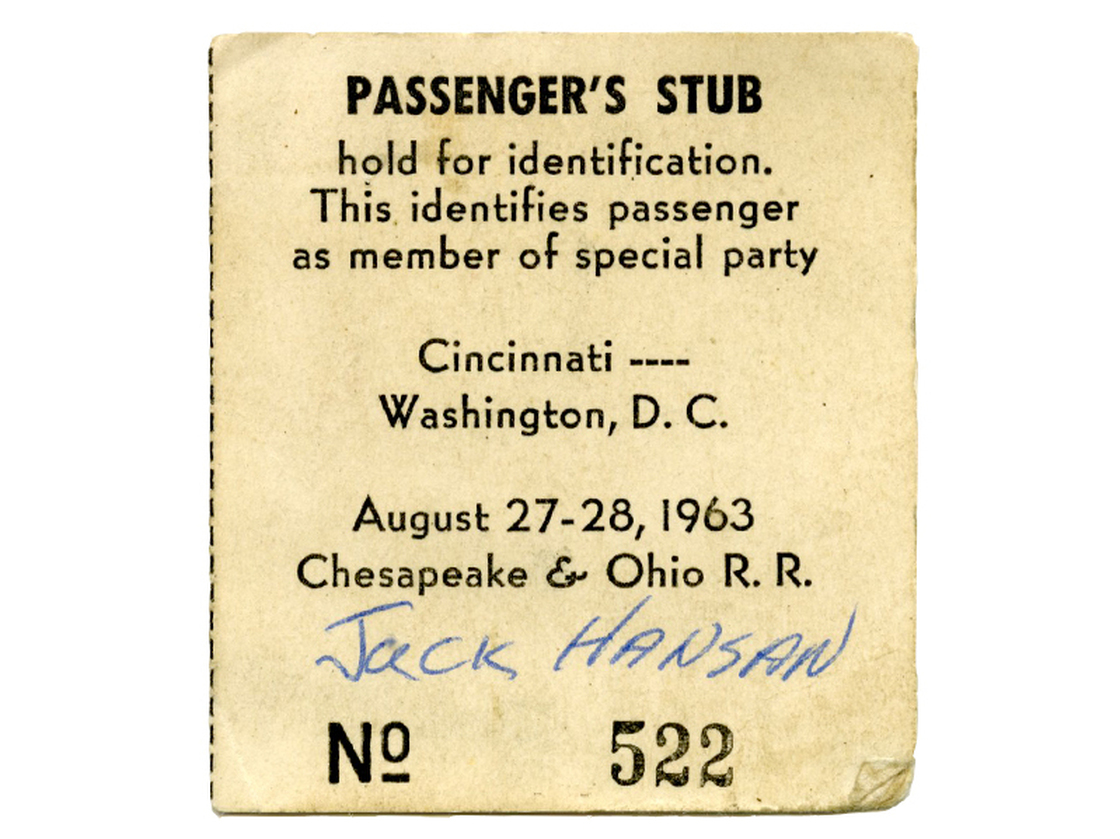
Hansan rode a chartered train to the capital with 500 other members of the Cincinnati Committee for the March On Washington. Fifty years later, he still has his ticket stub.


Hansan rode a chartered train to the capital with 500 other members of the Cincinnati Committee for the March On Washington. Fifty years later, he still has his ticket stub.


Courtesy of Jack Hansan


Rev. King’s speech was very moving, Ethel Hansan says. And even today, she cries when she hears the song, “We Shall Overcome.” “That was very moving for me, when they were all holding hands and they were singing.”


Ethel and Jack Hansan, who now live in Northern Virginia, are proud of their memories. He’s Catholic and she’s Jewish, and the pair has spent a lifetime working on building bridges of all kinds. They’ve kept a treasure trove of mementos from the march.


When asked to share their own six-word stories on race relations in America today, Jack Hansan says, “We all need to keep trying.”


“That’s it,” he says. “You know, it’s not been done. And the March on Washington was just one of the starting events, but it’s still not complete.”


Ethel had a harder time settling on just six words. “But what I would like to impart to people who are persecuted is to rise above it,” she says. “You know, don’t let it drag you down.


“Because I think that’s the tendency, when you have all that negative stuff thrown at you, that you tend to believe it,” she says. “Don’t believe it. You’re better than that … You’re better than that and you know it. You should know it.”


You can find more of Jack Hansan’s memories and mementos from the March on Washington at The Social Welfare History Project, a website he founded to educate the public about the history of social welfare in America.


News


To Join "63 March On Washington: "Like Climbing A Mountain"

Monday, July 22, 2013

In Climbing Income Ladder, Location Matters


ATLANTA – Stacey Calvin spends almost as much time commuting to her job — on a bus, two trains and another bus — as she does working part-time at a day care center. She knows exactly where to board the train and which stairwells to use at the stations so that she has the best chance of getting to work on time in the morning and making it home to greet her three children after school.


“It’s a science you just have to perfect over time,” said Ms. Calvin, 37.


Her nearly four-hour round-trip stems largely from the economic geography of Atlanta, which is one of America’s most affluent metropolitan areas yet also one of the most physically divided by income. The low-income neighborhoods here often stretch for miles, with rows of houses and low-slung apartments, interrupted by the occasional strip mall, and lacking much in the way of good-paying jobs.


This geography appears to play a major role in making Atlanta one of the metropolitan areas where it is most difficult for lower-income households to rise into the middle class and beyond, according to a new study that other researchers are calling the most detailed portrait yet of income mobility in the United States.


The study — based on millions of anonymous earnings records and being released this week by a team of top academic economists — is the first with enough data to compare upward mobility across metropolitan areas. These comparisons provide some of the most powerful evidence so far about the factors that seem to drive people’s chances of rising beyond the station of their birth, including education, family structure and the economic layout of metropolitan areas.


Climbing the income ladder occurs less often in the Southeast and industrial Midwest, the data shows, with the odds notably low in Atlanta, Charlotte, Memphis, Raleigh, Indianapolis, Cincinnati and Columbus. By contrast, some of the highest rates occur in the Northeast, Great Plains and West, including in New York, Boston, Salt Lake City, Pittsburgh, Seattle and large swaths of California and Minnesota.


“Where you grow up matters,” said Nathaniel Hendren, a Harvard economist and one of the study’s authors. “There is tremendous variation across the U.S. in the extent to which kids can rise out of poverty.”


That variation does not stem simply from the fact that some areas have higher average incomes: upward mobility rates, Mr. Hendren added, often differ sharply in areas where average income is similar, like Atlanta and Seattle.


The gaps can be stark. On average, fairly poor children in Seattle — those who grew up in the 25th percentile of the national income distribution — do as well financially when they grow up as middle-class children — those who grew up at the 50th percentile — from Atlanta.


Geography mattered much less for well-off children than for middle-class and poor children, according to the results. In an economic echo of Tolstoy’s line about happy families being alike, the chances that affluent children grow up to be affluent are broadly similar across metropolitan areas.


The team of researchers initially analyzed an enormous database of earnings records to study tax policy, hypothesizing that different local and state tax breaks might affect intergenerational mobility.


What they found surprised them, said Raj Chetty, one of the authors and the most recent winner of the John Bates Clark Medal, which the American Economic Association awards to the country’s best academic economist under the age of 40. The researchers concluded that larger tax credits for the poor and higher taxes on the affluent seemed to improve income mobility only slightly. The economists also found only modest or no correlation between mobility and the number of local colleges and their tuition rates or between mobility and the amount of extreme wealth in a region.


But the researchers identified four broad factors that appeared to affect income mobility, including the size and dispersion of the local middle class. All else being equal, upward mobility tended to be higher in metropolitan areas where poor families were more dispersed among mixed-income neighborhoods.


Income mobility was also higher in areas with more two-parent households, better elementary schools and high schools, and more civic engagement, including membership in religious and community groups.


Regions with larger black populations had lower upward-mobility rates. But the researchers’ analysis suggested that this was not primarily because of their race. Both white and black residents of Atlanta have low upward mobility, for instance.


The authors emphasize that their data allowed them to identify only correlation, not causation. Other economists said that future studies will be important for sorting through the patterns in this new data.


Still, earlier studies have already found that education and family structure have a large effect on the chances that children escape poverty. Other researchers, including the political scientist Robert D. Putnam, author of “Bowling Alone,” have previously argued that social connections play an important role in a community’s success. Income mobility has become one of the hottest topics in economics, as both liberals and conservatives have grown worried about diminished opportunities following more than a decade of disappointing economic growth. After years of focusing more on inequality at a moment in time, economists have more recently turned their attention to people’s paths over their lifetimes.


Polls show that Americans are worried about whether living standards will rise for most people in coming decades, as they have for nearly all of the nation’s history. In interviews in Atlanta and its suburbs, residents reflected many of the national concerns and many of the patterns in the study.


Jose Lopez, a 40-year-old who runs a local painting crew, said he wished he had enough time, amid work and parenthood, to go back to school.


Lampra Jones, a recent graduate of a chiropractic program who has struggled to find work, called herself “a loner” and said she wished she knew more people to help with her job search. “If you don’t know the right people,” said Ms. Jones, 28, “you’re not going to get anywhere.”


Michael Novajovsky, a father of three in Gwinnett County with a temporary job as a network engineer, said in an interview that the struggle to build a better life often felt similar to “a lottery.” His job pays $ 27 an hour but comes with no health insurance for him, his wife and his three children.


His wife, Sherrie, recently left a job at a diner that required an hour’s commute by bus. She would like to find a new job with health insurance, but the family has only one car. “I’d work just to have insurance,” Ms. Novajovsky said.


In previous studies of mobility, economists have found that a smaller percentage of people escape childhood poverty in the United States than in several other rich countries, including Canada, Australia, France, Germany and Japan. The latest study is consistent with those findings.


Whatever the reasons, affluent children often remain so: one of every three 30-year-olds who grew up in the top 1 percent of the income distribution was already making at least $ 100,000 in family income, according to the new study. Among adults who grew up in the bottom half of the income distribution, only one out of 25 had family income of at least $ 100,000 by age 30.


Yet the parts of this country with the highest mobility rates — like Pittsburgh, Seattle and Salt Lake City — have rates roughly as high as those in Denmark and Norway, two countries at the top of the international mobility rankings. In areas like Atlanta and Memphis, by comparison, upward mobility appears to be substantially lower than in any other rich country, Mr. Chetty said.


Especially intriguing is the fact that children who moved at a young age from a low-mobility area to a high-mobility area did almost as well as those who spent their entire childhoods in a higher-mobility area. But children who moved as teenagers did less well.


That pattern makes economists more confident that the characteristics of different regions — as opposed to something inherent and unchangeable in the local residents — are helping cause the varying mobility rates.


Lawrence Katz, a labor economist who did not work on the project, said he was struck by the fact that areas with high levels of income mobility were also those that established high school earliest and have long had strong school systems. Mr. Katz, a Harvard economist and former Clinton administration official, called the work “certainly the most comprehensive analysis of intergenerational mobility in the contemporary U.S.”


The project’s other researchers were Patrick Kline, a professor at the University of California, Berkeley, and Emmanuel Saez, a Berkeley economist who won the Clark Medal in 2009.


The comparison of metropolitan areas allows researchers to consider local factors that previous mobility studies could not — including a region’s geography. And in Atlanta, the most common lament seems to be precisely that concentrated poverty, extensive traffic and a weak public-transit system make it difficult to get to the job opportunities. “When poor communities are segregated,” said Cindia Cameron, an organizer for 9 to 5, a women’s rights group, “everything about life is harder.”


Ms. Calvin, the day care worker who commutes more than three hours, recently tried to rent an apartment closer to her job, in a better school district and a neighborhood closer to grocery stores. But the landlords required more income than her roughly $ 1,200 in monthly take-home pay, she said.


She now plans to stay for another couple of years in her three-bedroom home, in a set of tan garden apartments in DeKalb County, east of Atlanta. By then, she expects to have married her boyfriend — they are recently engaged — and may be able to afford to move.


“I’m a little disappointed I had to renew my lease,” she said. But she is happy that she has a routine that allows her to play an active role in her children’s school, including with the PTA, and to be home when they arrive home.


“It’s enough to get by,” Ms. Calvin said.


Interactive graphics by Mike Bostock, Shan Carter, Amanda Cox, Matthew Ericson, Josh Keller, Alicia Parlapiano, Kevin Quealy and Josh Williams, based on data from Raj Chetty and Nathaniel Hendren, Harvard, and Patrick Kline and Emmanuel Saez, U.C. Berkeley.


NYT > Global Home


In Climbing Income Ladder, Location Matters