The Mark of the Beast is WWWI am almost entirely convinced that Skyfloating is right about the Mark of the Beast being “www,” and I am about to present a ton of evidence for how come. It will include historical evidence, behavioral evidence, psychological evidence, and even more prophetic evidence – but from a different source than expected – prophecies about what life is like after 2030, which almost (possibly always) state that we have actually returned to a less technological state than the one we are currently in, and this tone is even noted by Nostradamus, who was aware that there would be a shift.
If you look at the historical context, the internet, especially with smart phones and tablets (which mean that people are constantly networked with each other, so they represent the Epitome of the previous generation of laptops and desktops) and Google Glass (same) is a major change in the way people think, behave and such.
I would like to point out that this is going to be a scientific post and not one where I’m judging internet users. What I am going to show is that the Internet is going to come, and then, contrary to popular belief, it is going to be rejected by society – if anything, it makes the Mark of the Beast story more interesting – a story about a technological revolution, where people were free to choose whether or not to participate the whole time, and how technocrats miscalculated how humans think -
Until eventually, the technology-wielders of Google Glass and Smart Phones are overthrown by a younger generation more interested in comprehensive thinking and altruism.
As a matter of fact, for me, I am usually completely a moderate – I will entirely support one perspective one day, and another the next – so what does all of this say about the future of the Internet? Is it going to be rejected or integrated into society (a.k.a. humans will be assimilated into the www)? Can both societies live together simultaneously?

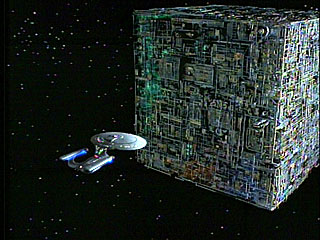
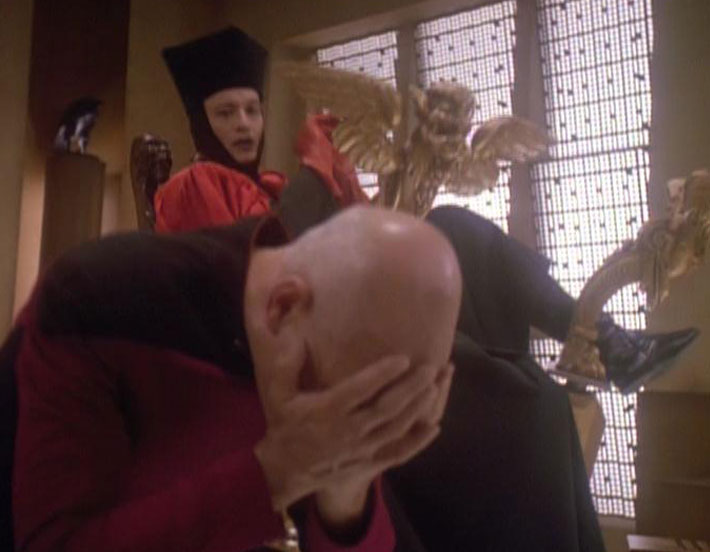

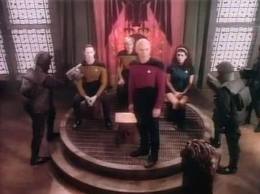
The first two pictures were of Borg Cubes from Star Trek. The next three pictures were from the Star Trek: The Next Generation episode Encounter at Farpoint (Episode 1, Season 1) – which I recommend watching (on Netflix) in order to see how much you agree with or disagree with the perspective of Q – traditionally a Star Trek villain. The court system pictured is also one from the Future, and could be the result of a society where the Internet and the Tribe have split.
Let’s get started.
The Internet is Changing the Way We Think (The Guardian)
American writer Nicholas Carr’s claim that the internet is not only shaping our lives but physically altering our brains has sparked a lively and ongoing debate, says John Naughton. Below, a selection of writers and experts offer their opinion
Every 50 years or so, American magazine the Atlantic lobs an intellectual grenade into our culture. In the summer of 1945, for example, it published an essay by the Massachusetts Institute of Technology (MIT) engineer Vannevar Bush entitled “As We May Think”. It turned out to be the blueprint for what eventually emerged as the world wide web. Two summers ago, the Atlantic published an essay by Nicholas Carr, one of the blogosphere’s most prominent (and thoughtful) contrarians, under the headline “Is Google Making Us Stupid?”.
Notice that analysts, much like prophets, are often accurate in their ability to predict future events. More on this is a bit.
“Over the past few years,” Carr wrote, “I’ve had an uncomfortable sense that someone, or something, has been tinkering with my brain, remapping the neural circuitry, reprogramming the memory. My mind isn’t going – so far as I can tell – but it’s changing. I’m not thinking the way I used to think. I can feel it most strongly when I’m reading. Immersing myself in a book or a lengthy article used to be easy. My mind would get caught up in the narrative or the turns of the argument and I’d spend hours strolling through long stretches of prose. That’s rarely the case anymore. Now my concentration often starts to drift after two or three pages. I get fidgety, lose the thread, begin looking for something else to do. I feel as if I’m always dragging my wayward brain back to the text. The deep reading that used to come naturally has become a struggle.”
The title of the essay is misleading, because Carr’s target was not really the world’s leading search engine, but the impact that ubiquitous, always-on networking is having on our cognitive processes.
I cannot explain it any better than Carr did in this narrative. But I can add some proof. ATS has a back-search engine that any of you reading this can use in order to check out threads from prior to 2005 by date, which was when Facebook came out on college campuses, and also when cell phones started to become more dominant.
On Sunday, April 6, 2008 Facebook Chat started. This marks a gigantic event in the increase of networking. It is also an interesting milestone to use when searching through ATS backlogs.
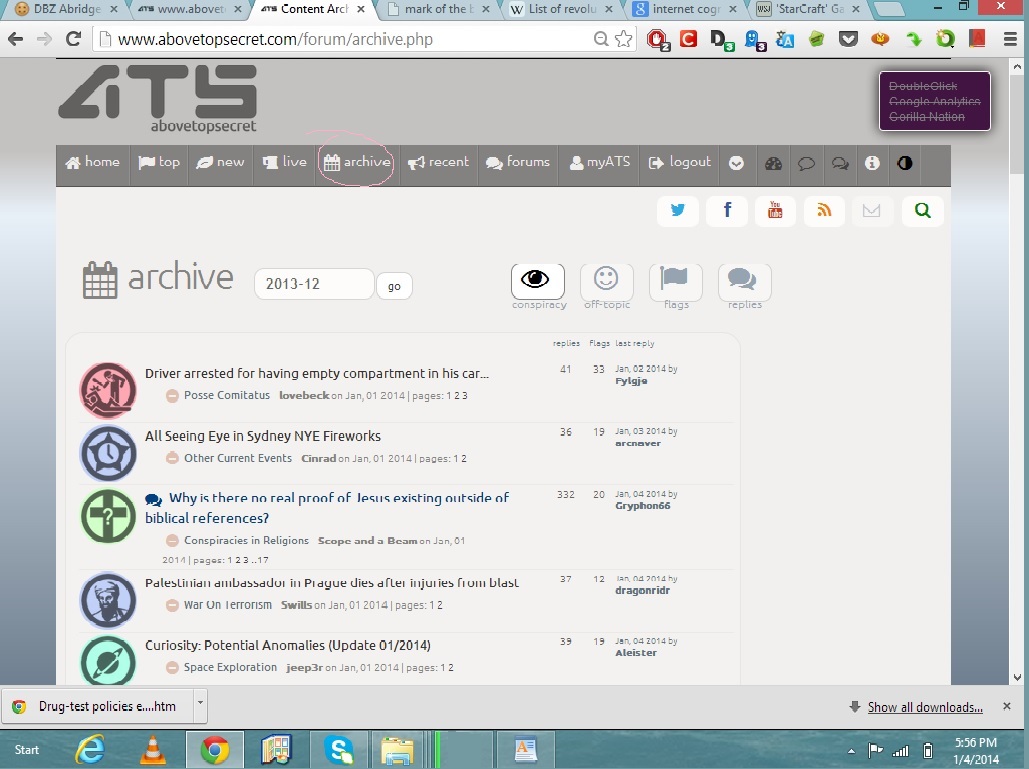
There is a picture to help you do it – I always have trouble finding it!
When you do, notice the difference in thinking processes of posters through their behavior, in fact, this is the only reason I’m having you do this -
Are their posts longer and more comprehensive or shorter and more likely to be one-liners not adding anything to the conversation now? How about in the past?
How much do the participants of the threads pay attention to each other in the past and present and integrate each others ideas into their own?
Has their ability to listen to each other increased or decreased? In what manners?
Has their intelligence increased or decreased? Can you identify specific intellectual traits that may have gone up or down?
Has hostility increased or decreased?
This is a way that all of you can personally participate in this thread in a hands-on manner and decide for yourselves through behavioral evidence right before your eyes – you can even look at your posts from the past and present if you wish, or of your friends to see – and figure out if you think the internet has caused a change in how people think and behave.
Carr argues that modern neuroscience, which has revealed the “plasticity” of the human brain, shows that our habitual practices can actually change our neuronal structures.
I can personally verify this statement. Let’s look at some other studies (faster now, need to be quick) but that article by The Guardian is pure gold. I’ll give you some more Gold.
Starcraft Gameplay Boosts Mental Flexibility: WSJ
Well let’s leave you all there for now – I am running out of characters – and when we return (after the break, at some point in the future) I will give you some more links regarding how the Internet and technology can affect how you and your friends and others think! Now that I posted that article, Gold is slacking… we need Di
edit on 04pmSat, 04 Jan 2014 20:15:56 -0600kbpmkAmerica/Chicago by darkbake because: (no reason given)

