Showing posts with label hamas. Show all posts

Tuesday, August 20, 2013

Cornered Hamas looks back at Iran, Hezbollah


The border area between Egypt and the southern Gaza Strip is seen in this general view August 19, 2013. REUTERS/Ibraheem Abu Mustafa

The border area between Egypt and the southern Gaza Strip is seen in this general view August 19, 2013.


Credit: Reuters/Ibraheem Abu Mustafa


GAZA | Tue Aug 20, 2013 7:24am EDT


GAZA (Reuters) – Stunned by turmoil in neighboring Egypt and starved of funds, the Palestinian Islamist group Hamas is looking to repair damaged ties with its traditional Middle East allies, Iran and the Lebanese Hezbollah party.


An off-shoot of the Muslim Brotherhood, Hamas celebrated when the Sunni movement’s Mohamed Mursi was elected president of Egypt in 2012, believing the vote would boost its own international standing and its grip on the isolated Gaza Strip.


In the meantime, outraged by the bloody civil war in Syria, the Palestinian group quit its headquarters in Damascus, snapping the Iran-led “axis of resistance” that challenged Israel and the West across the turbulent region.


Shi’ite Muslim Iran, which had for years supplied Hamas with cash and arms, was infuriated by what it saw as a betrayal of its close friend, Syrian President Bashar al-Assad, and drastically scaled back its support. Tehran’s Shi’ite partner, Hezbollah, also voiced its fierce disapproval.


But following the ousting of Mursi, removed by the Egyptian military on July 3, political sources said Hamas had had direct and indirect contacts with both Iran and Hezbollah — anxious to revitalize old alliances and restore its battered funding.


“Some meetings have taken place … to clear the air. There is no boycott (of Hamas) but at the same time, things have not yet got back to normal,” said a Palestinian official, with knowledge of discussions, who declined to be named.


Moussa Abu Marzouk, former deputy head of Hamas’s political office, saw Hezbollah and Iranian officials in Lebanon last month, with other meetings taking place subsequently.


“It is in the interest of Hamas today to revise its rapport with Iran and Hezbollah for many reasons,” said Hani Habib, a political analyst based in the Gaza Strip. “At the end of the day, all the parties have an interest in this partnership.”


SYRIA ROW


Locked in conflict with arch foe and neighbor Israel, which it refuses to recognize, Hamas has governed the small, densely populated Gaza Strip since 2007 after a brief civil war against its secular rivals.


With the Muslim Brotherhood in control of Egypt, Hamas felt it did not have to worry so much about its ties with Iran.


Hamas’s leader in exile, Khaled Meshaal abandoned his long-time base in Damascus last year because of the civil war that pitted President Assad’s forces, backed by reinforcements sent by both Iran and Hezbollah, against mainly Sunni rebels.


Shi’ite and Sunni are the main streams of Islam. There are differences in their interpretations of the Koran and some traditions. The majority of the world’s Muslims are Sunni.


One of the veteran leaders of Hamas, Mahmoud Al-Zahar, said there had never been a suspension of relations with Tehran and Hezbollah, suggesting that contacts may have slowed only because of the recent presidential election in Iran.


“We do not yet know the nature of Iran’s new policy, but the information we have received, which is not direct, suggests that the old policy will be endorsed by the new administration,” Zahar, a renowned hardliner, told Reuters in an interview.


Hamas hopes newly installed President Hassan Rouhani will open the financial taps again.


Diplomats estimated that Iran used to give Hamas some $ 250 million a year, but one Palestinian official reckoned that only 20 percent of that was now being handed over. Ehud Yaari, a Middle East expert from Israel, put the figure at just 15 percent, with no arms being offered up either.


“We have a situation of close to zero arms trafficking through the tunnels into Gaza,” said Yaari.


Very little material, weapons or otherwise, is passing at present through the smuggling tunnels that criss-cross the desert border between Egypt and Gaza, with the new rulers in Cairo ordering a clampdown following Mursi’s removal.


The army-backed government has accused Hamas of interfering in Egyptian affairs and suggested that Palestinians might be helping Islamist militants active in the Sinai peninsula.


The restrictions on the tunnels, which flourished thanks to an Israeli blockade on the coastal enclave, cost Gaza at least $ 230 million in July alone, said Hamas Economy Minister Ala Al-Rafati. But he rejected any suggestion of a financial crisis.


“There are some problems and they are being overcome,” he told Reuters on Monday, adding that the tunnel trade, which provides Hamas with a crucial source of tax income, had dropped some 60 percent since Mursi’s ousting.


In an additional blow, Hamas’s close ties with Qatar have also been dented this summer.


The emir of the energy-rich Gulf state visited Gaza last October promising millions of dollars of aid, but he abdicated in June and his heir has shown much less interest in Hamas.


PRIORITIES


In reaching out once more to Iran and Hezbollah, Hamas’s dilemma is as much ideological as political — how to balance its Sunni Muslim Brotherhood roots with its vital interests to forge partnerships with fellow enemies of Israel.


Leading a special prayer meeting on Friday for the souls of the “Egyptian martyrs”, the Hamas prime minister in Gaza, Ismail Haniyeh, made clear that the war with Israel took precedence.


“We understand that the priority of our resistance is to liberate the land, regain the rights and return the Palestinian people to the land they were forced out of,” said Haniyeh, the movement’s deputy chief.


“We have no military and no security role in Egypt or in the Sinai. Our military and security role is here, on the land of Palestine and against the Zionist enemy.”


Founded in 1988, Hamas has regularly squared off against Israel, most recently in November last year in an eight-day conflagration that killed at least 170 Palestinians and six Israelis. The truce was brokered by Mursi.


Israeli analyst Yaari thought Iran would exact a price for welcoming Hamas back into the fold. “It will require them to stop opposing Assad and stop any criticism of Hezbollah’s intervention (in Syria) and Iranian support of Assad,” he said.


Zahar, who lost two sons in the conflict against Israel in past years and carries great weight in the movement, has always sought to maintain good ties with Iran.


But he also says the organization, which is estimated to have around 30,000 well-equipped fighters, has survived difficult situations in the past when U.S.-backed strongman Hosni Mubarak ruled Egypt and kept Gaza in a vice.


“We became very strong in an era where the entire surrounding environment was hostile,” he said. “Our resistance relies mainly on God and also on its capabilities. History proved we have always emerged stronger every time.”


(Editing by Crispian Balmer and Anna Willard)


Reuters: Top News


Cornered Hamas looks back at Iran, Hezbollah

Friday, July 26, 2013

Ousted Egypt president detained over Hamas contact


Egyptian soldiers stand guard atop an armored personnel vehicle on a bridge that leads to Tahrir Square in Cairo, Egypt, Friday, July 26, 2013. Political allies of Egypt’s military lined up behind its call for huge rallies Friday to show support for the country’s top general, pushing toward a collision with Islamist opponents demanding the return of the nation’s ousted president, Mohammed Morsi. (AP Photo/Hassan Ammar)


Egyptian soldiers stand guard atop an armored personnel vehicle on a bridge that leads to Tahrir Square in Cairo, Egypt, Friday, July 26, 2013. Political allies of Egypt’s military lined up behind its call for huge rallies Friday to show support for the country’s top general, pushing toward a collision with Islamist opponents demanding the return of the nation’s ousted president, Mohammed Morsi. (AP Photo/Hassan Ammar)


A man waves Egyptian flags as he kneels on a bridge that leads to Tahrir Square in Cairo, Egypt, Friday, July 26, 2013. Political allies of Egypt’s military lined up behind its call for huge rallies Friday to show support for the country’s top general, pushing toward a collision with Islamist opponents demanding the return of Mohammed Morsi, the nation’s ousted president. (AP Photo/Hassan Ammar)


Buy AP Photo Reprints


(AP) — An investigating judge has ordered the detention of Egypt’s ousted president over alleged contacts with Hamas to help in his escape from prison in 2011, the official state news agency reported Friday in the first official word on his status since a military coup on July 3.


The MENA news agency said Mohammed Morsi has been detained for 15 days for investigation into the charges. His detention can be extended as the inquiry continues. The news agency indicated that Morsi has already been interrogated.


The announcement comes after military strongman Gen. Abdel-Fatah el-Sissi called for mass demonstrations Friday to oppose what he called “terrorism,” a clear reference to Morsi’s Muslim Brotherhood. The Brotherhood’s spiritual leader responded with a harsh denunciation of el-Sissi.


The Brotherhood also called for mass protests on Friday, escalating fears of clashes between the two opposing groups of demonstrators or with the military, which has pledged to keep order and prevent violence.


The case concerns the mass jailbreak of dozens of Muslim Brotherhood leaders during the popular uprising in 2011 that toppled Morsi’s predecessor, President Hosni Mubarak. There have been many reports in Egyptian media that the Brotherhood collaborated with Hamas, its Palestinian wing, and Hezbollah militants in Lebanon to arrange the breakout.


Muslim Brotherhood officials have said they were aided by local residents in breaking out of prison, not foreigners.


In Gaza, Hamas spokesman Sami Abu Zuhri condemned Morsi’s detention order. “The Egyptian decision is an attempt to drag Hamas into the Egyptian conflict,” he said. “We call on the Arab League to bear its responsibility in facing the incitement against Hamas.”


The Brotherhood has been demanding that Morsi, Egypt’s first freely elected president, be restored to power. The military moved against him after several days of widespread demonstrations, when millions turned out to demand his resignation after just one year in office.


Egypt’s military has been holding Morsi in an undisclosed location since deposing him on July 3. The MENA report did not indicate where Morsi is being held.


The MENA report said Morsi is being investigated over allegations of collaborating with Hamas “to carry out anti-state acts, attacking police stations, army officers and storming prisons, setting fire to one prison and enabling inmates to flee, including himself, as well as premeditated killing of officers , soldiers and prisoners.”


Islamists on Thursday lashed out at the military, saying el-Sissi’s call for mass demonstrations signals a plan to crush what they insist are their peaceful protests. The spiritual leader of the Brotherhood, Mohammed Badie, hiked up his rhetoric against el-Sissi, saying ousting Morsi was a worse crime than if the general had destroyed the Kaaba, Islam’s holiest site — an attempt to fire up the religious fervor in the pro-Morsi camp ahead of Friday’s rallies.


It was not clear what el-Sissi meant by seeking a mandate against violence — and how far the military would go. The most explosive move would be if troops were to eventually try to clear major Islamist sit-ins. The largest has been outside Cairo’s Rabaa al-Adawiya mosque, where crowds some nights have grown to tens of thousands.


A more limited move would be for troops to take tougher action against any sign of Morsi supporters engaged in violence. Some Islamist protesters have been seen with weapons — though their opponents have been as well, and each accuses the other of sparking clashes. Another possibility is that the military would detain Brotherhood and other Islamist leaders who already face arrest warrants.


On Thursday, military spokesman Col. Ahmed Mohammed Ali said el-Sissi’s call was “not a threat to any specific political group.” He said the military respects peaceful protests.


But he said any violence or terrorism will be “dealt with decisively and with force” — signaling a likely tough approach on any sign of violence, which Islamists’ opponents have largely blamed on the pro-Morsi camp.


He said a national reconciliation conference and a system of transitional justice, called for by military-backed interim President Adly Mansour, are the only way out of Egypt’s current standoff.


The military dropped leaflets on Morsi supporters outside the Rabaah al-Adawiya Mosque, trying to reassure them about their safety.


“We are not against you so don’t be against us. Don’t raise your weapons in the face of your brothers, don’t destroy, don’t burn, and let us all be together against killing, violence and terrorism,” the leaflets said.


___


Associated Press writer Mohammed Daraghmeh in Gaza City, Gaza Strip contributed to this report.


Associated Press


Top Headlines


Ousted Egypt president detained over Hamas contact

Ousted Egypt president detained over Hamas contact


Egyptian soldiers stand guard atop an armored personnel vehicle on a bridge that leads to Tahrir Square in Cairo, Egypt, Friday, July 26, 2013. Political allies of Egypt’s military lined up behind its call for huge rallies Friday to show support for the country’s top general, pushing toward a collision with Islamist opponents demanding the return of the nation’s ousted president, Mohammed Morsi. (AP Photo/Hassan Ammar)


Egyptian soldiers stand guard atop an armored personnel vehicle on a bridge that leads to Tahrir Square in Cairo, Egypt, Friday, July 26, 2013. Political allies of Egypt’s military lined up behind its call for huge rallies Friday to show support for the country’s top general, pushing toward a collision with Islamist opponents demanding the return of the nation’s ousted president, Mohammed Morsi. (AP Photo/Hassan Ammar)


A man waves Egyptian flags as he kneels on a bridge that leads to Tahrir Square in Cairo, Egypt, Friday, July 26, 2013. Political allies of Egypt’s military lined up behind its call for huge rallies Friday to show support for the country’s top general, pushing toward a collision with Islamist opponents demanding the return of Mohammed Morsi, the nation’s ousted president. (AP Photo/Hassan Ammar)


Buy AP Photo Reprints


(AP) — An investigating judge has ordered the detention of Egypt’s ousted president over alleged contacts with Hamas to help in his escape from prison in 2011, the official state news agency reported Friday in the first official word on his status since a military coup on July 3.


The MENA news agency said Mohammed Morsi has been detained for 15 days for investigation into the charges. His detention can be extended as the inquiry continues. The news agency indicated that Morsi has already been interrogated.


The announcement comes after military strongman Gen. Abdel-Fatah el-Sissi called for mass demonstrations Friday to oppose what he called “terrorism,” a clear reference to Morsi’s Muslim Brotherhood. The Brotherhood’s spiritual leader responded with a harsh denunciation of el-Sissi.


The Brotherhood also called for mass protests on Friday, escalating fears of clashes between the two opposing groups of demonstrators or with the military, which has pledged to keep order and prevent violence.


The case concerns the mass jailbreak of dozens of Muslim Brotherhood leaders during the popular uprising in 2011 that toppled Morsi’s predecessor, President Hosni Mubarak. There have been many reports in Egyptian media that the Brotherhood collaborated with Hamas, its Palestinian wing, and Hezbollah militants in Lebanon to arrange the breakout.


Muslim Brotherhood officials have said they were aided by local residents in breaking out of prison, not foreigners.


Egypt’s military has been holding Morsi in an undisclosed location since deposing him on July 3.


The MENA report said Morsi is being investigated over allegations of collaborating with Hamas “to carry out anti-state acts, attacking police stations, army officers and storming prisons, setting fire to one prison and enabling inmates to flee, including himself, as well as premeditated killing of officers , soldiers and prisoners.”


Islamists on Thursday lashed out at the military, saying el-Sissi’s call for mass demonstrations signals a plan to crush what they insist are their peaceful protests. The spiritual leader of the Brotherhood, Mohammed Badie, hiked up his rhetoric against el-Sissi, saying ousting Morsi was a worse crime than if the general had destroyed the Kaaba, Islam’s holiest site — an attempt to fire up the religious fervor in the pro-Morsi camp ahead of Friday’s rallies.


It was not clear what el-Sissi meant by seeking a mandate against violence — and how far the military would go. The most explosive move would be if troops were to eventually try to clear major Islamist sit-ins. The largest has been outside Cairo’s Rabaa al-Adawiya mosque, where crowds some nights have grown to tens of thousands.


A more limited move would be for troops to take tougher action against any sign of Morsi supporters engaged in violence. Some Islamist protesters have been seen with weapons — though their opponents have been as well, and each accuses the other of sparking clashes. Another possibility is that the military would detain Brotherhood and other Islamist leaders who already face arrest warrants.


On Thursday, military spokesman Col. Ahmed Mohammed Ali said el-Sissi’s call was “not a threat to any specific political group.” He said the military respects peaceful protests.


But he said any violence or terrorism will be “dealt with decisively and with force” — signaling a likely tough approach on any sign of violence, which Islamists’ opponents have largely blamed on the pro-Morsi camp.


He said a national reconciliation conference and a system of transitional justice, called for by military-backed interim President Adly Mansour, are the only way out of Egypt’s current standoff.


The military dropped leaflets on Morsi supporters outside the Rabaah al-Adawiya Mosque, trying to reassure them about their safety.


“We are not against you so don’t be against us. Don’t raise your weapons in the face of your brothers, don’t destroy, don’t burn, and let us all be together against killing, violence and terrorism,” the leaflets said.


Associated Press


Top Headlines


Ousted Egypt president detained over Hamas contact

Tuesday, June 4, 2013

In Gaza, Hamas Targets Palestinian Informants In Crackdown


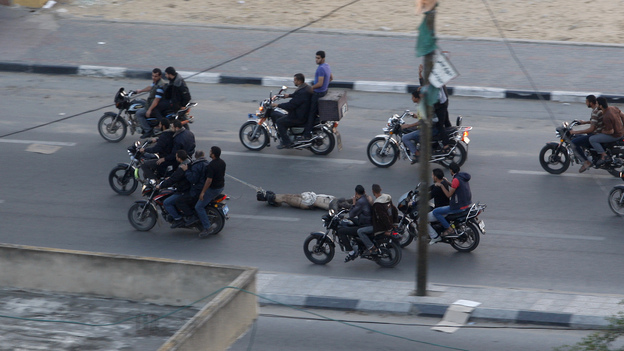
Palestinian gunmen drag a man from a motorcycle in Gaza City on Nov. 20. He was one of six men killed that day on suspicion of collaborating with Israel. The Hamas government in the Gaza Strip denied responsibility, though it has executed others judged to be working with Israel’s security forces.


Hatem Moussa/AP


Palestinian gunmen drag a man from a motorcycle in Gaza City on Nov. 20. He was one of six men killed that day on suspicion of collaborating with Israel. The Hamas government in the Gaza Strip denied responsibility, though it has executed others judged to be working with Israel’s security forces.


Hatem Moussa/AP


Life was already grim in the Gaza Strip when fighting raged between Israel and Hamas last November. Then Khulud Badawi got unexpected bad news about her husband.


“I was at home when my son came in and said, ‘Mom, they killed Dad.’ I said, ‘Who?’ He said, ‘Hamas.’ I asked him, ‘Where?’ He said, ‘Next to the gas station,’” she recalls.


Badawi’s husband, Ribhi Badawi, was in prison in Gaza City. He was supposed to go to court that day for a final appeal of charges that he had collaborated with Israel against Hamas, which runs the Gaza Strip.


But Ribhi Badawi was taken from prison and executed in public, along with five other inmates. They were all accused of being collaborators, or informants, working for Israel.


“In this case, what was remarkable was that these men were not executed in anything resembling legislative authority or the penal authority of the Hamas government, but by armed men,” says Sarah Leah Whitson, who directs the Middle East division of Human Rights Watch.


“How they managed to get these men out of prison, and then how they managed to shoot them dead in broad daylight and drag their corpses around the street is a very big question mark,” she adds.


Israel’s Informant Network


For decades, Israel’s security forces has relied heavily on Palestinian informants to track and keep tabs on wanted Palestinians. The standard practice is for Israel to pay the informants in exchange for the information. But if uncovered, the informants are treated as traitors to the Palestinian cause and can expect to face harsh judgment in the Palestinian courts, or in some cases, through vigilante justice.


Hamas, which has been in control of Gaza since 2007, has executed people judged to be collaborators. But in the six deaths last Nov. 20, the Hamas-run government said it was not responsible.


“What happened was against the law,” Islam Shawan, a spokesman for Gaza’s Interior Ministry, says. “We had a high-level committee investigate, and it handed down tough punishments to security officials who failed to do their jobs.”


Shawan won’t name names, give ranks or offer any other information, but he claims that four people working in the prison system were punished. One was fired, one was transferred, one was jailed and one lost any chance at promotions.


He has no progress to report on tracking down the people who actually did the killings, but he does claim progress in cracking down on collaboration.


Hamas’ Campaign Against Collaborators


Three months after those accused collaborators were killed, Hamas started an anti-collaboration campaign in Gaza.


TV ads played scary music with pictures of a young man being dragged to the gallows by Hamas security forces. The video storyline shows he was coerced into collaboration by doing things that could set him up for blackmail — drinking, taking drugs, searching for sex online.


Shawan says this campaign was aimed at everyone in Gaza.


“This was a national campaign — not just directed at collaborators,” he says. “It was designed to educate and protect society by showing people how Israelis recruit.”


People were offered a chance to turn themselves in. Shawan won’t say how many did, but claimed one example: an engineering student who allegedly gave Israel information about his neighbors, his professors and student politicians. The young man wasn’t punished, Shawan says, but quietly re-educated.


There was no “re-education” offered by Hamas in the case of Khulud Badawi’s husband, who was a member of a rival militant group.


“I don’t believe in this campaign,” she says. “My husband used to tell me that people who were collaborators would confess immediately, but people who weren’t would be tortured for months and never confess because they were innocent.”


Just last week, two accused spies were given death sentences, suggesting that tough punishment is just as important in Hamas’ efforts to crack down on collaboration as education and amnesty.


News


In Gaza, Hamas Targets Palestinian Informants In Crackdown