Showing posts with label Dakota. Show all posts

Friday, February 21, 2014

North and South Dakota Top List Of Happiest U.S. States, West Virginia At The Bottom


North and South Dakota Top List Of Happiest U.S. States, West Virginia At The Bottom


Nation


North Dakota was able to push out reigning “happiest state” Hawaii in an annual survey that measures Americans’ sense of well-being. West Virginia was revealed as the unhappiest state for the fifth year in a row.


North Dakota made the huge leap to first after coming in at number19 in the previous poll conducted by the Gallup-Healthways Well-Being Index. South Dakota came in a close second, moving up from 12th place, while Hawaii came in eighth after coming in first the previous five years.


West Virginia and Kentucky came in last and second to last, respectively.


The poll is based on more than 178,000 interviews of American adults in all 50 states between January and December 2013. The poll is an average score from six sub-indexes, which examine a person’s life evaluation, emotional health, work environment, physical health, healthy behaviors and basic access to necessities such as healthcare.


According to the poll, North Dakota ranked top in two sub-indexes: work environment and physical health.


A reason for this may because the state has experienced a job boom, according to Gallup.


Midwestern and Western states took up nine of the top ten highest well-being scores. Other states that join the Dakotas in the top ten happiest states are Nebraska, Minnesota, Montana, Vermont, Colorado, Hawaii, Washington and Iowa.


The South is highly represented in the bottom ten, which is made up of Louisiana, Oklahoma, Missouri, Tennessee, Arkansas, Ohio, Alabama, Mississippi, Kentucky and finally, West Virginia.


These regional patterns of well-being are aligned with previous years.


Residents in Kentucky and West Virginia reported poor physical health and low incomes.


The poll shows well-being has steadily increased in 11 states since 2010.


Sources: Healthways, Gallup


1


0


North and South Dakota Top List Of Happiest U.S. States, West Virginia At The Bottom

Saturday, November 16, 2013

Joan Jett switches from Macy"s South Dakota float after protest


A trade group for ranchers in South Dakota complained about Joan Jett


A trade group for ranchers in South Dakota complained about Joan Jett’s placement on the state’s float in the Macy’s Thanksgiving Day Parade.


  • NEW: Jett says she wants to be on another float because of “people’s political agendas”

  • Joan Jett & the Blackhearts are kicked off the float after cattlemen protest to Macy’s

  • “We were rightly concerned about her representing South Dakota,” ranchers’ rep says

  • Jett supports PETA, which says “the meat trade can’t stand any scrutiny of its cruelty”


(CNN) — Rock star Joan Jett was removed from a parade float representing South Dakota in the Macy’s Thanksgiving Day Parade after ranchers protested her appearance, saying she’s a vegetarian and a critic of their livestock production.


Jett is a supporter of People for the Ethic Treatment of Animals, the world’s largest animal rights group that promotes a vegetarian diet and condemns factory farms and ranches.


“I’ve decided to switch from South Dakota to another float because people’s political agendas were getting in the way of what should be a purely entertainment driven event,” Jett said in a statement Saturday. “I will remain focused on entertaining the millions of people watching, who will be celebrating a great American tradition.”


The trade group for ranchers in South Dakota complained about Jett’s placement on the state’s float, CNN affiliate KEVN reported.


“So, of course, when we learned that about Miss Jett, we were rightly concerned about her representing South Dakota and a state that is so heavily reliant on agriculture and livestock production to drive our economy,” Jodie Anderson of the South Dakota Cattlemen’s Association said, according to the station.


A Macy’s spokesman said Jett and her Blackhearts band will be moved to another float, and another undetermined performer will take Jett’s place on the South Dakota float, the affiliate said.


A PETA leader said the controversy reflected what the group deems as problems in the cattle industry.


“Thanks to South Dakota’s reactionary ranchers, people across the country have learned why Joan Jett supports PETA. The meat trade can’t stand any scrutiny of its cruelty,” PETA Senior Vice President Dan Mathews said in a statement.


CNN.com Recently Published/Updated


Joan Jett switches from Macy"s South Dakota float after protest

Saturday, October 5, 2013

Storm Brings Blizzard To Wyoming And South Dakota

Storm Brings Blizzard To Wyoming And South Dakota


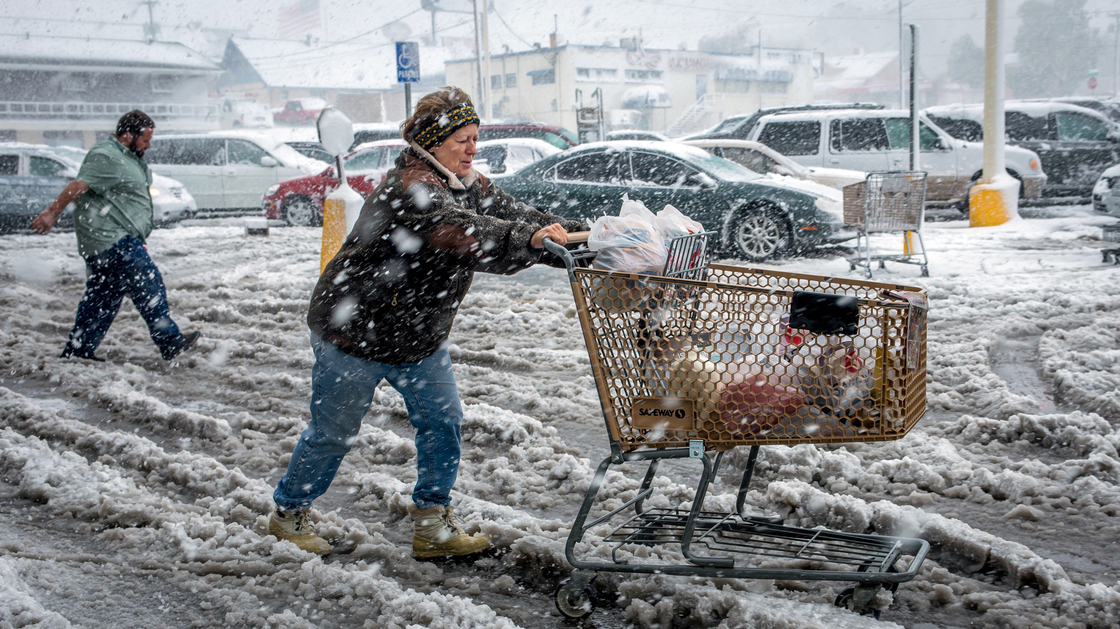
As snow fell in Rapid City, S.D., Friday Brenda Nolting took groceries to her car. An early snow storm swept through Wyoming and western South Dakota, dropping more than two fee of snow in some areas.


Steve McEnroe/AP

As snow fell in Rapid City, S.D., Friday Brenda Nolting took groceries to her car. An early snow storm swept through Wyoming and western South Dakota, dropping more than two fee of snow in some areas.


As snow fell in Rapid City, S.D., Friday Brenda Nolting took groceries to her car. An early snow storm swept through Wyoming and western South Dakota, dropping more than two fee of snow in some areas.


Steve McEnroe/AP


More than two feet of snow has crippled roadways in western South Dakota, the worst-hit target of a storm that brought snow to Wyoming and tornadoes to Nebraska Friday. Heavy snowfall and low visibility have combined to cause crashes and shut down roads.


“National Weather Service meteorologist Eric Helgeson says the system dumped 33 inches of wet, heavy snow five miles south-southwest of Lead by Friday afternoon,” the Rapid City Journal reports, describing an area in the Black Hills.


When the storm began to hit, nearly 9,000 people reported losing power, the newspaper reports. Many of those have since had electricity restored.


Many of the area’s highways and the interstate were closed early Friday, and state troopers performed sweeps of the roads to make sure people weren’t stranded. The conditions caused severe problems for motorists in Wyoming and South Dakota.


“Troopers have been going from one crash to the next,” Wyoming State Patrol Sgt. Stephen Townsend says. “As soon as we get the road cleared and get it open, it seems like it’s open for a very short time, and then we get a tangle of cars and a pileup, which closes the highway once again.”


Ahead of the snowfall, the system brought thunderstorms and sparked tornadoes.


“Wayne, Neb., saw some of the greatest damage from tornadoes where at least four homes were destroyed in the town of 9,600,” the AP reports.


As of Saturday morning, blizzard conditions were still being reported near Badlands National Park. That’s according to the National Weather Service’s office in Rapid City, S.D., where officials say 19 inches of snow fell east of the city Friday — a new record.


The weather service, which is operating despite a federal shutdown that has closed other agencies, reports a risk of severe thunderstorms Saturday as the storm system continues to move eastward, affecting a swath of the U.S. from Wisconsin down to northern Arkansas.


News


Storm Brings Blizzard To Wyoming And South Dakota

Saturday, August 3, 2013

Flaring Lights Up North Dakota


By Kieran Cooke, Climate News Network


This piece first appeared at Climate News Network.


LONDON—Flaring of gas associated with oil production has long been a contentious issue: it not only releases millions of tons of harmful greenhouse gas into the atmosphere but it’s also a chronic waste of a valuable energy resource.


Considerable progress has been made over recent years in reducing flaring: the World Bank estimates that between 2005 and 2011 there was a 20% drop in flaring worldwide. But in North Dakota, one of the pivotal regions driving the boom in US shale oil and gas production, flaring is very much in fashion.


A new report says flaring in North Dakota – now visible from space – has doubled over the past two years, with gas worth approximately $ 1 bn literally going up in smoke in 2012.


“Over the course of 2012, natural gas flaring in North Dakota emitted 4.5 million metric tons of carbon dioxide, equivalent to the annual emissions of approximately one million cars”, say the report’s authors.


The report, Flaring Up, is produced by Ceres, a US organisation promoting more sustainable business practices. It says nearly 30% of North Dakota gas is at present being burned off each month as a byproduct of oil production: as a result, the US has now joined Russia, Nigeria and Iraq among the world’s top 10 flaring countries.


North Dakota, a predominantly farming area and traditionally one of the less developed regions in the US, has seen its economic fortunes radically change in recent years.


Technological advances such as directional drilling and hydraulic fracturing – or fracking – have unlocked vast deposits of shale gas and oil in the Bakken area in the state’s north-west. Early last year North Dakota surpassed Alaska to become the second largest oil-producing state in the US – after Texas.


Oil production has multiplied 40 times since 2007, with production rising from 18,500 barrels per day (bpd) to 760,000 bpd. North Dakota’s economy is now growing far faster than anywhere else in the US: the population – and the crime rate – are also on the up.


The report gives two main reasons for the upsurge in flaring. As oil commands a far higher price than gas, companies investing in shale-based energy focus on oil.


$ 25 billion up in smoke


“A large differential between the prices for oil and gas acts as a deterrent for developers to invest capital in natural gas utilization”, says the study.


Also, natural gas needs its own infrastructure in order to be collected and put on the market. Gas pipelines and other facilities are undeveloped in North Dakota compared with other gas-producing states.


And North Dakota’s flaring regulations are unusually permissive, says the report, when compared with other resource-rich states such as Texas, California or Alaska.


“In the absence of a strong regulatory framework that prohibits flaring, companies working with a limited amount of capital (which is to say all companies) have a strong incentive to put their capital toward oil production, given its higher return relative to natural gas.”


Some exploration companies, pressured by investors worried about both the environmental and financial impact of flaring, have agreed to limit or stop burning off gas.


A recent rise in natural gas prices might give an incentive to build the necessary infrastructure for capturing gas. Yet the emphasis is still very much on exploiting far more financially attractive oil resources.


The World Bank estimates that flaring around the world accounts for the release of 400 million tons of CO2 each year. The World Petroleum Council says the amount of gas flared annually is worth about $ 25 bn in energy terms and is equivalent in volume to approximately 5% of total global natural gas production.


cmakin (CC BY-SA 2.0)


RINF Alternative News & Alternative Media Breaking Real News


Flaring Lights Up North Dakota