Showing posts with label display. Show all posts

Friday, March 7, 2014

Atheists demand display of Nothing next to Ground Zero cross

At Hey WTF? News, the privacy of our visitors is of extreme importance to us (See this article to learn more about Privacy Policies.). This privacy policy document outlines the types of personal information is received and collected by Hey WTF? News and how it is used.

Log Files

Like many other Web sites, Hey WTF? News makes use of log files. The information inside the log files includes internet protocol (IP) addresses, type of browser, Internet Service Provider (ISP), date/time stamp, referring/exit pages, and number of clicks to analyze trends, administer the site, track user"s movement around the site, and gather demographic information. IP addresses, and other such information are not linked to any information that is personally identifiable.

Cookies and Web Beacons

Hey WTF? News does use cookies to store information about visitors preferences, record user-specific information on which pages the user access or visit, customize Web page content based on visitors browser type or other information that the visitor sends via their browser.

DoubleClick DART Cookie

  • Google, as a third party vendor, uses cookies to serve ads on Hey WTF? News.
  • Google"s use of the DART cookie enables it to serve ads to users based on their visit to Hey WTF? News and other sites on the Internet.
  • Users may opt out of the use of the DART cookie by visiting the Google ad and content network privacy policy at the following URL - http://www.google.com/privacy_ads.html.

These third-party ad servers or ad networks use technology to the advertisements and links that appear on Hey WTF? News send directly to your browsers. They automatically receive your IP address when this occurs. Other technologies ( such as cookies, JavaScript, or Web Beacons ) may also be used by the third-party ad networks to measure the effectiveness of their advertisements and / or to personalize the advertising content that you see.

Hey WTF? News has no access to or control over these cookies that are used by third-party advertisers.

You should consult the respective privacy policies of these third-party ad servers for more detailed information on their practices as well as for instructions about how to opt-out of certain practices. Hey WTF? News"s privacy policy does not apply to, and we cannot control the activities of, such other advertisers or web sites.

If you wish to disable cookies, you may do so through your individual browser options. More detailed information about cookie management with specific web browsers can be found at the browser"s respective websites.


Atheists demand display of Nothing next to Ground Zero cross

Monday, January 20, 2014

LG’s Curved Display G Flex Smartphone Will Go Up For AT&T Pre-Order On January 24

At Not Just The News, the privacy of our visitors is of extreme importance to us (See this article to learn more about Privacy Policies.). This privacy policy document outlines the types of personal information is received and collected by Not Just The News and how it is used.


Log Files


Like many other Web sites, Not Just The News makes use of log files. The information inside the log files includes internet protocol (IP) addresses, type of browser, Internet Service Provider (ISP), date/time stamp, referring/exit pages, and number of clicks to analyze trends, administer the site, track user"s movement around the site, and gather demographic information. IP addresses, and other such information are not linked to any information that is personally identifiable.


Cookies and Web Beacons


Not Just The News does use cookies to store information about visitors preferences, record user-specific information on which pages the user access or visit, customize Web page content based on visitors browser type or other information that the visitor sends via their browser.


DoubleClick DART Cookie


  • Google, as a third party vendor, uses cookies to serve ads on Not Just The News.

  • Google"s use of the DART cookie enables it to serve ads to users based on their visit to Not Just The News and other sites on the Internet.

  • Users may opt out of the use of the DART cookie by visiting the Google ad and content network privacy policy at the following URL - http://www.google.com/privacy_ads.html.

These third-party ad servers or ad networks use technology to the advertisements and links that appear on Not Just The News send directly to your browsers. They automatically receive your IP address when this occurs. Other technologies ( such as cookies, JavaScript, or Web Beacons ) may also be used by the third-party ad networks to measure the effectiveness of their advertisements and / or to personalize the advertising content that you see.


Not Just The News has no access to or control over these cookies that are used by third-party advertisers.


You should consult the respective privacy policies of these third-party ad servers for more detailed information on their practices as well as for instructions about how to opt-out of certain practices. Not Just The News"s privacy policy does not apply to, and we cannot control the activities of, such other advertisers or web sites.


If you wish to disable cookies, you may do so through your individual browser options. More detailed information about cookie management with specific web browsers can be found at the browser"s respective websites.


LG’s Curved Display G Flex Smartphone Will Go Up For AT&T Pre-Order On January 24

Sunday, November 24, 2013

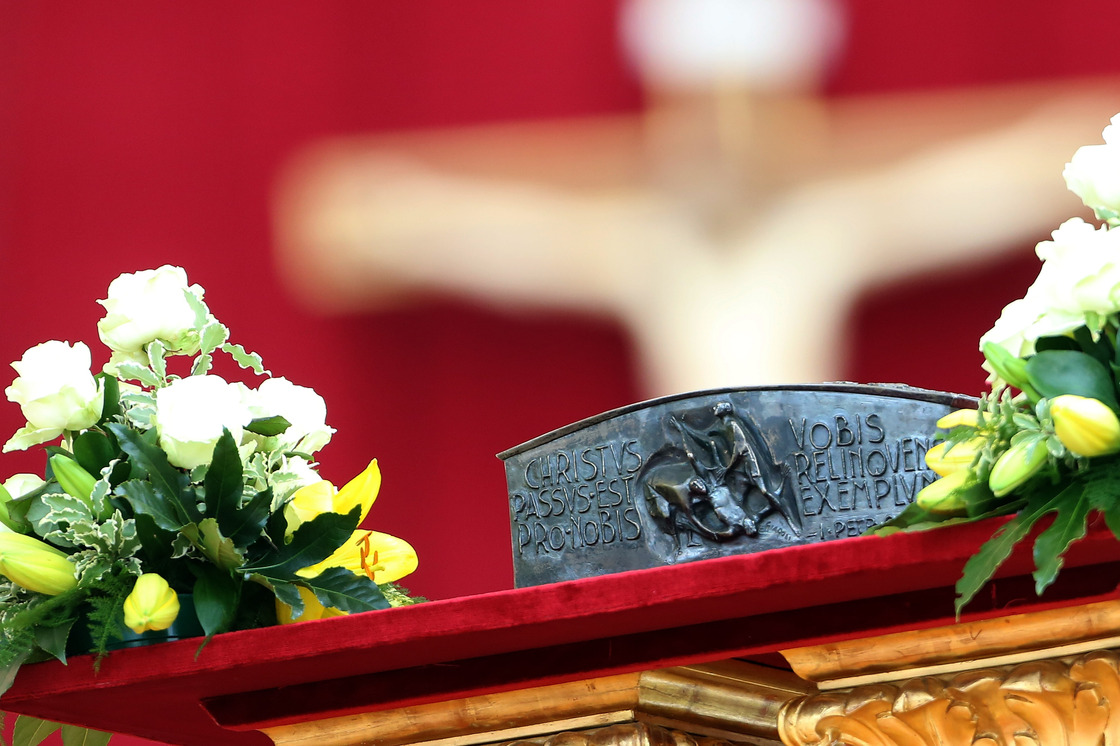
Vatican Puts St. Peter"s Bones On Display For The First Time

Vatican Puts St. Peter"s Bones On Display For The First Time
http://isbigbrotherwatchingyou.com/wp-content/uploads/2013/11/f761f__451692507_custom-8fc78516eb8518e162e8f57b10cdfeec245762f0-s6-c30.jpg


In the Vatican today, a surreal scene:


That’s Pope Francis, the 266th Bishop of Rome, holding what the church believes are the bone fragments of St. Peter, the apostle and the first bishop of Rome.


For the first time in nearly 2,000 years, relics of St. Peter the apostle (fragments of bone) are displayed for veneration.


Franco Origlia/Getty Images

For the first time in nearly 2,000 years, relics of St. Peter the apostle (fragments of bone) are displayed for veneration.


For the first time in nearly 2,000 years, relics of St. Peter the apostle (fragments of bone) are displayed for veneration.


Franco Origlia/Getty Images


Pope Francis cradled the relics during a mass at St. Peter’s Square, which marked the end of the global church’s Year of Faith. It was also the first time the Catholic Church has displayed the relics in public.


The Guardian reports there is much mystery and intrigue concerning the eight pieces of bone. No pope has ever definitively said the bones are the remains of St. Peter, but in 1968 Pope Paul VI said the bones found underneath St. Peter’s Basilica in the Vatican had been “identified in a way that we can consider convincing.”


The AP reports that archaeologists dispute the finding.


But the story is still alluring. The Guardian bases its story on The Ears of the Vatican, the 2012 book by Bruno Bartoloni. According to the book, the relics were discovered in 1939, as archaeologists were excavating in the grottoes of St. Peter’s Basilica to bury Pope Pius XI.


As they worked, they discovered a casket with an engraving in Greek that read, “Peter is here.”


The Guardian continues:


“The scholar of Greek antiquities Margherita Guarducci, who had deciphered the engraving, continued to investigate and learned that one of the basilica workers had been given the remains found inside the casket and stored them in a shoe box kept in a cupboard. She reported her findings to Paul VI, who later proclaimed there was a convincing argument that the bones belonged to Peter.


“Leading Vatican Jesuits and other archaeologists strongly denied the claim, but had little recourse.


“‘No pope had ever permitted an exhaustive study, partly because a 1,000-year-old curse attested by secret and apocalyptic documents, threatened anyone who disturbed the peace of Peter’s tomb with the worst possible misfortune,’ Bartoloni wrote.”


Rocco Palmo, who runs Whispers in the Loggia, the blog of record on the Vatican, writes that today’s mass brings to an end what’s been an extraordinary “year of faith” for the church in an extraordinarily surreal way.


During the past year, Palmo explains, we saw the first papal resignation since the 14th Century and then the College of Cardinals chose the first pope “from outside Europe in over a millennium.”


News


Read more about Vatican Puts St. Peter"s Bones On Display For The First Time and other interesting subjects concerning NSA at TheDailyNewsReport.com

Thursday, October 31, 2013

Bahrain police close art display on pro-democracy uprising


Friday, October 25, 2013

Bill would require all Pennsylvania public schools to display ‘In God we trust’ motto


By Travis Gettys
Friday, October 25, 2013 11:34 EDT


in_god_we_trust.istock


  • Print Friendly and PDF

  • Email this page


  • Pennsylvania lawmakers will consider a bill that would require all public schools in the state to display the national motto, “In God we trust.”


    Republican Rick Saccone, who represents parts of Allegheny and Washington counties, said the bill he’s sponsoring would celebrate the 150th anniversary of the U.S. Mint printing the motto on American currency.


    Saccone also said former Pennsylvania Gov. James Pollock suggested the motto to President Abraham Lincoln, with whom he’d shared a boarding house when both men were freshman congressmen, after he was appointed director of the U.S. Mint.


    “Pollock suggested we put ‘In God we trust’ on the coins,” Saccone said. “The treasury secretary and Abe agreed, and Congress agreed, so it became law to put that on our coins in 1864.”


    According to the U.S. Treasury, it was another Pennsylvanian, the Rev. M. R. Watkinson, who suggested a religious-themed motto, to “relieve us from the ignominy of heathenism,” and Treasury Secretary Salmon P. Chase directed Pollock to come up with one that reflected Americans’ “trust in God.”


    The eventual phrase apparently originated in one of the less-frequently sung verses of “The Star-Spangled Banner,” written during the War of 1812 and named as the U.S. national anthem by a 1931 congressional resolution.


    Saccone admitted the law would likely be challenged in court, but he wasn’t worried it’d be struck down.


    “It’s already settled that that is acceptable,” Saccone said. “It is our national motto by law, passed by Congress — unanimously by the way — signed into law by President Eisenhower, and reaffirmed by several Congresses after that. People will challenge anything, but we should celebrate it. It’s already been upheld.”


    The bill would require public schools to display the motto but doesn’t list any consequences for schools that don’t comply.


    As atheist activist and scientist Richard Dawkins noted in a recent interview, the motto is frequently cited as proof that the U.S. is a Christian nation.


    The Raw StoryPost id = does not exist.


    Bill would require all Pennsylvania public schools to display ‘In God we trust’ motto

Wednesday, September 25, 2013

Samsung to Unveil Smartphone With Curved Display


Samsung said Wednesday it would unveil a smartphone with a curved display in October — a technological innovation aimed at maintaining its lead in a lucrative but increasingly saturated market.


Curved displays are at a nascent stage in display technology which is shifting towards flexible panels that are bendable or can even be rolled or folded.


“We will introduce a smartphone with a curved display in October,” Samsung mobile business head of strategic marketing D.J. Lee told reporters.


He declined to give more details.


Samsung — the world’s top maker of smartphones and TVs — unveiled prototype products with a flexible screen in January.


But it still faces a major challenge in making other handset components — such as batteries — that can bend with the rest of the unit.


Curved displays are already commercially available in large-screen televisions offered by companies including Samsung and LG.


The displays are supposed to offer a more immersive viewing experience but are significantly more expensive than standard screens.


In another attempt to break new ground, Samsung unveiled earlier this month a smartwatch called Galaxy Gear, which can take photos and videos, make or take phone calls, or check e-mails.


Wearable computing, including Google’s smart glasses, is considered the next frontier in consumer electronics following smartphones.


The watch received some scathing reviews, along with complaints that it only worked in conjunction with Samsung’s latest oversized smartphone, the Galaxy Note III.


The Gear and the Galaxy Note III will hit stores in some 140 nations by the end of October, and Samsung executives said they were confident the critics could be won over.


“We received so much criticism when we first unveiled the Galaxy Note series…but it has created a whole new market segment for oversized smartphones,” said Lee Young-Hee, executive vice president of Samsung’s mobile unit.


D.J. Lee said the watch would be made connectable with other Samsung devices such as the flagship Galaxy S3 and S4 smartphones by the end of December.


jhw/gh


© AFP 2013


Newsmax – America


Samsung to Unveil Smartphone With Curved Display

Wednesday, August 7, 2013

Dolphins display memory better than elephants


This Oct. 3, 2012, photo provided by the Brookfield Zoo, shows the dolphin Allie at the zoo in Brookfield, Ill. Dolphins can swim circles around them elephants when it comes to long term memory. Scientists in a new study repeatedly found dolphins can remember the distinctive whistle _ which acts as a name to the marine mammal _ of another dolphin they haven’t seen in two decades. Bailey the dolphin hadn’t seen another dolphin named Allie since the two juveniles lived together at the Dolphin Connection in the Florida Keys. Allie landed up in a Chicago area zoo, while Bailey got moved to Bermuda. Yet 20.5 years later, Bailey recognized and reacted to Allie’s distinctive signal when University of Chicago researcher Jason Bruck played it on a speaker. (AP Photo/Brookfield Zoo, Jim Schultz)


This Oct. 3, 2012, photo provided by the Brookfield Zoo, shows the dolphin Allie at the zoo in Brookfield, Ill. Dolphins can swim circles around them elephants when it comes to long term memory. Scientists in a new study repeatedly found dolphins can remember the distinctive whistle _ which acts as a name to the marine mammal _ of another dolphin they haven’t seen in two decades. Bailey the dolphin hadn’t seen another dolphin named Allie since the two juveniles lived together at the Dolphin Connection in the Florida Keys. Allie landed up in a Chicago area zoo, while Bailey got moved to Bermuda. Yet 20.5 years later, Bailey recognized and reacted to Allie’s distinctive signal when University of Chicago researcher Jason Bruck played it on a speaker. (AP Photo/Brookfield Zoo, Jim Schultz)


Buy AP Photo Reprints


(AP) — Forget elephants. Dolphins can swim circles around them when it comes to long-term memory.


Scientists in a new study repeatedly found that dolphins can remember the distinctive whistle — which acts as a name to the marine mammal — of another dolphin they haven’t seen in two decades.


Bailey the dolphin hadn’t seen another dolphin named Allie since the two juveniles lived together at the Dolphin Connection in the Florida Keys. Allie ended up in a Chicago area zoo, while Bailey got moved to Bermuda. Yet 20 1/2 years later, Bailey recognized and reacted to Allie’s distinctive signal when University of Chicago researcher Jason Bruck played it on a speaker.


Other dolphins had similar steel-trap memories. And it’s not just for relatives. It’s non-kin too.


“It’s mind-blowing; I know I can’t do it,” Bruck says. “Dolphins in fact have the longest social memory in all of the animal kingdom because their signature whistle doesn’t change.”


Studies have shown that monkeys can remember things for about four years and anecdotes have elephants remembering for about 10, Bruck says in a paper published Wednesday by Proceedings of the Royal Society B. But remembering just a sound — no visuals were included — boggles even human minds, he says.


For Bruck, 33, it’s as if a long-lost classmate from middle school called him up and Bruck would be able to figure out who it was just from the voice.


Faces, yes, yearbook pictures, definitely, but voices that change with time, no way, Bruck says.


“We’re not as acoustically as adept as dolphins,” Bruck says. It helps that dolphins have massive parts of the brain that are geared toward sound.


Bruck thinks dolphins have the incredible memory because it could help them when they approach new dolphins on a potential group hunt. And even more likely it probably allows dolphins to avoid others that had mistreated them in the past or dominated them, he says.


Male dolphins had a slightly better memory than females and that’s likely a case of worrying about dominance. Some males would hear Lucky or Hastings, dominant males, that they hadn’t heard in years and they’d react by going into an aggressive S-posture or screaming their own signatures, Bruck says.


Outside dolphin researchers praised the work, saying the next effort is to see whether somehow the dolphins visualize their old buddies when they hear the whistle. Bruck says he is working on that.


“The study raises some very interesting questions and hints at the wider importance of long-term social memory in nonhuman mammals and suggests there are strong parallels between dolphin and human social recognition,” said dolphin researcher Stephanie King at the University of St. Andrews in Scotland.


___


Follow Seth Borenstein on Twitter at http://twitter.com/borenbears


Associated Press


Politics Headlines


Dolphins display memory better than elephants

Wednesday, May 8, 2013

Texas judge rules that cheerleaders may display Bible banners


SAN ANTONIO | Wed May 8, 2013 6:58pm EDT


SAN ANTONIO (Reuters) – A Texas judge on Wednesday ruled that the “Bible banners” waved by cheerleaders during football games in a small school district are constitutionally protected free speech and that the tradition will be allowed to continue.


No law “prohibits the cheerleaders from using religious-themed banners at school sporting events,” State District Judge Steven Thomas wrote in a two-page final ruling. He had temporarily ruled in favor of the cheerleaders in October.


For generations it has been a tradition in Kountze, a town of 2,100 in the Piney Woods of east Texas, for cheerleaders to write Bible verses and religious messages – such as, “If God is with us, who can be against us?” – on large sheets of paper. The football players run through the banners when they take the field for home games.


The Freedom From Religion Foundation, a Wisconsin-based group that promotes the separation of church and state, sent the Kountze superintendent a letter last fall, complaining that the banners were a violation of the Establishment Clause of the U.S. Constitution’s First Amendment, which states that the government “shall make no law respecting an establishment of religion.”


When the district tried to block the use of the banners in response to the group’s letter, the Texas-based Liberty Institute, a group that says it is “dedicated to defending religious liberty in America,” sued the school district on behalf of the cheerleaders.


“This is a victory for students across the country,” Liberty Institute General Counsel Jeff Mateer said of the ruling. “The message that this decision sends is it is impermissible for the government to ban the private speech of students.”


Annie Laurie Gaylor, co-president of the Freedom From Religion Foundation, called the ruling “outrageous.”


“The cheerleaders represent the school,” she said. “When they misuse their public podium to tell a captive audience that some of you have the right religion and the rest of you need to convert, that is not only bad law, that’s bad manners.”


The judge ruled that the messages on the banners “have not created, and will not create, an establishment of religion in the Kountze community.”


Gaylor said she expects the case to move to federal court.


“We are hoping that students, parents, and faculty members will come forward when this practice continues and we will be able to sue in federal court where this case really belongs,” she said.


Texas Governor Rick Perry celebrated the ruling in a statement on Wednesday.


“Today’s ruling is a win for free speech and religious freedom,” Perry said. “The Kountze High School cheerleaders showed great resolve and maturity beyond their years in standing up for their beliefs and constitutional rights.”


(Editing by Corrie MacLaggan and Steve Orlofsky)


Reuters: Oddly Enough


Texas judge rules that cheerleaders may display Bible banners