Showing posts with label Hawk. Show all posts

Thursday, October 3, 2013

US Teams Up With Japan to Spy on China With Global Hawk Drones

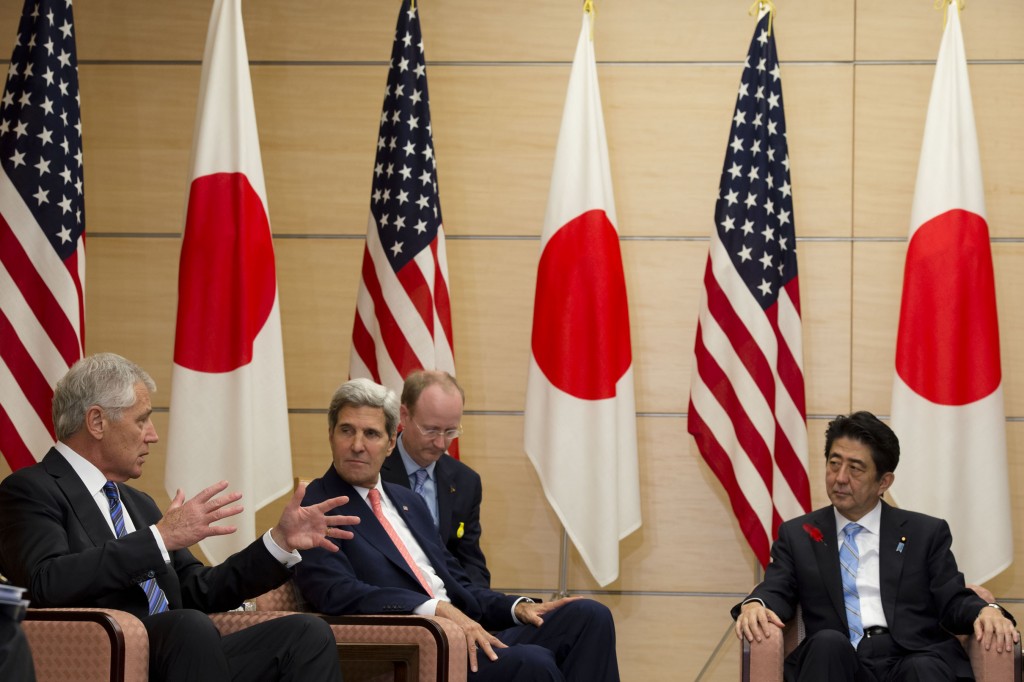
131003-D-BW835-1320


The U.S. has just announced a deal with Japan that will allow basing rights for surveillance drones. Oh and the Pentagon swears their purpose is to surveil North Korea. Really, they promise. China? What’s a China?


“The primary mission for the Global Hawks will be to fly near North Korea, where U.S. officials hope they will greatly enhance the current spying capabilities,” reports the Washington Post. Maybe – perhaps – an unintended side benefit to the drone missions will be to coordinate with Japan on “ the movements of Chinese ships in the vicinity.”


You can bet Beijing won’t see North Korea as the primary target for the U.S. spy drones. In recent weeks, the Japanese Defense Ministry has indicated a strong interest in obtaining drones for themselves in order to spy on and respond to Chinese military movements in and around the disputed maritime territory of the Senkaku/Diayou islands, currently the most intense point of tension between Japan and China.


Immediately following these indications, Secretary of State John Kerry and Secretary of Defense Chuck Hagel visit with their Japanese counterparts and secure a deal to allow the U.S. to base its own drones on Japanese territory and take care Japanese defense for them. It’s a win for the U.S. in that it mitigates the Japanese desire to obtain its own drones, a privileged capability that gives the U.S. an edge, and it maintains U.S. military autonomy in Japan at a time when tensions with China have influenced Tokyo towards beefing up its long-dormant national security state.


But it’s not exactly a win for regional security. The U.S. has been antagonizing China by militarily encircling the rising Asian power and reaffirming defense agreements with all of China’s neighboring rivals, Japan foremost among them. A new scheme to increase spying on Chinese military movements in its own backyard is not going to go over well with Beijing.


“The presence of Global Hawks in East Asia is sure to irritate China, which has become increasingly vocal in pushing back against the U.S. military presence in the region,” the  Washington Post reports. “Officials in Beijing had criticized Tokyo in recent days for reports that the Japanese military was considering acquiring its own Global Hawks, saying the introduction of the drones could escalate tensions.”


U.S. policy could easily exacerbate Sino-Japanese tensions and prompt a very dangerous escalation. “My biggest fear is that a small mishap is going to blow up into something much bigger,” says Elizabeth C. Economy of the Council on Foreign Relations.


“If there is a use of force between Japan and China,” warns Sheila A. Smith, also of CFR, “this could be all-out conflict between these two Asian giants. And as a treaty ally of Japan, it will automatically involve the United States.”


And for what? To contain China’s increasing global power? The U.S. can’t stop that train, which is fueled by their growing economy and increased defense budgets, short of all-out war.


Really, the U.S. should just mind its own business instead of trying to dictate China’s behavior in a desperate attempt to hold on to world hegemony.


Micah Zenko, a fellow at the Council on Foreign Relations, provides the following anecdote to sum up the hypcritical U.S. position on China:


Secretary of Defense Chuck Hagel declared at the Shangri-La Dialogue in Singapore earlier this year, “The United States stands firmly against any coercive attempts to alter the status quo.” Similarly, Hagel’s deputy, Ashton Carter, noted in reference to the Asia-Pacific, “We oppose provocation. We oppose coercion. We oppose the use of force,” adding a U.S. preference for “peaceful resolution of disputes in a manner consistent with international law.” Of course, resorting to coercion and the use of force to change the status quo are defining characteristics of U.S. foreign policy, and — as the reactions to Syria demonstrate — they are widely embraced among pundits and officials. The defining questions of East Asian relations in the coming decades is whether China emulates the U.S. military by embracing coercion, or follows U.S. guidelines as to how local disputes should be resolved.


Do as we see, not as we do. Follow our orders, or prepare for aggression.


Not exactly a constructive approach.


Antiwar.com Blog


US Teams Up With Japan to Spy on China With Global Hawk Drones

US Teams Up With Japan to Spy on China With Global Hawk Drones


131003-D-BW835-1320


The U.S. has just announced a deal with Japan that will allow basing rights for surveillance drones. Oh and the Pentagon swears their purpose is to surveil North Korea. Really, they promise. China? What’s a China?


“The primary mission for the Global Hawks will be to fly near North Korea, where U.S. officials hope they will greatly enhance the current spying capabilities,” reports the Washington Post. Maybe – perhaps – an unintended side benefit to the drone missions will be to coordinate with Japan on “ the movements of Chinese ships in the vicinity.”


You can bet Beijing won’t see North Korea as the primary target for the U.S. spy drones. In recent weeks, the Japanese Defense Ministry has indicated a strong interest in obtaining drones for themselves in order to spy on and respond to Chinese military movements in and around the disputed maritime territory of the Senkaku/Diayou islands, currently the most intense point of tension between Japan and China.


Immediately following these indications, Secretary of State John Kerry and Secretary of Defense Chuck Hagel visit with their Japanese counterparts and secure a deal to allow the U.S. to base its own drones on Japanese territory and take care Japanese defense for them. It’s a win for the U.S. in that it mitigates the Japanese desire to obtain its own drones, a privileged capability that gives the U.S. an edge, and it maintains U.S. military autonomy in Japan at a time when tensions with China have influenced Tokyo towards beefing up its long-dormant national security state.


But it’s not exactly a win for regional security. The U.S. has been antagonizing China by militarily encircling the rising Asian power and reaffirming defense agreements with all of China’s neighboring rivals, Japan foremost among them. A new scheme to increase spying on Chinese military movements in its own backyard is not going to go over well with Beijing.


“The presence of Global Hawks in East Asia is sure to irritate China, which has become increasingly vocal in pushing back against the U.S. military presence in the region,” the  Washington Post reports. “Officials in Beijing had criticized Tokyo in recent days for reports that the Japanese military was considering acquiring its own Global Hawks, saying the introduction of the drones could escalate tensions.”


U.S. policy could easily exacerbate Sino-Japanese tensions and prompt a very dangerous escalation. “My biggest fear is that a small mishap is going to blow up into something much bigger,” says Elizabeth C. Economy of the Council on Foreign Relations.


“If there is a use of force between Japan and China,” warns Sheila A. Smith, also of CFR, “this could be all-out conflict between these two Asian giants. And as a treaty ally of Japan, it will automatically involve the United States.”


And for what? To contain China’s increasing global power? The U.S. can’t stop that train, which is fueled by their growing economy and increased defense budgets, short of all-out war.


Really, the U.S. should just mind its own business instead of trying to dictate China’s behavior in a desperate attempt to hold on to world hegemony.


Micah Zenko, a fellow at the Council on Foreign Relations, provides the following anecdote to sum up the hypcritical U.S. position on China:


Secretary of Defense Chuck Hagel declared at the Shangri-La Dialogue in Singapore earlier this year, “The United States stands firmly against any coercive attempts to alter the status quo.” Similarly, Hagel’s deputy, Ashton Carter, noted in reference to the Asia-Pacific, “We oppose provocation. We oppose coercion. We oppose the use of force,” adding a U.S. preference for “peaceful resolution of disputes in a manner consistent with international law.” Of course, resorting to coercion and the use of force to change the status quo are defining characteristics of U.S. foreign policy, and — as the reactions to Syria demonstrate — they are widely embraced among pundits and officials. The defining questions of East Asian relations in the coming decades is whether China emulates the U.S. military by embracing coercion, or follows U.S. guidelines as to how local disputes should be resolved.


Do as we see, not as we do. Follow our orders, or prepare for aggression.


Not exactly a constructive approach.


Antiwar.com Blog


US Teams Up With Japan to Spy on China With Global Hawk Drones

Thursday, August 15, 2013

Did You Know the Deficit Is Shrinking? Most Americans Don"t, Thanks to Shameless Deficit Hawk Propaganda


The deficit is down 37.6 percent for the first 10 months of 2013. But half of Americans think it’s growing.


Remember all those deficit hawks who screamed that the federal deficit is spiraling out of control and must be stopped with spending cuts that have a funny way of hurting the pocketbooks of the most vulnerable Americans? Their excuse for ripping us off has been literally disappearing, but a new Google survey shows that not only do the vast majority Americans not know it — half of the public actually believes that the deficit is growing.


Here are the facts: The U.S. budget deficit has been shrinking at a rapid rate over the last few months. The deficit peaked at 10.2 percent of GDP in 2009, but over the past four quarters, it has shrunk to a mere 4.2 percent of GDP. What’s more, the Congressional Budget Office predicts that the deficit will fall to 2.1 percent of GDP in 2015.


Why such a disconnect? Unfortunately, disgraceful propaganda has left the public misinformed and confused.


Over in Economic Wonderland, the deficit hawk duo of Alan Simpson and Erksine Bowles have made a second career over the last several years wildly exaggerating the deficit issue and scaring Americans into thinking that deep cuts in the federal budget were necessary for the economy. The reality was just the opposite. If these two had ever sat down to read John Maynard Keynes, whose work is vital to understanding how to respond to economic crises, they would have known that cutting the federal budget when the economy is weak actually slows it down even more.  Yet to this day, Simpson and Bowles continue waging battle for a “grand bargain” that would shred the social safety net and cost many Americans their jobs by requiring trillions of dollars to be cut from the federal budget over ten years. All in the name of a “problem” that doesn’t even exist.


Deficit hawks like Simpson and Bowles, and their grand funder, hedge fund billionaire Pete Peterson, go on promoting the nonsense that the deficit is the major economic problem of 2013 despite the obvious facts and a growing consensus from economists that such a claim is utterly absurd. Incredibly, they do it even after the faulty work they relied on to make their case – a paper produced by two Harvard economists, Carmen Reinhart and Kenneth Rogoff – was discredited by a mere grad student in one of the great academic revelations of our time. Even conservative economists are bowing to reality. The folks over at the conservative American Enterprise Institute, for example, have come to the conclusion that austerity is a terrible idea and that without proper stimulus, the U.S. economy would look a lot more like Europe’s, where individual countries without sovereign currency have been forced to go the austerity route. It’s getting increasingly hard to deny that things have gotten pretty ugly over there because of deficit hawks and their ilk.


But deficit hawks are paid well to misinform the public. They write reports. They get corporate honchos to help them run campaigns with innocent-sounding names like “Fix the Debt.” They build websites. They write articles. They hold conferences. They pay off think tanks – even progressive ones – to play ball with them.  And the corporate dominated major media frequently is happy to play along.On it goes, until the lies repeated to the public take on the ring of truth.


So it’s no surprise that the public is not aware of the important news that the deficit is shrinking. Or that it is shrinking precisely for the reason progressive economists have been saying all along. When you have a recession, you have to juice the economy through government investment. That, in turn, reaps you the benefit of more money in people’s pockets, which leads to more jobs, more tax revenue for the government, and less reliance on social safety net programs like unemployment insurance or food stamps. If the original stimulus package had been bigger, the deficit would have shrunk even faster.


The deficit hawks have been more than spectacularly wrong. They have impacted policy in a way that turned the attention of Washington away from what it should have been focused on all along – jobs. Instead of a deficit commission, Obama should have called for a jobs commission to address the fact that hard-working people have not been able to find jobs to feed their families because of a Wall Street-driven financial crisis.


One might hope that the reality emerging will help squelch the calls to recklessly cut government investment in the economy. But there’s a big problem: Deficit lies benefit the 1 percent in the short-run. Rather than shrinking the deficit, what the short-sighted, greedy rich in America really want to shrink is their tax liabilities, which is why they don’t want to pay for things like education, infrastructure, and social safety net programs that benefit the population and ultimately help keep the economy humming.  The financiers among them would also dearly like to privatize things like Social Security so that they can collect fees on American retirement accounts. The corporate honchos like the way austerity drives up unemployment and drives down wages because they hold the mistaken view that keeping workers stressed and vulnerable is good for their bottom line. They want people like Larry Summers to head the Federal Reserve, who, while in the White House as the president’s chief economic adviser , famously presided over a stimulus program many economists warned was way too small.


In the fall, will deficit hawks in Congress manage once again to hold the American economy hostage? Or will reality finally rear its head? Facts have a tough time competing with well-funded mythology.


Related Stories


AlterNet.org Main RSS Feed


Did You Know the Deficit Is Shrinking? Most Americans Don"t, Thanks to Shameless Deficit Hawk Propaganda