Conservative radio host Glenn Beck on Tuesday accused celebrity scientist Bill Nye of trying to silence the teaching of creationism as science just like the Catholic Church had tried to deny that the Earth was not the center of the Universe by imprisoning Galileo.
In a short video posted to YouTube last year, Nye had called on parents to stop teaching their children to deny evolution.
“And I say to the grownups, if you want to deny evolution and live in your world, in your world that’s completely inconsistent with everything we observe in the universe, that’s fine, but don’t make your kids do it because we need them,” Nye said. “We need scientifically literate voters and taxpayers for the future. We need people that can—we need engineers that can build stuff, solve problems.”
On his Tuesday Internet broadcast, Beck said that Nye was one of the voices who want to “segregate an entire group of people.”
“How’s he going to look?” he asked. “Is he going to look like the people who threw Galileo up?”
Beck added that former Vice President Al Gore was going to “look like the biggest joke in the world” 30 years from now because of his belief in climate change.
“Because they’re not having an open debate, they’re forcing it on people,” Beck insisted. “We can debate it. I’ve even said, if you don’t look at the thermometer, you’re an idiot.”
“But if you don’t buy into it every step of the way, well then, you’re a holocaust denier.”
The Sunday Assembly has been franchising their program around the world. Now their first atheist Martin Luther has arrived, and he says that the Sunday Assembly has a problem with atheism.
The world’s most voguish – though not its only – atheist church opened last year in London, to global attention and abundant acclaim.
So popular was the premise, so bright the promise, that soon the Sunday Assembly was ready to franchise, branching out into cities such as New York, Dublin and Melbourne.
“It’s a way to scale goodness,” declared Sanderson Jones, a standup comic and co-founder of The Sunday Assembly, which calls itself a “godless congregation.”
But nearly as quickly as the Assembly spread, it split, with New York City emerging as organized atheism’s Avignon.
In October, three former members of Sunday Assembly NYC announced the formation of a breakaway group called Godless Revival.
“The Sunday Assembly,” wrote Godless Revival founder Lee Moore in a scathing blog post, “has a problem with atheism.”
Moore alleges that, among other things, Jones advised the NYC group to “boycott the word atheism” and “not to have speakers from the atheist community.” It also wanted the New York branch to host Assembly services in a churchlike setting, instead of the Manhattan dive bar where it was launched.
Jones denies ordering the NYC chapter to do away with the word “atheism,” but acknowledges telling the group “not to cater solely to atheists.” He also said he advised them to leave the dive bar “where women wore bikinis,” in favor of a more family-friendly venue.
At Not Just The News, the privacy of our visitors is of extreme importance to us (See this article to learn more about Privacy Policies.). This privacy policy document outlines the types of personal information is received and collected by Not Just The News and how it is used.
Log Files
Like many other Web sites, Not Just The News makes use of log files. The information inside the log files includes internet protocol (IP) addresses, type of browser, Internet Service Provider (ISP), date/time stamp, referring/exit pages, and number of clicks to analyze trends, administer the site, track user"s movement around the site, and gather demographic information. IP addresses, and other such information are not linked to any information that is personally identifiable.
Cookies and Web Beacons
Not Just The News does use cookies to store information about visitors preferences, record user-specific information on which pages the user access or visit, customize Web page content based on visitors browser type or other information that the visitor sends via their browser.
DoubleClick DART Cookie
Google, as a third party vendor, uses cookies to serve ads on Not Just The News.
Google"s use of the DART cookie enables it to serve ads to users based on their visit to Not Just The News and other sites on the Internet.
Users may opt out of the use of the DART cookie by visiting the Google ad and content network privacy policy at the following URL - http://www.google.com/privacy_ads.html.
These third-party ad servers or ad networks use technology to the advertisements and links that appear on Not Just The News send directly to your browsers. They automatically receive your IP address when this occurs. Other technologies ( such as cookies, JavaScript, or Web Beacons ) may also be used by the third-party ad networks to measure the effectiveness of their advertisements and / or to personalize the advertising content that you see.
Not Just The News has no access to or control over these cookies that are used by third-party advertisers.
You should consult the respective privacy policies of these third-party ad servers for more detailed information on their practices as well as for instructions about how to opt-out of certain practices. Not Just The News"s privacy policy does not apply to, and we cannot control the activities of, such other advertisers or web sites.
If you wish to disable cookies, you may do so through your individual browser options. More detailed information about cookie management with specific web browsers can be found at the browser"s respective websites.
(Newser) – The Catholic Church may be “pro-traditional marriage,” but it’s “not anti-anybody,” Cardinal Timothy Dolan said today on NBC’s Meet the Press. The church has simply “been out-marketed” when it comes to the issue of gay marriage, and “caricatured as being anti-gay,” the Archbishop of New York continued. “When you have forces like Hollywood, when you have forces like politicians, when you have forces like some opinion-molders that are behind it, it’s a tough battle.” Elsewhere on the Sunday dial, per Politico:
Dolan also said the Church could have been a “cheerleader” for ObamaCare, seeing as Catholic bishops are “for universal, comprehensive, life-affirming healthcare.” The problem? The Affordable Care Act “isn’t comprehensive, because it’s excluding the undocumented immigrant and it’s excluding the unborn baby.”
Speaking of ObamaCare, Rep. Mike Rogers said on the same program that Healthcare.gov’s security standards show a “sheer level of incompetence.” Specifically, he claimed, “The security of this site and the private information does not meet even the minimal standards of the private sector.”
On ABC’s This Week, former National Security Adviser Tom Donilon weighed in on the Iran nuclear deal (“a very solid achievement”) and Afghan President Hamid Karzai’s refusal to sign the US-Afghan security agreement (“reckless”).
And on CNN’s State of the Union, Howard Dean and Rick Santorum sparred over ObamaCare. At one point, Santorum asked, “Is the president competent to do his job?” and Dean responded that though ObamaCare is not “ideal,” “I fail to see how it has anything to do with the president’s competence. I lose my patience with this nonsense.”
As Christmas approaches, conservative Christians must once again witness an attack on the true meaning of the Holiday as leftists redefine the season in secular terms. Former Alaska Gov. Sarah Palin addressed this trend, along with its underlying causes, during a recent speech at a dinner hosted by the Iowa Faith and Freedom Coalition.
Citing an ever-present “War on Christmas,” Palin identified the “politically correct police out there” as the group responsible. Though the ongoing fight against the Christian Holiday is an affront to believers across the nation, she cautioned it is merely a “symptom of a bigger issue.”
While it is obvious leftists take issue with faith in God of the Holy Bible, she pointed out the hypocrisy with which they show unwavering faith in the state.
She called out the “scrooges who are too enlightened for religion,” marveling at the fact the same activists show “zealot-like faith in the church of big government.”
Exploring the topic further, Palin explained why putting faith in a frequently fallible federal bureaucracy is detrimental for the future of this nation. Primarily, she explained, the government does not deserve the people’s trust because “it does not have faith in us.”
Furthermore, while its proponents claim the “best and brightest” minds are working in the public sector, Palin pointed out numerous recent examples of spectacular governmental failure or corruption.
Scandals involving ObamaCare, the National Security Agency, and the administration’s politicization of last month’s government shutdown prove Washington, D.C., is not the benevolent force many on the left claim.
“We’re not wards of state,” she said, “but free men and women who can live good lives without D.C.’s appointed best and brightest telling us what to do.”
Her most pointed indictment of this culture came when she called out the “immoral and unscrupulous” politicians able to work at cross purposes with the American public due to the complacency of a “lapdog media.”
Too many elected officials are “enriching themselves and their cronies while their nation goes bankrupt,” she said, which amounts to nothing less than “dictatorship.”
The left routinely mocks and disparages Sarah Palin, along with a few other outspoken conservatives, in an effort to discredit her strong defense of conservatism. Her ability to plainly address the virtues of individual liberty and limited government make her a constant threat to the progressive power structure.
–B. Christopher Agee
Have an idea for a story? Email us at tips@westernjournalism.com
Please share this post with your friends and comment below. If you haven’t already, take a moment to sign up for our free newsletter above and friend us on Twitter and Facebook to get real time updates.
VATICAN CITY (Reuters) – The Vatican officially declared its intention to defeat the Church of England on Tuesday – not in a theological re-match nearly 500 years after they split, but on the cricket pitch.
The challenge was launched at the baptism of the St. Peter’s Cricket Club.
Vatican officials said the league will be composed of teams of priests and seminarians from Catholic colleges and seminaries in Rome.
The seminaries and religious colleges will play each other in a “Twenty20″ tournament, where games last about three hours.
After that, the best players will form a Vatican team, which will be called the “Vatican XI,” and challenge the Church of England to form its own team of Anglican priests and seminarians to play in London at Lord’s, the home of cricket.
“The Vatican team will be able to play anybody in the world. We hope to see a Vatican team playing at Lord’s,” said Alfonso Jayarajah, a Sri Lankan who was the first captain of the Italian national team and a board member of St. Peter’s Cricket Club.
“We hope to have ecumenical dialogue through cricket and play a Church of England side by September,” said Father Theodore Mascarenhas, an Indian official at the Vatican’s Council for Culture, who once played as an off-spin bowler.
The idea for a Catholic cricket club was the brainchild of John McCarthy, Australia’s ambassador to the Vatican. He wanted to see something similar to the Clericus Cup, a soccer tournament among the religious colleges and seminaries of Rome.
He enlisted the support of other diplomats and prelates from what he called “other cricket countries” – including Britain, South Africa and Pakistan – and found “anonymous sponsors from the cricketing world”.
In response to a suggestion that cricketing terms and field positions might be translated into Latin or Italian, McCarthy was firm: “English is the language of cricket and will remain the language of cricket”.
The Vatican team will wear the official colors of the tiny city-state – yellow and white – and their jackets will have the seal of the papacy, two crossed keys.
By all accounts Pope Francis is not much of a cricket man. He still supports the San Lorenzo football club of his native Buenos Aires.
But Mascarenhas, the Indian priest who is the chairman of the St. Peter’s Cricket Club said: “I am sure that cricket will be another thing that he accepts as part of his openness.”
(Reporting By Philip Pullella, editing by Paul Casciato and Ron Askew)
By David Edwards Monday, October 21, 2013 11:39 EDT
A Catholic church in North Carolina is refusing to host an interfaith Thanksgiving worship service after finding out that a gay man in a same sex marriage would be participating as music director.
The Charlotte Observerreported that St. Matthew Catholic Church in Ballanytne had dropped its plans to host Mecklenburg Ministries’ 38th annual Thanksgiving Interfaith Service because event planners had requested that Steav Bates-Congdon, music director at St. Paul’s Episcopal Church in Fort Mill, be invited to participate.
And this is not the first time that Bates-Congdon and St. Matthew have crossed paths: He served as the music director at the church until 2012, when he was fired for marrying his longtime partner Bill.
“At the heart of our core values is honoring the dignity of all people and not excluding anyone,” Mecklenburg Ministries board member Rev. Christy Snow told The Charlotte Observer.
Bates-Congdon, who is expected to sing and conduct one of the musical selections, called Mecklenburg Ministries “heroes” for taking a stand.
“Mecklenburg Ministries refused to let me stay home for Thanksgiving,” he said.
The 38th annual Thanksgiving Interfaith Service will be held at Covenant Presbyterian Church in Dilworth on Nov. 26.
Watch this video from WSOC, broadcast Feb. 11, 2012.
VATICAN CITY (Reuters) – A Roman Catholic bishop under fire for spending some 31 million euros ($ 42 million) on an ultra-luxurious residence should examine his conscience over the crisis he has caused, the head of Germany’s bishops said on Monday.
Bishop Franz-Peter Tebartz-van Elst of Limburg in western Germany has stirred anger and calls for his resignation among German Catholics and media over huge cost overruns on his residence at a time when Pope Francis is stressing humility and serving the poor.
“I am convinced that the bishop of Limburg… will confront this situation in a spirit of self-criticism,” Archbishop Robert Zollitsch, head of the German bishops’ conference, told a news conference at the Vatican.
Zollitsch, one of the highest ranking figures in the Roman Catholic Church in Germany, will discuss the crisis this week with Pope Francis, who early in his pontificate renounced the papal apartments for a simple residence.
Tebartz-van Elst flew to Rome at the weekend but his whereabouts are unknown. It was not clear whether he would also meet the pope, who has called for a more austere Church and has told bishops not to live like princes.
Speaking at a previously scheduled news conference not related to events in Germany, Zollitsch said he viewed the Limburg situation “with great attention and great concern”.
Zollitsch said the German Church would “have to draw the consequences” of the scandal that is shaking it, adding that he had sent the pope a dossier.
The German media has dubbed Tebartz-van Elst “the luxury bishop” after an initial audit of his spending, ordered after a Vatican monitor visited Limburg last month, revealed the project cost at least 31 million euros, six times more than planned.
Tebartz-van Elst, whose baroque style was more in line with the conservative model of Roman Catholicism projected by retired German-born Pope Benedict, has also been accused by German magistrates of lying under oath about a first-class flight to visit poverty programs in India.
The “luxury bishop” story has become front-page news in Germany, deeply embarrassing a Church enjoying an upswing thanks to Pope Francis’s popularity after years of criticism for hiding sexual abuse cases among clergy.
German media, citing official documents, said the residence had been fitted with a free-standing bath that cost 15,000 euros, a conference table that cost 25,000 euros and a private chapel that cost 2.9 million euros. ($ 1 = 0.7373 euros)
(Additional reporting by Alexandra Hudson and Stephen Brown in Germany and Tom Heneghan in Paris; Editing by Gareth Jones)
1 of 2. A man cries at the death of his brother at the site of a suicide blast at a church in Peshawar, September 22, 2013.
Credit: Reuters/Fayaz Aziz
By Fayaz Aziz
PESHAWAR, Pakistan | Sun Sep 22, 2013 7:15am EDT
PESHAWAR, Pakistan (Reuters) – A pair of suicide bombers blew themselves up outside a 130-year-old church in Pakistan after Sunday Mass, killing at least 56 people in the deadliest attack on Christians in the predominantly Muslim South Asian country.
Religious violence and attacks on security forces have been on the rise in Pakistan in past months, undermining Prime Minister Nawaz Sharif’s efforts to tame the insurgency after coming to power in June.
The attackers struck the historic white-stone All Saints Church in the north-western city of Peshawar just as hundreds of parishioners streamed out of the building after Sunday mass.
“I heard two explosions. People started to run. Human remains were strewn all over the church,” said one parishioner, who only gave her first name, Margrette.
Her voice breaking with emotion, she said she had not seen her sister since the explosions ripped through the gate area outside the church.
Christians make up about four percent of Pakistan’s population of 180 million and tend to keep a low profile in a country where Sunni Muslim militants frequently bomb targets they see as heretical, including Christians, Sufis and Shi’ites.
Attacks on Christian areas occur sporadically around the country but Sunday’s assault was the most violent in recent history.
In 2009, 40 houses and a church were set ablaze by a mob of 1,000 Muslims in the town of Gojra in Punjab province. At least seven Christians were burnt to death. Seventeen Christians were killed in an attack on a church in Bahawalpur in 2001.
Najeeb Bogvi, a senior police officer, put the death toll from Sunday’s attack at 56, saying more than 100 people were wounded. Police said the death toll included many children and women.
No one immediately claimed responsibility for the attack in the densely populated Christian residential area in the old walled city in Peshawar.
ANGRY RESIDENTS
Some residents, enraged at the lack of adequate security at the church, took to the streets immediately after the attack, burning tires and shouting slogans. Shops were closed in the Kohati Gate area where several other churches are located.
“Terrorists have not spared mosques, temples and churches. Please have mercy on us,” one man outside the church, his face distorted by fear and anger, told Pakistan’s private Geo television channel.
Protests by Christians were also reported in other cities including the violent port city of Karachi.
A bomb disposal security source said there were two explosions carried out by a pair of attackers. More than 600 parishioners were inside the church for the service.
Pakistan, which also faces a Taliban insurgency, is one of the most dangerous countries in the world for minorities, and Christians, Shi’ite Muslims and Ahmadis are victims of a rising tide of deadly violence.
Sunday’s attacks could complicate efforts by Sharif to engage militants in peace negotiations at a time when roadside bombs, targeted killings and suicide attacks continue unabated.
“The Prime Minister said that terrorists have no religion and targeting innocent people is against the teachings of Islam and all religions,” his office said in a statement.
“He added that such cruel acts of terrorism reflect the brutality and inhumane mind set of the terrorists.”
(Writing by Maria Golovnina; additional reporting by Hameedullah Khan and Syed Raza Hassan; Editing by Nick Macfie)
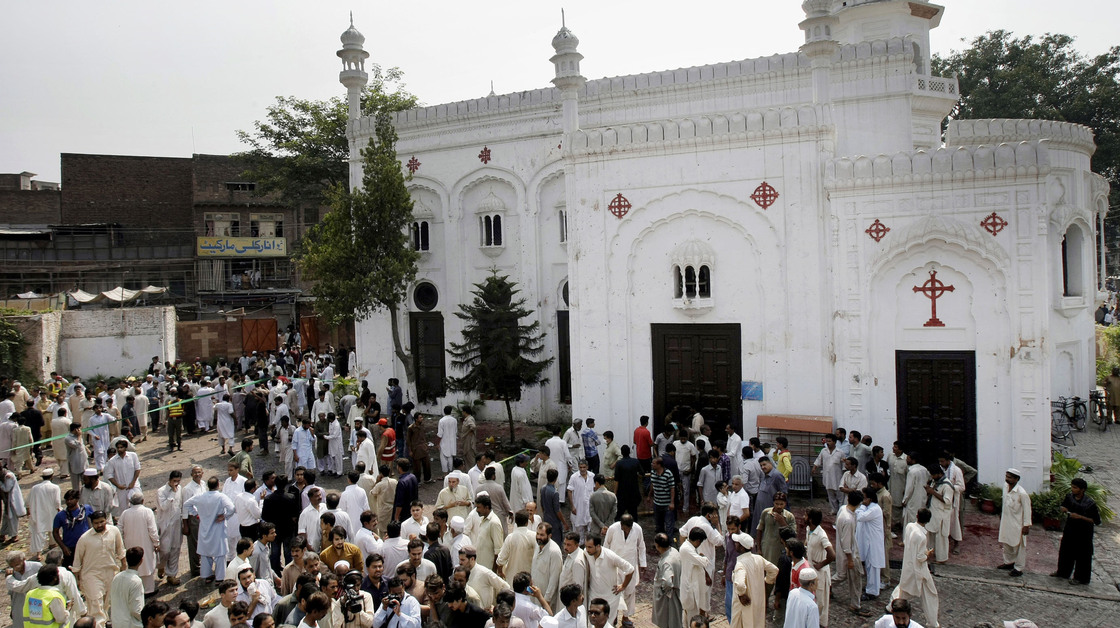
People gather outside All Saints Church in Peshawar, Pakistan, Sunday, after a suicide bombing attack killed scores of people earlier in the day, officials said.
Mohammad Sajjad/AP
People gather outside All Saints Church in Peshawar, Pakistan, Sunday, after a suicide bombing attack killed scores of people earlier in the day, officials said.
Mohammad Sajjad/AP
Two suicide bombers struck the All Saints Church following a service in Peshawar, Pakistan, Sunday, killing more than 70 people and wounding more than 120, according to the AP and other news outlets. The victims are believed to include many children.
The church’s bishop, Rev. Humphrey S. Peters, issued a statement in which he condemned the violence and expressed his condolences to those affected by the attack, which officials say is one of the deadliest ever conducted against Pakistan’s Christian minority.
“A wing of the Pakistani Taliban claimed responsibility for the bombing,” the AP reports, “saying it would continue to target non-Muslims until the United States stopped drone attacks in the country’s remote tribal region.”
The All Saints church website describes the violence, saying, “As the Sunday Service ended and the people came out of the Church, two suicide bombers entered the church compound from the main gate and blew themselves up in the midst of the people.”
The site added, “According to those we have spoken to, among the dead were a number of Sunday School children and Choir members of the Church who were all in the Church compound at the moment of the blasts.”
Dating from the 1880s, All Saints Church is famed for its architecture that echoes elements of a Saracenic Muslim mosque. Sunday’s deadly attack sparked protests in other Pakistani cities, with demonstrators calling for violence against Christians to cease.
The attack comes one day after Pakistan released a prisoner who was a high-ranking member of the Taliban in Afghanistan, where officials say he could play a pivotal role in the peace process. Mullah Abdul Ghani Baradar was formerly the Taliban’s second-in-command.
“The Afghan government welcomes Pakistan’s decision to release Mullah Baradar,” said Afghan presidential spokesman Aimal Faizi, according to Reuters. “This release has occurred because of the Afghan government’s consistent pressure requesting that Mullah Baradar be set free,”
The attack occurred as worshipers left the All Saints Church in the old quarter of the regional capital, Peshawar, after a service on Sunday morning. Up to 600 worshipers had attended the service and were leaving to receive free food being distributed on the lawn outside when two explosions ripped through the crowd.
Dozens of people were killed and more than 100 wounded, said Akhtar Ali Shah, the home secretary of Khyber Pakhtunkhwa Province.
The death toll continued to rise as rescue workers sifted through the damaged church property, said Hamid Ullah, a rescue worker with Al Khidmat Foundation, a rescue service operated by the Jamaat-e-Islami political party. He said his team had recovered 75 bodies.
The dead included women, children and two Muslim police officers who had been posted outside the church. Witness reported scenes of mayhem as rescue workers ferried victims from the church, which witnesses said was scattered with body parts, shrapnel and bloodied clothing.
On Sunday afternoon, the bodies of 45 victims were placed in coffins and moved to the nearby Saint John’s Church, the oldest church in the city.
The coffins were placed next to one another in the church playground as dozens of grieving relatives and mourners gathered around. The mood was somber and angry.
A large contingent of police officers was deployed outside the church, and mourners were allowed to enter the compound after a thorough security check. Ambulances were allowed to enter the compound one by one as dead bodies were then placed in vehicles to take them to the morgue.
The police said it was not clear whether the attack was the work of a lone attacker or of two suicide bombers. Muhammad Ilyas, a senior officer in Peshawar, said it was more likely that a lone suicide bomber had first thrown a hand grenade before detonating his explosives.
“As soon as the service finished and the food was being distributed, all of a sudden we heard one explosion, followed by another,” said Azim Ghori, a witness.
It was the worst attack in years on the Christian minority in Pakistan, and coincides with a broader wave of attacks on religious minorities including Shiite Muslims this year.
Could the Pakistani government do more to protect Chirstians, Shias, and other religious minorities? Of course they can. They are great at giving lip service to ecumenism, but when it comes time to demonstrate their commitment to religious freedom, they drop the ball. Like Egypt under the Muslim Brotherhood, pretty words about protecting Christians were made hollow by radical preachers stirring up the population against the Copts.
The west continues to remain silent and conduct business as usual with middle eastern countries that countenance violence against Christians. And Christians in the region continue to vote with their feet and flee the oppression for more tolerant countries.
“A bomb went off and an all-white police force moved into action,” proclaimed Charles Morgan Jr. at the Birmingham Young Men’s Business Club. (Associated Press)
In the next few days, you are likely to be inundated with 50th anniversary reminiscences of the Birmingham church bombing of September 15, 1963, a blast that killed four young black children and intensified the struggle for civil rights in the South. This is as it should be. The bombing of the 16th Street Baptist Church was the most terrible act of one of the most terribly divisive periods in American history, and it’s not too much of a leap to suggest that all that came after it—including the Civil Rights Act of 1964 and the Voting Rights Act of 1965—would not have come as quickly as it did without the martyrdom of those little girls.
What you likely will not hear about in the next few days is what happened the day after the church bombing. On Monday, September 16, 1963, a young Alabama lawyer named Charles Morgan Jr., a white man with a young family, a Southerner by heart and heritage, stood up at a lunch meeting of the Birmingham Young Men’s Business Club, at the heart of the city’s white Establishment, and delivered a speech about race and prejudice that bent the arc of the moral universe just a little bit more toward justice. It was a speech that changed Morgan’s life—and 50 years later its power and eloquence are worth revisiting. Just hours after the church bombing, Morgan spoke these words:
Four little girls were killed in Birmingham yesterday. A mad, remorseful worried community asks, “Who did it? Who threw that bomb? Was it a Negro or a white?” The answer should be, “We all did it.” Every last one of us is condemned for that crime and the bombing before it and a decade ago. We all did it.
He had written the speech that morning, he would recount years later after he and his family were forced to flee Birmingham because of the vicious reaction his words had generated from his fellow Alabamans. He had jotted down his remarks, he said, “from anger and despair, from frustration and empathy. And from years of hopes, hopes that were shattered and crumbled with the steps of that Negro Baptist Church.” He had had enough of the silent acquiescence of good people who saw wrong but didn’t try to right it.
A short time later, white policemen kill a Negro and wound another. A few hours later, two young men on a motorbike shoot and kill a Negro child. Fires break out, and, in Montgomery, white youths assault Negroes. And all across Alabama, an angry, guilty people cry out their mocking shouts of indignity and say they wonder, “Why?” “Who?” Everyone then “deplores” the “dastardly” act. But you know the “who” of “Who did it” is really rather simple.
There was little in Morgan’s early life to suggest that he would have the courage to speak out in this fashion—but you also can see signs of the civil rights lawyer to come. He was born in Kentucky, the son of parents who moved their family to Birmingham in 1945 and were always courteous to the “black help.” Like so many other local sons and daughters of the time, Morgan went to University of Alabama. By the time he got there he was interested in law and politics. He would spend his life enmeshed in both.
The “who” is every little individual who talks about the “niggers” and spreads the seeds of his hate to his neighbor and his son. The jokester, the crude oaf whose racial jokes rock the party with laughter. The “who” is every governor who ever shouted for lawlessness and became a law violator. It is every senator and every representative who in the halls of Congress stands and with mock humility tells the world that things back home aren’t really like they are. It is courts that move ever so slowly, and newspapers that timorously defend the law.
He was always a Democrat, which in Alabama in 1948 meant that he was present at the creation of the chasm on race that defines American politics to this very day. Tellingly, he was drawn first to James E. Folsom—”Big Jim”—who served two non-consecutive terms as governor from 1947 to 1959. Folsom was a populist, which wasn’t uncommon, but was also an early and ardent integrationist. “As long as the Negroes are held down by deprivation and lack of opportunity the other poor people will be held down alongside them,” Folsom had said, in 1949, the year after Alabama went Dixiecrat.
It is all the Christians and all their ministers who spoke too late in anguished cries against violence. It is the coward in each of us who clucks admonitions. We have 10 years of lawless preachments, 10 years of criticism of law, of courts, of our fellow man, a decade of telling school children the opposite of what the civics books say. We are a mass of intolerance and bigotry and stand indicted before our young. We are cursed by the failure of each of us to accept responsibility, by our defense of an already dead institution.
I suppose it was inevitable that a smart young man interested in law and politics would pass the decade of the 1950s in Alabama at the center of a constant storm of racial tension. And 1954 clearly was the dividing line. Before it there were the deplorable conditions that generated the United States Supreme Court’s decision in Brown v. Board of Education. After it there was the virulent opposition that the ruling generated in the South. What did Morgan say he learned during this tumultuous time? That voices of moderation must have the courage to speak up—or accept the pain of being left out.
Yesterday while Birmingham, which prides itself on the number of its churches, was attending worship services, a bomb went off and an all-white police force moved into action, a police force which has been praised by city officials and others at least once a day for a month or so. A police force which has solved no bombings. A police force which many Negroes feel is perpetrating the very evils we decry. And why would Negroes think this?
He got married. He became a lawyer. He was active in state and local politics. By 1958 he had his own firm. And through this era, of Citizens Councils and Little Rock, he struggled to reconcile his love of the South with his aversion to its racism, his loyalty to Birmingham with his frustration at its opposition to integration. What he learned during this time in both law and politics, he would later say, was that the topic of race was a trap and that “every white man in Alabama was caught up in it.”
There are no Negro policemen; there are no Negro sheriff’s deputies. Few Negroes have served on juries; few have been allowed to vote; few have been allowed to accept responsibility, or granted even a simple part to play in the administration of justice. Do not misunderstand me. It it not that I think that white policemen had anything whatsoever to do with the killing of these children or previous bombings. It’s just that Negroes who see an all-white police force must think in terms of its failure to prevent or solve the bombing and think perhaps Negroes would have worked a little harder. They throw rocks and bottles and bullets. And we whites don’t seem to know why the Negroes are lawless. So we lecture them.
In 1960, The New York Times‘ correspondent Harrison Salisbury wrote a flammable piece on Birmingham titled “Fear and Hatred Grip Birmingham. In a tone Morgan would echo three years later, Salisbury wrote of the city: “Every channel of communication, every medium of mutual interest, every reasoned approach, every inch of middle ground has been fragmented by the emotional dynamite of racism, enforced by the whip, the razor, the gun, the bomb, the torch, the club, the knife, the mob, the police and many branches of the state’s apparatus.” Furious, Alabama officials quickly sued the Times for libel.
Birmingham is the only city in America where the police chief and the sheriff in the school crisis had to call our local ministers together to tell them to do their duty. The ministers of Birmingham who have done so little for Christianity call for prayer at high noon in a city of lawlessness, and in the same breath, speak of our city’s “image.” Did those ministers visit the families of the Negroes in their hour of travail? Did many of them go to the homes of their brothers and express their regrets in person or pray with the crying relatives? Do they admit Negroes into their ranks at the church?
The libel lawsuit (remember, this was before the Supreme Court issued New York Times v. Sullivan, a decision that broadened first amendment protections for journalists) immediately impacted Morgan. He was asked to represent the Rev. Robert L. Hughes, a white Methodist minister who was a director of the Alabama Council on Human Relations, a group designed to act as a liaison between the white and black communities in Birmingham. Hughes had been served a subpoena to produce the records of all those who supported the council. And he had decided to fight the request.
Who is guilty? A moderate mayor elected to change things in Birmingham and who moves so slowly and looks elsewhere for leadership? A business community which shrugs its shoulders and looks to the police or perhaps somewhere else for leadership? A newspaper which has tried so hard of late, yet finds it necessary to lecture Negroes every time a Negro home is bombed? A governor who offers a reward but mentions not his own failure to preserve either segregation or law and order? And what of those lawyers and politicians who counsel people as to what the law is not, when they know full well what the law is?
Representing Rev. Hughes immediately made Morgan the target of the Klan. Its members accosted him in a courthouse at a hearing. There were anonymous nighttime phone calls. “How come you’d represent that nigger-lover Hughes?” he would be asked. “You better watch out, tough guy. Some night we’ll get you alone.” The experience made Morgan realize that he and Hughes, that all moderates seeking to foster equal rights in the South at that time, were “in the same boat.” Whether he had wanted to or not, he had chosen a side.
Those four little Negro girls were human beings. They had lived their fourteen years in a leaderless city: a city where no one accepts responsibility, where everybody wants to blame somebody else. A city with a reward fund which grew like Topsy as a sort of sacrificial offering, a balm for the conscience of the “good people,” whose ready answer is for those “right wing extremists” to shut up. People who absolve themselves of guilt. The liberal lawyer who told me this morning, “Me? I’m not guilty!” he then proceeding to discuss the guilt of the other lawyers, the one who told the people that the Supreme Court did not properly interpret the law. And that’s the way it is with the Southern liberals. They condemn those with whom they disagree for speaking while they sit in fearful silence.
He became radicalized—but only to a point and always within the structure of the law. He represented a black murder defendant named Boaz Sanders, a case that further opened his eyes to the state’s unequal justice under law. Then he sued the University of Alabama, his beloved alma mater, after it refused to admit two black men around the same time it was stalling the admission of Hood and Malone. These were formal acts of subversion against a culture he could neither abide nor quit. It was tough love. It was the tiny ripple of hope that Robert Kennedy, years later, would talk about in South Africa.
Birmingham is a city in which the major industry, operated from Pittsburgh, never tried to solve the problem. It is a city where four little Negro girls can be born into a second-class school system, live a segregated life, ghettoed into their own little neighborhoods, restricted to Negro churches, destined to ride in Negro ambulances, to Negro wards of hospitals or to a Negro cemetery. Local papers, on their front and editorial pages, call for order and then exclude their names from obituary columns.
The Alabama of the early 1960s was the Alabama of George Wallace and the Freedom Riders. It was the Alabama of Vivian Malone and James Hood and Eugene “Bull” Connor. It was the Alabama from which came many blacks and whites who believed in integration and in civil rights and who participated in the March on Washington on August 28, 1963. And then, just 18 days later, it was the Alabama that detonated a bomb inside a church on a Sunday. “My God,” a woman on the scene screamed, “you’re not even safe in a church.”
And who is really guilty? Each of us. Each citizen who has not consciously attempted to bring about peaceful compliance with the decisions of the Supreme Court of the United States, every citizen who has ever said “they ought to kill that nigger,” every citizen who votes for the candidate with the bloody flag, every citizen and every school board member and schoolteacher and principal and businessman and judge and lawyer who has corrupted the minds of our youth; every person in this community who has in any way contributed during the past several years to the popularity of hatred, is at least as guilty, or more so, than the demented fool who threw that bomb.
What’s it like living in Birmingham? No one ever really has known and no one will until this city becomes part of the United States. Birmingham is not a dying city; it is dead.
And with those words—”It is dead”—Morgan sat down. In his powerful book, “A Time to Speak,” from which the speech has been transcribed, Morgan wrote: “There was applause, and then one member rose. He suggested that we admit a Negro into the club. There was silence. The motion died. Soon the Young Men’s Business Club of Birmingham, Alabama, adjourned its meeting of September 16, 1963. It was one o’clock. Downstairs, the troopers still laughed and talked, and blocks away the carillon again played ‘Dixie.’”
Postscript
Following the speech, the threats began almost immediately. The very next morning, at 5 a.m., Morgan received a call. “Is the mortician there yet?” a voice asked. “I don’t know any morticians,” Morgan responded. “Well, you will,” the voice answered, “when the bodies are all over your front yard.” Later, Morgan recounted, a client of his drove an hour to tell him to flee Birmingham. “They’ll shoot you down like a dog,” the client told Morgan. Little wonder that Morgan quickly closed down his law practice and moved himself and his family to safety.
“Chuck told me that he received a stream of threats both by telephone and letter for weeks after his speech,” recalls Steve Suitts, the renowned author, scholar, and civil libertarian who was one of Morgan’s longtime friends. “Once we discussed the anonymous threats that Alabama-born Justice Hugo Black received from white Southerners after the Brown decision, and a note I had found in Black’s papers saying ‘Nigger-lovers don’t live long in Alabama.’ Chuck smiled and said he got the very same language in a note after his speech in 1963.
“But, the threats that worried Chuck the most were those made against his wife, Camille, and his little boy, Charles,” Suitts told me this week via email. “He once told me that he had received a note that he did not share with Camille or anyone else. It listed all the places that Camille and Charles had been on a recent Saturday and said something like, ‘Wife and kid of a troublemaker ain’t always getting home. Next time?’ That one worried him the most, because it meant someone had actually followed his family all day.”
What did he do when he left Alabama? A great deal. He led an extraordinarily vital life on behalf of the poor and the dispossessed and the accused. Here’s how the Times, in its 2009 obituary of him, described the impact of Morgan’s work upon the lay of the law:
Among his many cases as a civil rights lawyer, Mr. Morgan sued to desegregate his alma mater, the University of Alabama; forced a new election in Greene County, Ala., that led to the election of six black candidates for local offices in 1969; and successfully challenged racially segregated juries and prisons. After the civil rights movement began to subside, Mr. Morgan, as a leader of the American Civil Liberties Union, fought three celebrated court cases involving protests against the Vietnam War.
He represented Muhammad Ali in his successful court fight to avoid being drafted. He represented the civil rights activist Julian Bond in the early stages of an ultimately successful lawsuit after Mr. Bond had been denied a seat in the Georgia legislature because of his antiwar views. And he defended an officer when he was court-martialed for refusing to help instruct Green Berets headed for Vietnam.
But it is Suitts, who in many ways carries on the tradition of the Southern moderate, who deserves the last word as we approach the golden anniversary of this remarkable act of personal courage. Of Morgan, Suitts told me:
In many ways, Chuck took one of the key points in Dr. King’s “Letter from the Birmingham Jail,” written five months earlier, and extended it into the horrendous facts of the bombing. (Dr. King wrote: “I have almost reached the regrettable conclusion that the Negro’s great stumbling block in his stride toward freedom is not the White Citizen’s Counciler or the Ku Klux Klanner, but the white moderate, who is more devoted to ‘order’ than to justice… who paternalistically believes he can set the timetable for another man’s freedom; who lives by a mythical concept of time and who constantly advises the Negro to wait.”)
Chuck’s speech carried this theme one step further by suggesting the white moderate was responsible for the worst of “disorder” as well as gross injustice … by asking” Who is guilty?” of the bombing of innocent little girls and answering “Each of us!” – not the Klan, not the extremist whites but every white person in Birmingham…
There is no monument or commemoration of Chuck’s “Time to Speak” in Birmingham. Last time I was in the Birmingham Civil Rights Museum, I did not see any reference to Chuck’s speech. Birmingham’s Young Men’s Business Club still remembers Chuck’s speech occasionally, but it is not remembered all that often there or elsewhere in Birmingham.
There is probably more than one reason for this fact. The bombing – not Chuck’s speech – was the event that rocked Birmingham and the nation. It is also very hard for anyone today, in Birmingham and elsewhere, to genuinely understand how often and how many good white people kept silent in the face of rank injustice and racial violence in the South during the era of Jim Crow.
In fact, in one of the last conversation Chuck and I had, we laughed about how difficult it is nowadays to find a Southern white family that does not claim having done at least one heroic act on their part to end racial injustice during the civil rights movement.
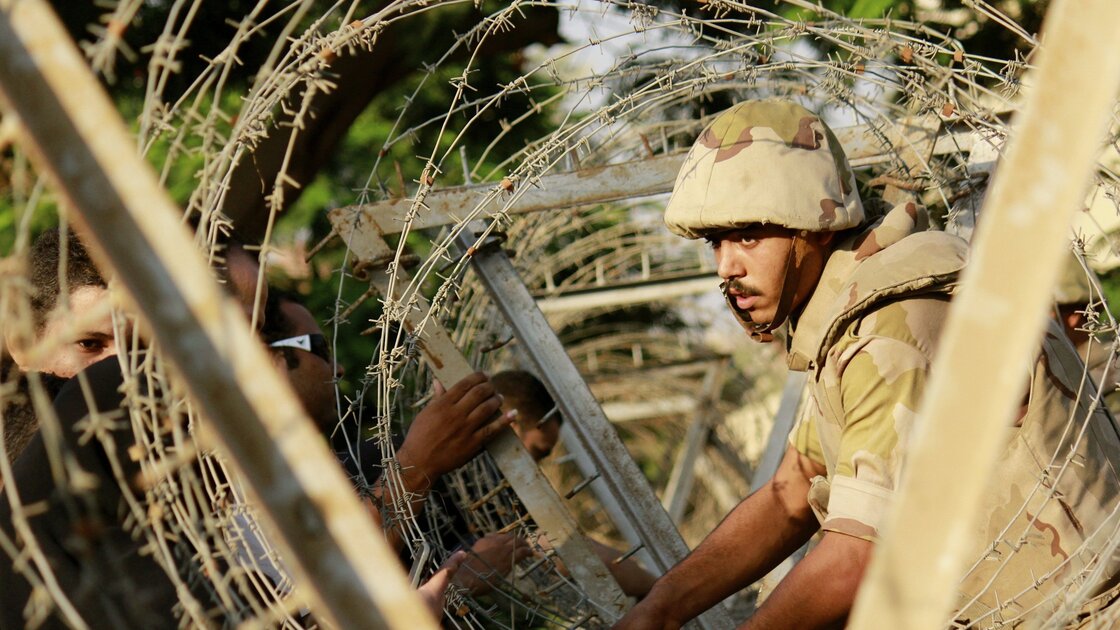
In Cairo, soldiers have put barbed wire around the constitutional court, one of many government institutions under guard.
Amina Ismail /MCT/Landov
In Cairo, soldiers have put barbed wire around the constitutional court, one of many government institutions under guard.
Amina Ismail /MCT/Landov
From ‘Morning Edition’: Cairo Bureau Chief Leila Fadel reports
The news from Egypt, where more than 900 people have died and thousands more have been wounded since the interim government began cracking down on supporters of ousted President Mohammed Morsi last Wednesday, remains grim:
— “Suspected militants on Monday ambushed two mini-buses carrying off-duty policemen in Egypt’s northern Sinai, killing 25 of them execution-style and wounding two, security officials said.” (The Associated Press)
— The circumstances of 36 other deaths Sunday “are especially murky. Thirty six prisoners were killed in what the government say was an attempted escape by jailed supporters of Morsi.” (Morning Edition)
— A “wave of attacks” on the country’s Christian minority continues. (Also on Morning Edition)
There are, as NPR’s David Greene adds, “fears the country might be headed toward a civil war.”
William Hague, the U.K.’s foreign secretary, has told the BBC that it will take “years or maybe decades” for the turmoil in the Middle East and Arab world to “play itself out.” The situation Egypt in particular, he says, is “very bleak.”
Hague added that it is “hard to overstate the levels of hatred and mistrust between the various sides of politics in Egypt.”
A woman watches a Stations of the Cross performance, on the Copacabana beachfront in Rio de Janeiro, Brazil, Friday, July 26, 2013. Pope Francis presided over one of the most solemn rites of the Catholic Church on Friday, a procession re-enacting Christ’s crucifixion, that received a Broadway-like treatment; staging a wildly theatrical telling of the Stations of the Cross, complete with huge stage sets, complex lighting, a full orchestra and a cast of hundreds acting out a modern version of the biblical story. (AP Photo/Andre Penner)
RIO DE JANEIRO (AP) — In the thick of his historic visit to Brazil this week, Pope Francis urged young Catholics to make a “mess” in their dioceses and break out of their spiritual cages.
Francis’ exhortation, spoken Thursday during a special meeting with Argentine faithful, won him acclaim as a renegade leader of the world’s biggest church. But it also left many of his followers with their own interpretations of the pontiff’s words about the need to shake up the church.
Some said they thought Francis wanted them to object more forcefully when taught modern ideas that clash with church doctrine. Others said it meant hitting the streets and pushing for social change.
“If in my biology class they speak about abortion, I should raise my hand and say I don’t believe in that,” said Maria Alejandrina de Dicindio, a 54-year-old Argentine catechism teacher who had traveled to Rio to see her pope, a fellow Argentine. “The youth should open their mouths when it’s their turn.”
For Mexican pilgrim Gilberto Amado Hernandez, the pope’s message meant he should start showing off to the world Jesus Christ’s message of love.
“It’s difficult to meet young people who want to get close to Christ,” Amado said. “We have to show them that faith is something beautiful.”
Francis himself didn’t specify what to do, but he has displayed his own mold-breaking ways throughout this week’s visit to Rio de Janeiro and rural Sao Paulo state, his first overseas trip as pope.
The first pontiff from the Americas worried security officials by riding through massive crowds atop an open-sided popemobile rather than the fully enclosed, bulletproof vehicle his last two predecessors used. He’s also ventured straight up to well-wishers to kiss babies and bless children and met privately Friday with juvenile offenders to provide counsel.
While speaking to his fellow Argentines Thursday, Francis said Catholics should make a concerted effort to get outside their own worlds.
“I want to see the church get closer to the people,” he told them. “I want to get rid of clericalism, the mundane, this closing ourselves off within ourselves, in our parishes, schools or structures, because these need to get out.”
His final message: “Don’t forget: make trouble.”
In his own way, he lived those words as the archbishop of Buenos Aires, Argentina, before being selected as pope in March.
Then known as Jorge Mario Bergoglio, the future pope largely abandoned the kinds of luxuries favored by other high-ranking church officials. He rented out the archbishop’s luxurious suburban mansion, living instead in a spartan room in a downtown church office building. He also rode subways and buses around town rather than keep a chauffeur.
Francis’ visit to a Rio slum on Thursday wasn’t his first such venture. He made regular unescorted trips to dangerous slums as archbishop and saw to it that every major “misery village” in Buenos Aires had a chapel and a priest to spread the Lord’s word.
He also encouraged young people and the laity to take on leadership roles in parishes that were previously held by priests, so that church members would have much more say in what happens in their communities. Though the Catholic Church openly supported Argentina’s 1976-1983 dictatorship, Francis later approved sainthood investigations for priests who were killed by the military government.
Yet pope biographer Sergio Rubin said Francis the archbishop also had a very keen sense of politics and took care to act prudently, choosing his battles and avoiding challenging superiors in ways that would backfire.
He wasn’t so gleeful and devoted to the crowd, seemingly mindful that he didn’t yet have the power to make a big splash in the church, according to an Argentine Catholic official who asked not to be identified because he wasn’t authorized to talk publicly about church politics.
Instead, Francis molded the church in Argentina in quieter ways by hiring and promoting a new generation of outgoing priests in his own model, and not only fellow Jesuits used to living among lay people.
His replacement as archbishop, Mario Poli, had impressed Bergoglio by earning a degree in social work from the public University of Buenos Aires. In a book of dialogues with a friendly rabbi, Francis said, “This is a much better situation, because in the (university) you become acquainted with real life, the different points of view there are about it, the different scientific aspects, cosmopolitanism. . It’s a way of having your feet well planted in the earth.”
The shake-up message is also one he’s applying as pope to the Vatican’s staid and dysfunctional bureaucracy. Francis has made clear that big change is on the way, naming commissions of inquiry to investigate the scandals at the Vatican bank and propose an overarching reform of the entire central governance of the Catholic Church.
The pontiff has dived into the crowds that have greeted him at the Vatican and in Brazil.
During two raucous rides down Copacabana beach, he’s waved, smiled and stopped repeatedly to accept gifts thrown at him from the crowd. At one point, Francis gave away his own white skullcap and put on another one tossed in from the street.
For Argentine student Ana Paula Garrote, Francis was showing Catholics they needed to live that type of spirit.
“For me, the pope wanted to say that we should go out into the streets, not stay in the parishes, and not be ashamed of talking about God,” Garrote said. “The pope is telling us to talk about God without impunity because we have the truth, in uppercase, and we aren’t alone.”
___
Associated Press writer Marco Sibaja contributed to this report from Rio de Janeiro.
FILE – This June 20, 2013, file photo, Charles Richard Jennings, Jr. appears for a hearing at Second District Court in Ogden, Utah. A judge on Monday July 22, 2013 rejected a request to lower bail for Jennings, who is accused of shooting his father-in-law in the head during a Father’s Day Catholic Mass. (AP Photo/Standard-Examiner, Nick Short, Pool, File)
FILE – This June 20, 2013, file photo, Charles Richard Jennings, Jr. appears for a hearing at Second District Court in Ogden, Utah. A judge on Monday July 22, 2013 rejected a request to lower bail for Jennings, who is accused of shooting his father-in-law in the head during a Father’s Day Catholic Mass. (AP Photo/Standard-Examiner, Nick Short, Pool, File)
Buy AP Photo Reprints
OGDEN, Utah (AP) — A man accused of shooting and nearly killing his father-in-law during a crowded Father’s Day church service in northern Utah told authorities he pulled the trigger because he felt “disrespected,” prosecutors said Monday.
Weber County deputy attorney Dean Saunders told a judge about the alleged motive of Charles “Ricky” Jennings Jr. at a court hearing in Ogden, about 40 miles north of Salt Lake City. He also argued Jennings, 35, should be kept in jail because he might try to “complete the act” of killing James Evans.
Judge Michael Lyons revoked Jennings’ bail, which had been set at $ 105,000, The Salt Lake Tribune reported (http://bit.ly/17yMOom).
Police say Jennings shot Evans once in the back of the head June 16 during a Catholic Mass in Ogden. The shooting occurred during a quiet part of the service as about 300 people stood in preparation for communion.
Jennings had walked into the church seconds earlier holding hands with his wife, Cheryl Jennings, who is Evans’ daughter.
The bullet remarkably missed Evans’ brain, entering near his ear and exiting out his cheek. Evans, 66, is expected to survive but faces a long recovery from the damage done to his jaw.
Jennings is charged with attempted murder. No further details about motive were released.
Jennings’ attorney, Michael Bouwhuis, fought the move to revoke bail, saying the amount was too much for Jennings to pay anyway.
Bouwhuis also asked the court to order a review of Jennings’ competency. He said that after the shooting, Jennings made comments to detectives about being hypnotized that raised concerns. He also said Jennings has brain damage from an accident 10 years ago that might influence his decision-making.
A competency hearing has been set for Sept. 9.
Detectives have said they thought Jennings might have been drinking or on drugs, and they know he and his wife had a history of domestic disputes that might have triggered the shooting.
Court records show Jennings has a criminal record going back to 1996. Over the years, he has pleaded no contest to felony charges of receiving a stolen vehicle and criminal trespassing. He also has pleaded guilty to theft charges and a felony charge of attempting to tamper with a witness or juror.
Jennings’ wife stayed inside the church after he fled. There was no indication she knew what her husband was going to do, and authorities don’t expect to file any charges against her.
Jennings was apprehended walking near a highway hours after the shooting. Authorities say he had stolen a truck but it ran out of gas.
After his arrest, Jennings acknowledged he was the man who shot James, court documents show. He told detectives he thought he missed. Jennings said he didn’t see what happened because he quickly ran out of the church after several members of the congregation came after him.
Authorities said Jennings wouldn’t tell them where he got the gun.
Several days after the shooting, the Rev. Erik Richtsteig — who was leading the Father’s Day Mass when the shooting occurred — led churchgoers in a special Catholic ceremony, called the Liturgy of Reparation, to cleanse the place of worship.
“The evil done in this church can stop today, if we can forgive,” Richtsteig said that June evening.
FILE – This June 20, 2013, file photo, Charles Richard Jennings, Jr. appears for a hearing at Second District Court in Ogden, Utah. A judge on Monday July 22, 2013 rejected a request to lower bail for Jennings, who is accused of shooting his father-in-law in the head during a Father’s Day Catholic Mass. (AP Photo/Standard-Examiner, Nick Short, Pool, File)
FILE – This June 20, 2013, file photo, Charles Richard Jennings, Jr. appears for a hearing at Second District Court in Ogden, Utah. A judge on Monday July 22, 2013 rejected a request to lower bail for Jennings, who is accused of shooting his father-in-law in the head during a Father’s Day Catholic Mass. (AP Photo/Standard-Examiner, Nick Short, Pool, File)
Buy AP Photo Reprints
OGDEN, Utah (AP) — A man accused of shooting and nearly killing his father-in-law during a crowded Father’s Day church service in northern Utah told authorities he pulled the trigger because he felt “disrespected,” prosecutors said Monday.
Weber County deputy attorney Dean Saunders told a judge about the alleged motive of Charles “Ricky” Jennings Jr. at a court hearing in Ogden, about 40 miles north of Salt Lake City. He also argued Jennings, 35, should be kept in jail because he might try to “complete the act” of killing James Evans.
Judge Michael Lyons revoked Jennings’ bail, which had been set at $ 105,000, The Salt Lake Tribune reported (http://bit.ly/17yMOom).
Police say Jennings shot Evans once in the back of the head June 16 during a Catholic Mass in Ogden. The shooting occurred during a quiet part of the service as about 300 people stood in preparation for communion.
Jennings had walked into the church seconds earlier holding hands with his wife, Cheryl Jennings, who is Evans’ daughter.
The bullet remarkably missed Evans’ brain, entering near his ear and exiting out his cheek. Evans, 66, is expected to survive but faces a long recovery from the damage done to his jaw.
Jennings is charged with attempted murder. No further details about motive were released.
Jennings’ attorney, Michael Bouwhuis, fought the move to revoke bail, saying the amount was too much for Jennings to pay anyway.
Bouwhuis also asked the court to order a review of Jennings’ competency. He said that after the shooting, Jennings made comments to detectives about being hypnotized that raised concerns. He also said Jennings has brain damage from an accident 10 years ago that might influence his decision-making.
A competency hearing has been set for Sept. 9.
Detectives have said they thought Jennings might have been drinking or on drugs, and they know he and his wife had a history of domestic disputes that might have triggered the shooting.
Court records show Jennings has a criminal record going back to 1996. Over the years, he has pleaded no contest to felony charges of receiving a stolen vehicle and criminal trespassing. He also has pleaded guilty to theft charges and a felony charge of attempting to tamper with a witness or juror.
Jennings’ wife stayed inside the church after he fled. There was no indication she knew what her husband was going to do, and authorities don’t expect to file any charges against her.
Jennings was apprehended walking near a highway hours after the shooting. Authorities say he had stolen a truck but it ran out of gas.
After his arrest, Jennings acknowledged he was the man who shot James, court documents show. He told detectives he thought he missed. Jennings said he didn’t see what happened because he quickly ran out of the church after several members of the congregation came after him.
Authorities said Jennings wouldn’t tell them where he got the gun.
Several days after the shooting, the Rev. Erik Richtsteig — who was leading the Father’s Day Mass when the shooting occurred — led churchgoers in a special Catholic ceremony, called the Liturgy of Reparation, to cleanse the place of worship.
“The evil done in this church can stop today, if we can forgive,” Richtsteig said that June evening.