Showing posts with label agree. Show all posts

Sunday, March 16, 2014

Russia-Ukraine Agree “Truce” Until March 21st; White House Warns Putin Stop Playing “Russian Roulette”


Embedded image permalinkZero Hedge – by Tyler Durden


“President Putin has started a game of Russian roulette and I think the United States and the West have to be very clear in their response,” states Sen. Foreign Relations Committed Chair Robert Menendez among a slew of Sunday morning talk-show rhetoric from US politicians with the White House’s Dan Pfeiffer adding “President Putin has a choice about what he’s going to do here. Is he going to continue to further isolate himself, further hurt his economy, further diminish Russian influence in the world, or is he going to do the right thing?” As the “sham referendum” continues, Reuters, however, reports that Ukraine’s acting defense minister believes Russia and Ukraine have agree a truce until March 21st.  


Sunday Morning Talk-Show Rhetoric… (via AP)


If Russian President Vladimir Putin doesn’t back down in Crimea, he will face penalties from the West that will hurt the Russian economy and diminish Moscow’s influence in the world, the White House said Sunday.


White House senior adviser Dan Pfeiffer said the Obama administration’s top priority is supporting the new Ukrainian government “in every way possible.” He also said the United States would not recognize the results of a referendum taking place in Crimea Sunday on whether it should become part of Russia.


Pfeiffer said everything that Russia has done in Crimea has been a violation of international law and bad for stability in the region.


“President Putin has a choice about what he’s going to do here. Is he going to continue to further isolate himself, further hurt his economy, further diminish Russian influence in the world, or is he going to do the right thing?” Pfeiffer said on NBC’s “Meet the Press.”


…


“President Putin has started a game of Russian roulette and I think the United States and the West have to be very clear in their response because he will calculate about how far he can go,” said Sen. Robert Menendez, the Democratic chairman of the Senate Foreign Relations Committee.


Menendez appeared on Fox News Sunday along with the ranking Republican on the Foreign Relations Committee, Sen. Bob Corker of Tennessee. Corker said the U.S. and Europe were entering a “defining moment” in their relationship with Russia.


“Putin will continue to do this. He did it in Georgia a few years ago. He’s moved into Crimea and he will move into other places unless we show that long-term resolve.”


Democratic Sen. Chris Murphy of Connecticut returned early Sunday from meetings in Ukraine.He called an annexation vote taking place in Crimea a “sham referendum.” He said that Ukrainians he talked to, both inside the government and outside, said war could occur if Russia attempts to annex more territory. They indicated that “If Russia really does decide to move beyond Crimea it’s going to be bloody and the fight may be long,” he said on ABC’s “This Week.”


But it appears truce has been reached for now…


The defense ministries of Ukraine and Russia have agreed on a truce in Crimea until March 21, Ukraine’s acting defense minister said on Sunday.


“An agreement has been reached with (Russia’s) Black Sea Fleet and the Russian Defense Ministry on a truce in Crimea until March 21,” Ihor Tenyukh told journalists on the sidelines of a cabinet meeting.


“No measures will be taken against our military facilities in Crimea during that time. Our military sites are therefore proceeding with a replenishment of reserves.“


As Ukrainian armed forces appear resigned to the loss:


No confirmation as yet from the Russian authorities… which, it would appear, merely gives Putin more time to arrange his military pieces since for sure he shows no signs of backing down… as the tanks keep rolling


http://www.zerohedge.com/news/2014-03-16/russia-ukraine-agree-truce-until-march-21st-white-house-warns-putin-stop-playing-rus


Russia-Ukraine Agree “Truce” Until March 21st; White House Warns Putin Stop Playing “Russian Roulette”

Physicists, Generals And CEOs Agree: Ditch The PowerPoint


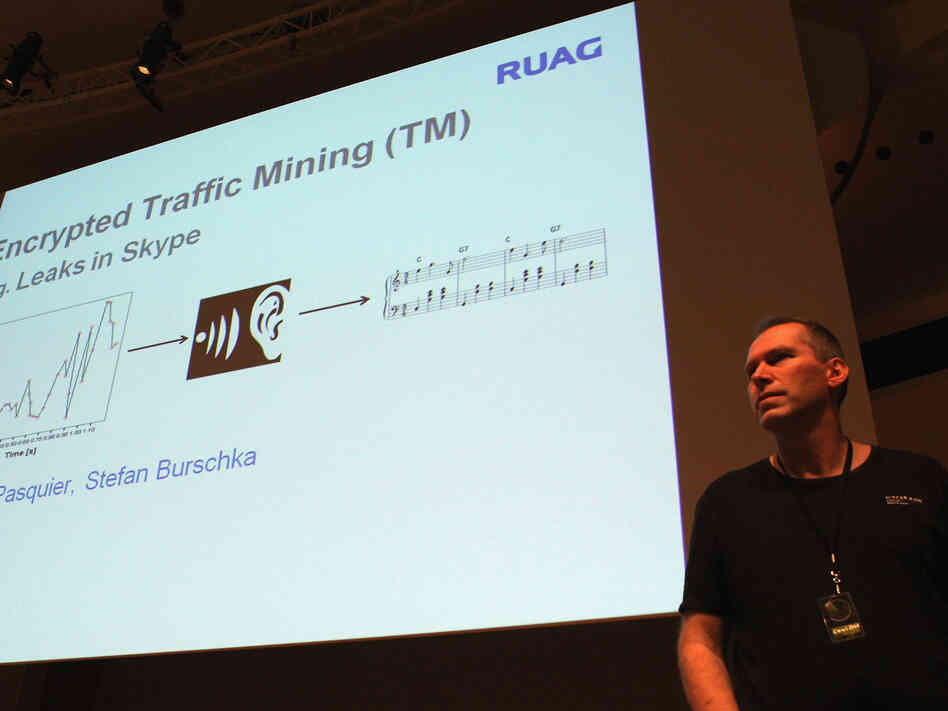
hide captionA PowerPoint slide is projected on a screen prior to a lecture at the 28th Chaos Communication Congress computer hacker conference in Berlin.


Adam Berry/Getty Images

A PowerPoint slide is projected on a screen prior to a lecture at the 28th Chaos Communication Congress computer hacker conference in Berlin.


A PowerPoint slide is projected on a screen prior to a lecture at the 28th Chaos Communication Congress computer hacker conference in Berlin.


Adam Berry/Getty Images


About six months ago, a group of physicists in the U.S. working on the Large Hadron Collider addressed a problem they’ve been having for a while: Whenever they had meetings, everyone stuck to the prepared slides, and couldn’t really answer questions that weren’t immediately relevant to what was on the screen.


The point of the forum is to start discussions, so the physicists banned PowerPoint — from then on, they could only use a board and a marker.


“The use of the PowerPoint slides was acting as a straitjacket to discussion,” says Andrew Askew, an assistant professor of physics at Florida State University and one of the organizers of the forum at the Fermi National Accelerator Laboratory in Illinois.


He says it was as if “we removed the PowerPoint slide, and like a big glass barrier was removed between the speaker and the audience.


“The communication became a lot more two-way instead of just the speaker speaking at length for 15, 20 minutes. The audience really started to come alive, to look up from their laptop computers and actually start participating in the discussion, which is what we were really trying to foster.”


Askew admits the presentations are now considerably longer: whereas they used to do four to five each time, now they can do at most three. It’s also been harder to find speakers, because now the presentations are a lot less scripted — more improv comedy than reading from slides. But on the plus side, more physicists have started attending.


The physicists are far from the only people moving away from PowerPoint style presentations: The CEOs of Amazon and LinkedIn have eliminated the presentations from meetings. In his recently published memoir, former U.S. Defense Secretary Robert Gates calls PowerPoint slides “the bane of my existence in Pentagon meetings; it was as though no one could talk without them.” Gates writes that as CIA director, he banned slides except for maps and charts, but could not do so as Secretary of Defense. Gen. James Mattis, former commander of the U.S. Central Command, has said that “PowerPoint makes us stupid.” Maj. Gen. H.R. McMaster banned PowerPoint presentations when he led a successful mission in Iraq, and he compared it to an internal threat.


The main advantage of forgoing PowerPoint is that it forces both the speaker and the listener to pay attention, says John Paul Chou, an assistant professor of physics at Rutgers University who recently presented at one of the Fermilab forums.


With PowerPoint, he says, it’s “easier to let your mind go on autopilot and you start to lose focus more easily.”


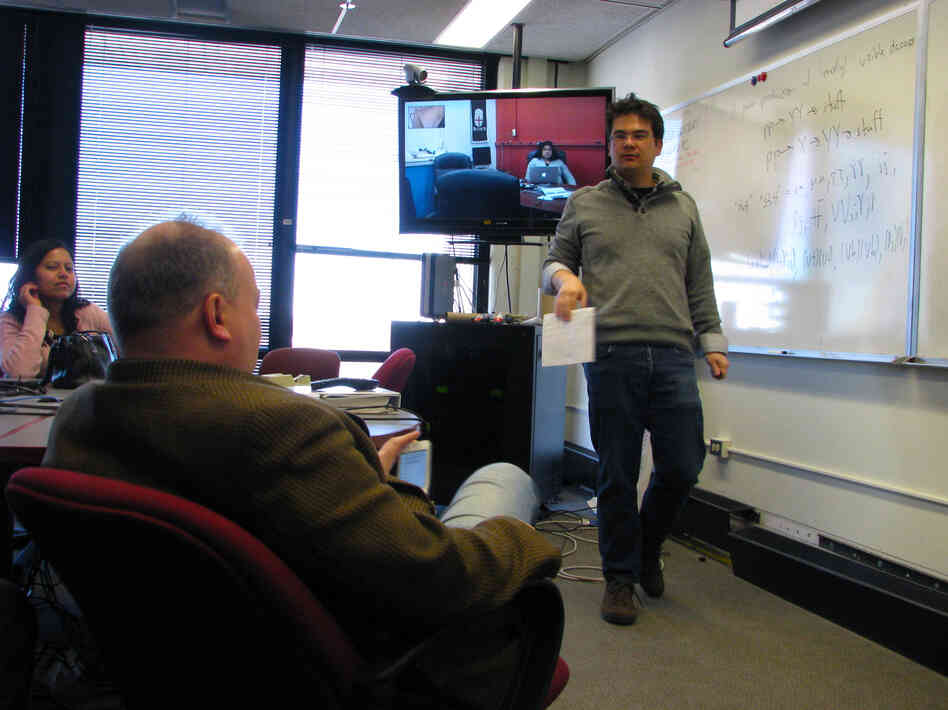
hide captionJohn Paul Chou (right), a physics professor at Rutgers University, uses a whiteboard and answers questions during a forum at Fermilab.


Amanda Solliday/Fermilab

John Paul Chou (right), a physics professor at Rutgers University, uses a whiteboard and answers questions during a forum at Fermilab.


John Paul Chou (right), a physics professor at Rutgers University, uses a whiteboard and answers questions during a forum at Fermilab.


Amanda Solliday/Fermilab


He points out physicists often have a lot of graphs and data to share, and with access to just a whiteboard, he has to be much more selective about what to present. He also explains that he has to make sure his audience is following his train of thought — he can’t just advance to the next slide anymore.


“It forces you to be a better teacher as well as making better students,” Chou says.


But this isn’t just an issue for academics, says Richard Russell, a special adviser to U.S. Central Command who also teaches at the University of Central Florida and National Defense University.


He cites an example from the Kosovo war in 1999, when the CIA recommended a bombing run on what officials thought was a Serbian military production facility by presenting a PowerPoint slide identical to the ones used by the U.S. European Command. The chain of command thought the intelligence had been approved, the site was bombed, and it turned out to be the Chinese embassy in Belgrade.


“There are real-world consequences for this, and so it’s not a purely academic, ivory tower concern,” Russell says. He also points to a report from the board at NASA charged with investigating the Space Shuttle Columbia disaster of 2003. The board argued that NASA had become too reliant on presenting technical information with PowerPoint rather than reports. In a recent column for Foreign Policy, Russell writes that PowerPoint should be banned in the military education system.


Of course, PowerPoint does have its advantages, says John Paul Chou of Rutgers. “If you’re giving a lecture for 10 people or 100 people, you can do it very easily with a chalkboard. But once you move up to 1,000 people, you run into all kinds of technical problems that PowerPoint solves very easily,” Chou says. He says the problem is simply that “we’re so used to giving PowerPoint [presentations] that we forget there are other means of communicating.”


News


Physicists, Generals And CEOs Agree: Ditch The PowerPoint

Tuesday, February 4, 2014

Koreas agree to hold family reunions this month


By AP
February 5, 2014, 2:20 pm TWN


SEOUL, South Korea — South Korea says it and North Korea have agreed to hold the first reunions of war-divided families in more than three years later this month.

The planned Feb. 20-25 reunions coincide with the expected start of South Korea-U.S. annual springtime military drills that North Korea calls a rehearsal for a northward invasion. The allies call the training defensive.


North Korea scrapped previously scheduled reunions at the last minute in September after accusing South Korea of preparing war drills and other hostile acts.


Seoul’s Unification Ministry says the latest agreement was reached during a border meeting between Red Cross delegates from the Koreas on Wednesday. It gave no further details.


 Thailand opposition seeks to annul election 

In this photo released by South Korean Unification Ministry, head of South Korean working-level delegation Lee Duk-haeng, center right, shakes hands with his North Korean counterpart Park Yong Il, center left, during their meeting at Tongilgak in the North Korean side of Panmunjom which has separated the two Koreas since the Korean War, Wednesday, Feb. 5.

(AP)


Enlarge Photo


China Post Online – Taiwan , News , Taiwan newspaper


Koreas agree to hold family reunions this month

Tuesday, January 7, 2014

America the Polarized? No, We Mostly Agree


(Newser) – Conventional wisdom has it that America is more polarized in terms of politics and culture than at any point in history. “Not so fast,” writes Nick Gillespie at Time. It may seem that way because of the talking heads on cable news and the fringe politicians who love to make headlines, but a closer look at the views of actual Americans tells a different story. He ticks off a list of issues such as pot legalization, attitudes toward homosexuality, and abortion (only 20% think it should be legal in all circumstances, which is pretty much unchanged over decades) and finds a majority of Americans in sync on them.


Of course, gray areas and rooms for disagreement exist in those and other issues. “But with so many pressing problems confronting Washington, acknowledging that more unites us than divides us might be a smart way to create a future that doesn’t revolve hermeneutic readings of the theological implications of reality TV stars or actively ignoring what large majorities of Americans actually believe,” writes Gillespie. Click to read his full column.


Politics from Newser


America the Polarized? No, We Mostly Agree

Friday, November 15, 2013

U.S. justices agree to hear Halliburton securities class action

U.S. justices agree to hear Halliburton securities class action
http://currenteconomictrendsandnews.com/wp-content/uploads/2013/11/ebbe9__?m=02&d=20131115&t=2&i=812193004&w=460&fh=&fw=&ll=&pl=&r=CBRE9AE1FI200.jpg


WASHINGTON Fri Nov 15, 2013 1:32pm EST


Read more about U.S. justices agree to hear Halliburton securities class action and other interesting subjects concerning Business at TheDailyNewsReport.com

Friday, November 1, 2013

Nations fail to agree on Antarctic marine reserve

WELLINGTON, New Zealand (AP) — The nations that make decisions about Antarctic fishing failed Friday for a third time to agree on a plan that would create the world’s largest marine sanctuary.
Science Headlines


Nations fail to agree on Antarctic marine reserve

Wednesday, October 2, 2013

Prison Officials Finally Agree to Transfer Floridly Psychotic Inmate


Jonathan Francisco as a child with his mother, Linda Embrack, and as an adult (Linda Embrack)

Government shutdown notwithstanding, Justice Department lawyers came to federal court in Colorado yesterday to defend the Bureau of Prisons against an “emergency motion.” The lawyers who had filed the motion represented some of the inmates at ADX-Florence, the “Supermax” facility that houses some of the nation’s most notorious prisoners. Turns out, there wasn’t much of a defense to offer.

Here is the link to the brief filed by the lawyers on behalf of inmate Jonathan Francisco. When confronted with a floridly psychotic inmate eating his own feces — the manifestation of severe mental illness occurring day after day, month after month — the BOP did little more than place sandbags around his cell to reduce the odor of excrement. Here are the astonishing key paragraphs from the plaintiff’s motion:


As demonstrated in the attached declarations and other evidence, for nearly five years Francisco has displayed a persistent pattern of bizarre and worrisome signs and symptoms suggesting that he suffers from a severe and worsening mental illness. During that time, he has been almost entirely mute, speaking very little, if any, to anyone, including family members with whom he previously had a close relationship. He spends most of his time standing with his face very near a wall, staring blankly at the surface before him.

He also obsessively hoards and handles his own feces, placing it on food trays, rolling it into balls, making sculptures out of it, and smearing it on his walls and sometimes on his body or in his hair. He has repeatedly defecated in common-use shower facilities, and on at least one occasion has been seen consuming his feces. In addition, he often has little if any personal property in his cell, frequently sleeps without even a mattress, and continuously lives in unsanitary conditions verging on squalor.

Despite all of this, BOP records reflect that he receives no meaningful ongoing mental health treatment; instead, the BOP’s mental health professionals essentially ignore him. The available evidence suggests that the BOP’s response to his situation, thus far, has been to occasionally force him into a shower stall, and to pile sandbags outside his door in a futile effort to prevent the overwhelming smell of feces emanating from his cell from spreading throughout the part of the prison where he lives.


The government lawyers didn’t say much in response to this motion. They did not try to defend BOP practices or policies. Instead, they quickly assured a grim-faced U.S. District Judge Richard Matsch that the forms for Francisco’s transfer to the federal mental health prison at Springfield, Missouri, already had been filled out and that he would be moved for treatment at the end of next week. Judge Matsch reasonably asked why the process was taking so long. Indeed, that’s a question that goes beyond yesterday’s hearing.

I wrote about the manifestations of Francisco’s mental illness four months ago, in early June, and since that time, the Bureau of Prisons has done nothing to help Francisco. Another mentally ill inmate at ADX-Florence, a man named Robert Gerald Knott, committed suicide at the facility in early September and the Bureau of Prisons did nothing to help Francisco. There has been civil rights litigation pending now for nearly 18 months and the BOP has done nothing to help Francisco. Prison officials promised Congress long ago that there were adequate mental health programs at ADX-Florence and no one helped Francisco.


Tuesday’s acknowledgement by the government that Francisco needs help and finally will get it surely comes as a relief to his mother, Linda Embrack, who has tried for five years to get treatment for her obviously ill son. In April 2010, for example, she wrote a heartbreaking letter to a federal magistrate judge chronicling her son’s descent into madness in prison. “Very uncharacteristic of Jonathan to stop writing or calling,” she told the judge, describing how her only son’s appearance had become disheveled, his hair matted, as he grew unable to speak and or recognize his own mother.


I spoke Wednesday morning with Embrack. Naturally, she is pleased with yesterday’s news.  “I’m so excited. I thank God for this,” she said. She told me that Francisco first became ill in 2008. “The people said that he was just playing but I knew that he wasn’t just playing.” At ADX-Florence, she alleges, prison officials “were doing everything they could to hide Jonathan.” But they can’t hide him any longer. If he makes it to next week, if he makes it Springfield, he will have a chance at a life of sanity, and dignity, even if it’s still a life behind bars. 


Master Feed : The Atlantic


Prison Officials Finally Agree to Transfer Floridly Psychotic Inmate

Friday, September 20, 2013

Rebels agree truce in Syrian town


Paul Adams explains the challenges of removing Syria’s chemical weapons


Two Syrian rebel groups in the town of Azaz have agreed a ceasefire.


The Islamic State in Iraq and Syria (Isis), linked to al-Qaeda, seized the northern town on Wednesday from the larger Western-backed Free Syrian Army.


The fighting has raised fears of a possible war within a war.


The clashes come ahead of one-week deadline for Syria to provide a list of its chemical weapons facilities, as part of a US-Russian deal for the country to destroy its deadly arsenal.


Russia’s Deputy Foreign Minister, Sergei Ryabkov, is holding talks in Damascus over the deal.


US Secretary of State John Kerry said a “definitive” UN report had proved that the Syrian government was behind a deadly chemical weapons attack in the Damascus suburbs of Ghouta on 21 August.


Damascus – backed by Moscow – insists that rebel forces carried out the attack.


The West wants the deal on ridding the Syrian government of its chemical arsenal enshrined in a UN resolution backed by the threat of military force.


Mr Kerry said the UN Security Council must be willing to act on this when the UN General Assembly holds its annual meeting in New York next week.


But Russia objects to any mention of the threat of force in a UN resolution.


Syria’s President Bashar al-Assad, in an interview with Fox News, said it could take about a year to destroy Syria’s chemical stockpiles and could cost about $ 1bn (£623m).


Impact unclear

The BBC’s Paul Wood, on the Syrian border with Turkey, says that under the ceasefire deal, two rebel sides have agreed to exchange prisoners and hand back property.


It is unclear if the ceasefire will have an impact on clashes between the groups elsewhere in the country, he says.


Analysts say there is more chance that the US and other Western powers may arm the Free Syrian Army if it shows a distinct separation from the Islamists.


Meanwhile, the party of Syria’s Deputy Prime Minister Qadri Jamil insists he was misquoted in Friday’s edition of the UK’s Guardian newspaper.


Mr Jamil reportedly told the paper that the civil war had reached stalemate, with neither government forces nor the rebels strong enough to win – and that the government would use proposed talks in Geneva to call for a ceasefire.


But the People’s Will Party said the Guardian journalist was ”neither precise nor professional” about what he quoted Mr Jamil as saying.


Iranian President Hassan Rouhani has said Tehran is ready to help broker peace in Syria, as part of what he called his country’s “constructive engagement” policy with other nations.


In an article in the Washington Post newspaper, Mr Rouhani wrote: “We must create an atmosphere where peoples of the region can decide their own fates.”


Correspondents say the article is the latest signal that Mr Rouhani wants to improve Iran’s relationship with the US and other countries that believe Iran is developing nuclear weapons.


Islamic laws

The fighting in Azaz began when a wounded rebel – either from Isis or from an allied group, al-Muhajireen – was taken to a field clinic and, while there, filmed as part of a fundraising exercise.


The wounded fighter demanded the film, and called some of his friends to come and help him.


Free Syrian Army fighters, from a unit called the Northern Storm brigade, were guarding the field clinic, and there was a confrontation which ended up with Isis launching a full attack on the town, putting the Northern Storm brigade to flight.


Isis is reported to have made a number of arrests of activists, journalists and even Sharia court officials during the time it controlled Azaz.


One eyewitness inside the town said no-one was smoking on the streets – tobacco is forbidden according to strict Islamist doctrine.


Powered By WizardRSS.com | Zombie Gear | Full Text RSS Feed | Amazon Affiliate

BBC News – Home

Rebels agree truce in Syrian town

Saturday, September 14, 2013

Syria crisis: US and Russia agree chemical weapons deal


Conal Urquhart
The Guardian
September 14, 2013


US Secretary of State John Kerry next to United Nations-Arab League special envoy for Syria Lakhdar Brahimi and Russian Foreign minister Sergei Lavrov during a press conference after their high-stakes talks on Syria’s chemical weapons at the UN headquarters in Geneva. Photograph: PHILIPPE DESMAZES/AFP/Getty Images


The United States and Russia have agreed that Syrian chemical weapons will be placed under international control and destroyed in a process that will begin with a week.


International inspectors from the Organisation of the Prevention of Chemical weapons must be given “immediate and unfettered” access to Syrian chemical weapons, said US secretary of state, John Kerry.


Speaking at a press conference in Geneva on Saturday, Kerry outlined the details of the deal as Russian foreign minister, Sergei Lavrov looked on.


Full story here.


Prison Planet.com


Syria crisis: US and Russia agree chemical weapons deal

OK AFL-CIO leaders agree ACA is ‘not perfect’


By Patrick B. McGuigan | Oklahoma Watchdog


.

AFT ON ACA: Ed Allen, president of the American Federation of Teachers Local 2309, said “In a lot of ways we’re in uncharted territory. We’re supportive of the Affordable Care Act, but it’s not perfect.”


OKLAHOMA CITY – Labor leaders with the AFL-CIO union in Oklahoma City were not active in the push for a resolution at the recent national convention in Los Angeles, but they agree it represents a significant moment in development of public policy touching the Affordable Care Act.


President Barack Obama on Friday met with national union leaders in an effort to quell rising labor movement opposition to provisions of ACA, widely known as ObamaCare.


“The national leadership plans to go back to Washington and work out something specific, some plans on the improvements that are needed,” Oklahoma AFL-CIO president Jimmy Curry told Oklahoma Watchdog. “The impetus for the resolution came from the buildings and trades unions. They were the ones most wanting to fix this.


“It was not as passionate an issue here locally in Oklahoma. I will wait a couple of months to hear from the national level what we can do to help. … I am not sure about it, but there are a lot of people in our movement who felt it needed to be addressed.”


Ed Allen, president of the American Federation of Teachers Local 2309 told Oklahoma Watchdog, “Something of this magnitude, making these kinds of changes to the health care system, we’re going to run into a good number of issues and problems.”


“We’ll never satisfy everybody on it, but it seems clear the legislation can be made better,” he said. “In a lot of ways we’re in uncharted territory. We’re supportive of the Affordable Care Act, but it’s not perfect.”


In an unusual confluence of opinion with Republican critics, including leading conservative economists, Terry O’Sullivan of the Laborers International Union of North American, said the ACA in its present form is likely to trigger “unintended consequences.” He told delegates: “It needs to be changed and fixed now … We will work with the president to do everything we can to fix the Affordable Care Act … We want it fixed, fixed, fixed.”


National AFT union secretary-treasurer Lorretta Johnson decried the effects of ACA as “a work in progress” that, among other impacts, has led some para-professionals, such as adjunct college professors, nurses and public employees, to see their hours cut below the 30-hour threshold that, under ACA, triggers comprehensive health insurance coverage at employer expense, or penalties.


In a report from the convention in Los Angeles, the AFL-CIO’s Mike Hall summarized the resolution as “expressing support for the goals of the Affordable Care Act but also addressing a number of issues about the ACA’s implementation, including the way the ACA treats multi-employer health care plans.”


The resolution called for “preservation of high-quality coverage.” The resolution reads, in part, “Federal agencies administering the ACA have interpreted the Act in ways that are threatening the ability of workers to keep  health care coverage through some collectively bargained, non-profit health care funds.”


U.S. Sen. Orrin Hatch, R-Utah, recently wrote to several national union leaders asking them to join Republican efforts to enact “a permanent delay” in the law’s implementation.


However, the labor behemoth’s agreement with many of ObamaCare’s most ardent critics seems likely to go only so far. In addition to the resolution’s call for similar treatment of large and small health care plans, delegates renewed the union’s call for a “single-payer model” in the long term.


Contact Patrick McGuigan, Oklahoma City bureau chief for the Watchdog.org network, at patrick@capitolbeatok.com.


Please, feel free to “steal our stuff”! Just remember to credit Watchdog.org. Find out more


Watchdog.org


OK AFL-CIO leaders agree ACA is ‘not perfect’

Thursday, August 1, 2013

Kerry: U.S., Pakistan agree to re-establish full partnership

ISLAMABAD (Reuters) – U.S. Secretary of State John Kerry agreed with Pakistan on Thursday to re-establish a “full partnership” hurt by U.S. drone strikes and a 2011 NATO air attack in which 24 Pakistani soldiers were killed.


Reuters: Top News


Kerry: U.S., Pakistan agree to re-establish full partnership

Tuesday, June 25, 2013

Russia, U.S. fail to agree plan for Syria peace talks


Free Syrian Army fighters carrying their weapons are reflected in a mirror in the old city of Aleppo June 24, 2013. REUTERS/Muzaffar Salman


1 of 4. Free Syrian Army fighters carrying their weapons are reflected in a mirror in the old city of Aleppo June 24, 2013.


Credit: Reuters/Muzaffar Salman


BEIRUT | Tue Jun 25, 2013 11:33am EDT


BEIRUT (Reuters) – Syria’s military pounded rebel bastions in Damascus on Tuesday and Saudi Arabia demanded an arms embargo on what it called President Bashar al-Assad’s genocidal and illegitimate regime.


Attacking Iran, Russia and Lebanon’s Hezbollah for supporting Assad, Saudi Foreign Minister Prince Saud al-Faisal said the kingdom could not be silent and called for arms to be supplied to Syrian rebels, now militarily on the back foot.


“Syria is facing a double-edged attack, it is facing genocide by the government and an invasion from outside the government, and … a massive flow of weapons to aid and abet that invasion and that genocide. This must end,” he told a news conference with U.S. Secretary of State John Kerry in Jeddah.


“The kingdom calls for issuing an unequivocal international resolution to halt the provision of arms to the Syrian regime and states the illegitimacy of the regime,” Prince Saud said.


In Damascus, Assad’s gunners fired mortars and artillery at Zamalka and Irbin, just east of the government-held city centre, in an assault backed by air strikes, opposition activists said.


Mostly Sunni Muslim rebels who grabbed footholds in Damascus nearly a year ago now say they face a grinding advance by the Syrian military, buoyed by support from Assad’s regional Shi’ite allies, notably Iranian-backed Hezbollah fighters on the ground.


If the insurgents are driven from the capital’s eastern suburbs, they would lose arms supply routes and suffer a severe blow in their drive to end four decades of Assad family rule.


The Saudi minister’s strongly worded remarks reinforced signs that the Syrian war is entangling much of the Middle East.


Security in neighboring Iraq and Lebanon, where the conflict has aggravated Sunni-Shi’ite tensions, has crumbled.


Suicide bombers killed eight people north of Baghdad on Tuesday, a day after 39 people died when 10 car bombs exploded in the capital. Violence has spiraled in Iraq since April.


“GETTING OUT OF HAND”


In Lebanon, clashes between the Lebanese army and gunmen led by a fiercely anti-Hezbollah Sunni cleric engulfed the southern port of Sidon on Sunday. At least 40 people were killed, including 18 soldiers, security sources said.


Sectarian hatred has even flared in Sunni-majority Egypt, where a crowd attacked and killed five Shi’ites on Sunday.


Lakhdar Brahimi, the U.N.-Arab League mediator, urged the United States and Russia to help “contain this situation that is getting out of hand, not only in Syria but also in the region”.


Speaking in Geneva before preparatory talks with U.S. and Russian officials, he said he doubted that a Syria peace conference proposed by Moscow and Washington could take place next month, citing disarray among Assad’s political opponents.


More than 93,000 people have been killed in Syria since peaceful protests erupted in March 2011. Assad’s violent response helped generate what is now a civil war that has driven nearly 1.7 million refugees into neighboring countries.


Outgunned rebels are looking to Western and Arab nations to help them to reverse Assad’s battlefield gains of the last few weeks. But although the United States announced unspecified military aid this month, it is unclear whether this can shift the balance against the Syrian leader and his allies.


Kerry wants to ensure that aid to the rebels is properly coordinated, in part out of concern that weapons could end up in the hands of Islamist militants who are prominent in their ranks.


“Our goal is very clear, we cannot let this be a wider war, we cannot let this contribute to more bloodshed and prolongation of the agony of the people of Syria,” he said.


Saudi Arabia, a Sunni state which views Shi’ite Iran as its arch-rival, has increased aid to Syrian rebels in recent months, supplying anti-aircraft missiles among other weapons.


Prince Saud denounced foreign involvement in Syria “by Hezbollah and other militias supported by the forces of the Iranian Revolutionary Guard”, and also took a swipe at Moscow.


“There is no logic that allows Russia to publicly arm the Syrian regime and the foreign forces that support it.”


(Additional reporting by Mahmoud Habboush in Dubai and Lesley Wroughton in Jeddah; Writing by Alistair Lyon, editing by Peter Millership)


Reuters: Top News


Russia, U.S. fail to agree plan for Syria peace talks

Russia, U.S. fail to agree plan for Syria peace talks

BEIRUT/GENEVA (Reuters) – Talks between the United States and Russia to set up a Syrian peace conference produced no deal on Tuesday, with the powers on either side of the two-year civil war failing to agree when it should be held or who would be invited.


Reuters: Top News


Russia, U.S. fail to agree plan for Syria peace talks