NOM president Brian Brown is seeing a rise in “anti-Christian” bigotry, which is just a rise in LGBTQ rights
Salon.com
“Anti-Christian religious bigotry” is apparently what conservatives are now calling LGBTQ rights
NOM president Brian Brown is seeing a rise in “anti-Christian” bigotry, which is just a rise in LGBTQ rights
Salon.com
At Not Just The News, the privacy of our visitors is of extreme importance to us (See this article to learn more about Privacy Policies.). This privacy policy document outlines the types of personal information is received and collected by Not Just The News and how it is used.
Log Files
Like many other Web sites, Not Just The News makes use of log files. The information inside the log files includes internet protocol (IP) addresses, type of browser, Internet Service Provider (ISP), date/time stamp, referring/exit pages, and number of clicks to analyze trends, administer the site, track user"s movement around the site, and gather demographic information. IP addresses, and other such information are not linked to any information that is personally identifiable.
Cookies and Web Beacons
Not Just The News does use cookies to store information about visitors preferences, record user-specific information on which pages the user access or visit, customize Web page content based on visitors browser type or other information that the visitor sends via their browser.
DoubleClick DART Cookie
These third-party ad servers or ad networks use technology to the advertisements and links that appear on Not Just The News send directly to your browsers. They automatically receive your IP address when this occurs. Other technologies ( such as cookies, JavaScript, or Web Beacons ) may also be used by the third-party ad networks to measure the effectiveness of their advertisements and / or to personalize the advertising content that you see.
Not Just The News has no access to or control over these cookies that are used by third-party advertisers.
You should consult the respective privacy policies of these third-party ad servers for more detailed information on their practices as well as for instructions about how to opt-out of certain practices. Not Just The News"s privacy policy does not apply to, and we cannot control the activities of, such other advertisers or web sites.
If you wish to disable cookies, you may do so through your individual browser options. More detailed information about cookie management with specific web browsers can be found at the browser"s respective websites.
UPDATE: The Court on Thursday afternoon expanded the time for this argument to ninety minutes, to be divided equally.
—————
At 10 a.m. next Tuesday, the Supreme Court will hold one hour of oral argument on the government’s authority to require private businesses to provide birth control and other pregnancy-related services to their employees under the Affordable Care Act. Arguing for the challengers to the so-called “contraceptive mandate” will be Paul D. Clement, of the Washington, D.C., law firm of Bancroft PLLC. Defending the mandate will be U.S. Solicitor General Donald B. Verrilli, Jr. Each will have thirty minutes of time, although that may be extended at the option of Chief Justice John G. Roberts, Jr. The consolidated cases are Sebelius v. Hobby Lobby Stores and Conestoga Wood Specialties Corp. v. Sebelius.
Background
For the first time since the broad new federal health care law partially survived its most sweeping constitutional challenge in the Supreme Court nearly two years ago, the Affordable Care Act comes up for a new test before the Justices. This time, the Court will be examining whether the government may enforce against private businesses owned by religiously devout owners the requirement that employee health plans provide no-cost coverage for women’s pregnancy-related services, including birth control.
These services, required under the so-called “contraceptive mandate” in the Act and in government regulations, are not themselves in legal trouble: the only issue before the Court at this point is which businesses can be ordered to provide the services to their female workers at no cost to them.
That issue will be debated by two of the legal gladiators who met in the last test at the Court of the Affordable Care Act: Washington attorney Paul D. Clement, a former U.S. Solicitor General, and the current Solicitor General, Donald B. Verrilli, Jr.
There probably would be a significant loophole in the contraceptive mandate’s reach if the challengers win. Some women’s rights groups have estimated that millions of women would be affected. Female workers of the two companies involved and those of other religiously oriented companies would have to cover personally the cost of at least some of the birth-control services — unless the government were to set up a new program on its own to do so, which is a very unlikely prospect.
Thus, the two cases that the Court has combined for review set up a direct conflict between the interests of some employers against those of their female workers of child-bearing age. The federal government is clearly on the workers’ side, but the lower federal courts have been divided on who should win.
The dispute only involves private businesses because religious groups, as such, are given an exemption by regulations the government has issued. Even some businesses get exemptions, too, because their employee health plans have been “grandfathered,” but before long those, too, will actually have to provide the benefits at issue, or face heavy financial penalties.
At the level of their greatest potential, the two cases raise the profound cultural question of whether a private, profit-making business organized as a corporation can “exercise” religion and, if it can, how far that is protected from government interference. The question can arise — and does, in these cases — under either the First Amendment’s Free Exercise Clause or under a federal law, the Religious Freedom Restoration Act, passed by Congress in 1993.
In a manner of speaking, these issues pose the question — a topic of energetic debate in current American political and social discourse — of whether corporations are “people.” The First Amendment protects the rights “of the people,” and the 1993 law protects the religious rights of “persons.” Do profit-making companies qualify as either?
Aside from whether corporations do have any religious rights, as such, the cases also raise the question whether the religious rights of their owners — real people, who undeniably can act according to their faith — are violated by the requirement that their companies obey the contraceptive mandate. Ordinarily, in business law, corporations are separate from their owners, but the owners in these cases resist that notion, at least so far as the owners’ religious views actually shape the business of their companies.
No one doubts that the owners of the two companies have sincere religious objections to some forms of birth control or that their beliefs do counsel them to avoid any role in providing those services to their employees. The companies and their owners do not have to convince the Court that that is what they believe — only whether that belief controls enforcement, or not, of the mandate.
One company is Hobby Lobby Stores, Inc., and a related company, Mardel, Inc. Headquartered in Oklahoma City, the two companies are owned — through a trust — by members of the Green family. Hobby Lobby is a chain of more than 500 arts-and-crafts stores across the country, with more than 13,000 employees. Mardel is a chain of Christian book stores, with 35 outlets and about 400 employees.
The Green family members signed a formal commitment to run the two chains according to Christian religious principles — closing on Sunday, advertising their religious orientation, and playing religious music in the stores. The owners and their stores do not object to every part of the contraceptive mandate, but they do object to the use of any drugs or intrauterine devices that — in the words of their lawyers — “end human life after conception.”
They have estimated that, if they follow their faith and violate the mandate, they face fines of about $ 1.3 million a day, or almost $ 475 million a year. They believe that cancelling their health plan to avoid obeying the mandate would put them at a competitive disadvantage with other employers. They do not believe that the government can force them to make such choices.
The other company is Conestoga Wood Specialties Corp., a company based in East Earl, Pennsylvania, that also has operations in other states, making wooden cabinets and wood specialty products. It has about 950 employees.
The company is owned by members of the Hahn family, who are Mennonite Christians. Their faith teaches them that it is wrong to take a human life and to prevent its creation through drugs and intrauterine devices If the company or its owners were to violate the mandate to adhere to their beliefs, they estimate that they would face financial penalties of about $ 35 million a year.
Federal appeals courts ruled in conflicting ways. The U.S. Court of Appeals f0r the Tenth Circuit decided that Hobby Lobby was likely to win its challenge because, even though it is a profit-making business, it can, indeed, act according to faith principles. The U.S. Court of Appeals for the Third Circuit decided that neither the company, Conestoga Wood Specialties, nor its owners could claim First Amendment religious rights — because, it found, the corporation is incapable of doing so, and because the owners had chosen the corporate form for their business and it stands apart from their personal interests.
Petitions for certiorari
The federal government asked the Supreme Court to review the Hobby Lobby case, while the Hahn family and their woodworking company did the same in their case. As offered to the Justices, the two cases together raise both the First Amendment religious rights question and the RFRA statutory issue, as to both the companies and their owners.
The First Amendment provides that no law may be passed, at any level of government, that prohibits “the free exercise of religion.” RFRA provides that government agencies (only at the federal level, since the Act no longer applies at the state and local levels) may not impose a “substantial burden” on the religious exercise of “a person,” even if the law is one that everyone ordinarily must obey, unless the government can justify the burden to satisfy a “compelling government interest,” and only if it is the “least restrictive means” of doing so. It does not specifically define “person.”
On November 26, the Court agreed to review both cases and consolidated them for review.
Briefs on the merits
Hobby Lobby Stores — whose name will probably provide the label for the case in history – argued aggressively in its merits brief that the federal government was pursuing “a misguided shell game” in which only the Green family has rights and the corporation suffers alone the burden of the mandate. That, it contended, was a move to ”drive a wedge” between the family and its corporation.
The brief insisted that, if the Court uses the definition of “person” that is in the federal Dictionary Act, it would refer not only to natural persons, but to corporations, too. And, under the ACA regulations at issue, the filing said, the government is seeking to force employers to provide specific contraceptives, not just “an exchange of money.” It is the contraceptives, not their cost, that burdens the Green family’s faith and the principles of Hobby Lobby Stores and the related bookstore chain, the brief argued.
Saying that the Court must apply “strict scrutiny,” the most demanding test for the validity of a government mandate or program, the Hobby Lobby brief said that the government has “not come close” to satisfying that standard. The official claims that the mandates support public health and women’s equality are so broad that they could never meet that test, the brief said.
The retail chains’ filing said that the government has come up at the last minute with another attempted justification — that is, that the mandate is part of a comprehensive scheme of providing health benefits to all. But that notion, the brief said, is belied by all the exemptions the government has allowed.
Because the question that the government raised in its petition in the Hobby Lobby case was restricted to the scope of the Religious Freedom Restoration Act, the retail chains’ merits brief is confined to that issue.
The merits brief for Conestoga Wood Specialties and its owners deals with its claims under both RFRA and the First Amendment. The filing begins with a defense of the Hahn family’s claim that its members choose to practice their faith through business activity, as well as in their personal lives. “The corporate formality of a business is not determinative of whether religious exercise occurs in that business,” it contended.
But, if the family’s religious interests could be separated from the company, the brief went on, the company itself “exercises religion, too.” Under state law, the corporate form may be used “to pursue all lawful purposes, without excluding religion,” Conestoga’s lawyers told the Court. The Supreme Court, they added, “has never limited religious freedom to natural persons.”
Aside from arguing that the contraceptive mandate substantially burdens the religious rights of the Hahns and of their company, the brief said that Congress in passing the Affordable Care Act did not require that contraceptive services be included in employee health plans; that was added by the federal government in ACA regulations.
And, like Hobby Lobby, the Conestoga filing asserted that “strict scrutiny” is the only valid test to apply and that the government cannot show that it has a compelling interest in enforcing the birth-control mandate against religious objectors. If the government is intent on assuring access to birth control, the brief said, it could either expand existing programs which provide that service or create new ones.
The Obama administration’s merits brief in Hobby Lobby focused on the RFRA claim, and its separate brief in the Conestoga case sought to answer claims under both RFRA and the First Amendment.
In each filing, the government made the same basic points: profit-making businesses do not “exercise” religion at all, for purposes of either federal law or the Constitution; the mandate only applies to corporations and not to their owners and, in any event, corporations law treats the business separate from the owner; and, even if the mandate did have to satisfy a compelling government interest, it does so by assuring that female workers have access to an important health benefit as part of a comprehensive health insurance scheme.
The contraceptive coverage requirement, according to the government, is a neutral obligation that applies to profit-making businesses in general, and does not target any religious exercise. The exemptions that have been provided for other businesses — those whose plans are “grandfathered” and thus do not immediately have to obey the mandate — will only exist in a phased sequence, and that alone is not enough to deprive the mandate of its neutral character, the U.S. brief said.
In passing RFRA, the brief contended, Congress did not intend to “uniquely disable the government by working a dramatic expansion” of the claims for exemption based on religious liberty. Besides, it added, there has not been a single decision by the Supreme Court that struck down a federal law — or required an exemption to it — on the theory that that was necessary “to protect the rights of a for-profit corporation or of the owners, managers, or directors of the corporation.”
The government brief also made a religious liberty argument of its own. It said that giving for-profit businesses the chance to obtain an exemption from federal laws based on religion would threaten “the special place of religious institutions in our society.” Congress has often given religious bodies exemptions from laws, but it has always “drawn the line at for-profit corporations,” the brief said.
If Hobby Lobby and Conestoga are legally entitled to exemptions, Congress would be discouraged from providing exemptions for non-profit religious organizations “for fear that doing so would automatically entitle for-profit corporations to the same accommodation,” according to the government’s argument.
The briefs for the government also asserted that there actually is no burden on any religious exercise by owners or corporations, because the choice to use a birth-control pill or device would be made independently by the female workers covered by a health insurance plan. The connection between those choices and the interests of the employer who finances the plan, the brief went on, is “too indirect” to make a legal difference.
The amicus briefs
If numbers of amici were to make a difference, there is no contest in these cases: the government drew two dozen briefs in support, while Hobby Lobby and Conestoga are backed by five dozen filings. There are two briefs that do not take a position on how these specific cases should be decided, but they take opposite positions: a brief by professors of history and law argues that the Court has always treated corporations differently from natural persons, while a brief by a group of traditional religious organizations urges the Court to adopt an expansive view of the right to religious exemptions from public laws.
The boldest brief in support of the government takes a position that the government did not, urging the Supreme Court to strike down RFRA as an unconstitutional attempt by Congress to scuttle a Supreme Court decision requiring religious organizations to obey laws that apply generally. That is a brief by a disparate group of advocacy organizations, including non-believers and survivors of clergy sexual abuse of children.
There is, on the corporations’ side, a brief by constitutional law scholars seeking to answer that constitutional challenge. That brief contends that RFRA is a valid exercise of Congress’s legislative powers, and that nullifying the law “would threaten thousands of statutes that protect religious minorities.”
There are predictable allies on each side: civil rights and women’s rights groups, liberal organizations, professors of various disciplines, and liberal lawmakers on the side of the federal government and the ACA, and traditional religious organizations and advocacy groups, conservative and libertarian entities, professors of various disciplines, and conservative lawmakers on the side of Hobby Lobby and Conestoga.
Analysis
If the legal territory the Court enters in these cases is not entirely new, it is also not well traveled. The Court has sort of assumed since 1886 — without ever ruling flatly — that corporations are “persons” in a constitutional sense. And, over time, it has filled in some of the gaps on what rights corporations are to have under the Constitution. But it has never said, explicitly, that they are endowed with the right to freely exercise a religious faith.
These two cases give it the chance to do just that, if it is so inclined, and that would be a profound constitutional shift, with deeply uncertain implications. It would, at a minimum, pave the way for businesses to choose whom they serve according to the identities of the customers and how those square with the religious preferences of the company.
But the Court need not go that far, even if it should lean toward ruling in favor of an exemption within the business world from the ACA’s contraceptive mandate. It could decide that the Green family and the Hahn family have a right to exercise their religious beliefs in the way they run their business firms, and that this mandate intrudes on those rights.
Along the way, of course, the Justices would have to find a way around the conventional business law notion that corporations stand apart from their owners. But they could do that with a very narrow definition of the rights of the owners of a company that is so closely held that it is essentially not a public corporation, except in name. Again, though, that would grow out of the rights of the owners, not of the corporate entity itself.
The problem in anticipating a victory for religious owners, though, is that the focus in that analysis may fall too heavily on the owner’s interests, and insufficiently on the interests of the employees. What is at stake on that side of the legal controversy is the interest of female employees in managing their personal lives and their reproductive health, with obvious implications for their ability to carry on their work lives and careers.
Just as there are Justices now on the Court who would, indeed, view this controversy through sympathetic eyes for business management, there also are Justices now serving who would certainly view sympathetically the claims of female workers of child-bearing age.
In these two cases, those two perspectives seem distinctly at odds, and the chances of finding common ground between them seem remote, indeed.
For example, the easiest way to rule for a religious exemption for businesses or their owners in this case would be to interpret the Affordable Care Act as not even authorizing the government to include birth control in the requirements for employee health plans. That is an argument that the lawyers for the businesses here actually make. But to rule that way would be to read the purposes of the statute’s coverage of preventive health services so narrowly as to ignore the realities of the health of women who work in offices, factories, and shops.
In terms of the legal foundations for a ruling, the Court might well go into this case hoping to avoid making new constitutional law, on the institutional premise that it should not decide a constitutional question unless it has no way to avoid it.
But it would be hard to base a ruling in this case solely on the scope of the Religious Freedom Restoration Act, because that Act is essentially designed to protect constitutional rights of religious liberty. To know what that law does protect requires knowing what the Constitution embraces — either as to corporations, or as to their owners, or both.
Only one thing, perhaps, is certain as the argument in this case approaches: whatever the Court decides, it will not decide the fate of the Affordable Care Act. The nation’s politics, and many of its legislatures (including Congress), are absorbed with debates over whether to keep the law, to amend it, to render it unenforceable, or to repeal it altogether. None of that depends upon the outcome of this case.
The Court has not been asked to strike down any part of the law, and it almost certainly won’t volunteer to do so. All that is at issue is who must obey the contraceptive mandate.
In association with Bloomberg Law
At Alternate Viewpoint, the privacy of our visitors is of extreme importance to us (See this article to learn more about Privacy Policies.). This privacy policy document outlines the types of personal information is received and collected by Alternate Viewpoint and how it is used.
Log Files
Like many other Web sites, Alternate Viewpoint makes use of log files. The information inside the log files includes internet protocol (IP) addresses, type of browser, Internet Service Provider (ISP), date/time stamp, referring/exit pages, and number of clicks to analyze trends, administer the site, track user"s movement around the site, and gather demographic information. IP addresses, and other such information are not linked to any information that is personally identifiable.
Cookies and Web Beacons
Alternate Viewpoint does use cookies to store information about visitors preferences, record user-specific information on which pages the user access or visit, customize Web page content based on visitors browser type or other information that the visitor sends via their browser.
DoubleClick DART Cookie
These third-party ad servers or ad networks use technology to the advertisements and links that appear on Alternate Viewpoint send directly to your browsers. They automatically receive your IP address when this occurs. Other technologies ( such as cookies, JavaScript, or Web Beacons ) may also be used by the third-party ad networks to measure the effectiveness of their advertisements and / or to personalize the advertising content that you see.
Alternate Viewpoint has no access to or control over these cookies that are used by third-party advertisers.
You should consult the respective privacy policies of these third-party ad servers for more detailed information on their practices as well as for instructions about how to opt-out of certain practices. Alternate Viewpoint"s privacy policy does not apply to, and we cannot control the activities of, such other advertisers or web sites.
If you wish to disable cookies, you may do so through your individual browser options. More detailed information about cookie management with specific web browsers can be found at the browser"s respective websites.
WASHINGTON, March 14, 2014 /Christian Newswire/ — The Restore Military Religious Freedom Coalition comprised of 24 groups led by the Family Research Council and including legal groups such as Alliance Defending Freedom, Liberty Counsel, The Liberty Institute, and Thomas More Law Center, has announced that they stand ready to offer assistance to any Air Force Academy cadet who faces repercussions for writing a Bible verse on a hallway whiteboard that has been designated by the Academy for both official and personal use.
Earlier this week, a Bible verse (Galatians 2:20) was removed at the Air Force Academy after a complaint by an anti-Christian group. Yesterday, reports surfaced that cadets are protesting the censorship by writing Bible verses on other campus whiteboards. Last year, the Restore Military Religious Freedom Coalition launched a website, www.militaryfreedom.org, to support the religious liberties of America’s men and women in uniform.
Several members of the Restore Military Religious Freedom Coalition released the following statements in support of the cadets and religious liberty:
Lt. Gen. (Ret.) Jerry Boykin, Family Research Council’s Executive Vice President:
“This reflects that the cadets understand the Constitution and have a greater faith in the Constitution than their leaders. They are freely exercising their constitutional rights that they will be defending upon graduation,” concluded Boykin.
Michael Berry, Liberty Institute’s Senior Counsel and Director of Military Affairs:
“This is a blatant violation of Department of Defense Instruction (DODI) 1300.17 and the Constitution, “Berry observed. “But the Air Force seems to think that AFI 1-1′s neutrality towards religion requirement means forbidding religious freedom. If that’s true, then I suggest the Air Force officials read DODI 1300.17, which supersedes AFI 1-1 and guarantees religious freedom for all service members,” concluded Berry.
Gary McCaleb, Chief Solicitor and Executive Vice President for Strategy Implementation at Alliance Defending Freedom:
“Suppressing religion is wrong whether it is done behind an Iron Curtain or in a dorm hallway. Certainly such raw anti-religious discrimination has no place in America’s Air Force.”
Mathew Staver, Chairman, Liberty Counsel:
“This latest incident at the United States Air Force Academy reveals a fundamental misunderstanding of religious freedom. Not only is the notion that cadets have to abandon or hide their faith as a requisite of military service not supported by law, it is actually discriminatory to brave men and women of faith that desire to serve their country,” concluded Staver.
Richard Thompson, President and Chief Counsel,Thomas More Law Center:
“From the Revolutionary War to the present day, military leaders have understood that in times of danger and death, no physical courage can sustain the soldier other than Divine help. This understanding prompted Article 6 of the military Code of Conduct, which emphasizes a soldier’s personal responsibilities for his actions and trust in God. Thus, the actions of the Air Force to restrict this cadet’s free speech and the free exercise of religion because it offends some, is not only unconstitutional, but conflicts with the military’s own understanding of the importance of religion to our military men and women placed in harm’s way,” concluded Thompson.
To read “A Clear and Present Danger,” Family Research Council’s comprehensive report on religious suppression in the military, click here: www.frc.org/clearpresentdanger
Click here for a list of the 24 groups that comprise the Restore Military Religious Freedom Coalition.


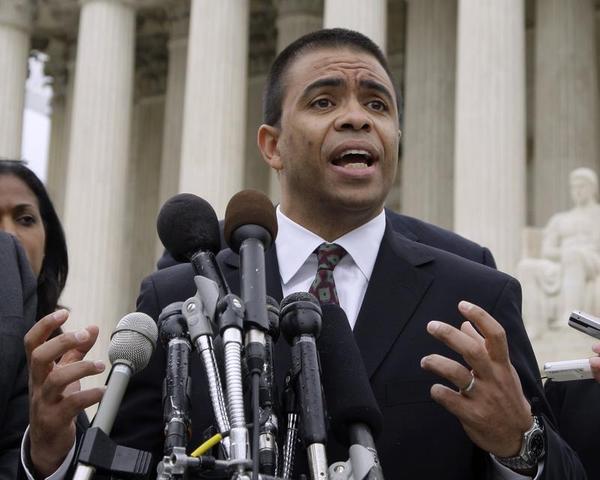
In a bipartisan vote, the Senate on Wednesday blocked President Obama’s controversial pick to head the Department of Justice’s civil rights division. It was the first defeat for the administration and Harry Reid under new rules pushed by the Senate majority leader last year requiring a simple majority vote on executive nominations.
Vice President Joe Biden was called to the Capitol ahead of what was expected to be a close vote in order to preside over the Senate and cast a tie-breaking ballot if necessary. Ultimately it wasn’t. Seven Democrats joined all Republicans in opposing Debo Adegbile’s confirmation, 52-47. (Reid switched his vote to no in a procedural move that allows him to bring the nomination back up again.)
The nomination had highly charged political implications. At issue was Adegbile’s past tenure as director of the NAACP’s Legal Defense Fund, which worked on behalf of Mumia Abu-Jamal, who was convicted in 1981 of killing Philadelphia police officer Daniel Faulkner. Abu-Jamal’s death sentence — though not his conviction — was eventually overturned.
Adegible’s nomination was opposed by the Fraternal Order of Police and the National Association of Police Organizations, which said the nominee “worked tirelessly to free this unrepentant cop-killer.”
Opposition garnered bipartisan support. Both of Pennsylvania’s senators, Democrat Bob Casey and Republican Pat Toomey, voted against the nomination.
“I respect that our system of law ensures the right of all citizens to legal representation no matter how heinous the crime. At the same time, it is important that we ensure that Pennsylvanians and citizens across the country have full confidence in their public representatives — both elected and appointed,” Casey said in a statement. “The vicious murder of Officer Faulkner in the line of duty and the events that followed in the 30 years since his death have left open wounds for Maureen Faulkner and her family as well as the City of Philadelphia.”
Delaware Sen. Chris Coons described his “no” vote as one of the most difficult he’s taken. He noted that, as a lawyer, he sympathized with the importance of legal advocacy, but said his decision was more about respecting the family’s concerns than about the nominee’s qualifications.
In a statement, the president called the rejection of Adegbile a “travesty based on wildly unfair character attacks against a good and qualified public servant.” He added that “the fact that his nomination was defeated solely based on his legal representation of a defendant runs contrary to a fundamental principle of our system of justice — and those who voted against his nomination denied the American people an outstanding public servant.”
Also in a statement, Attorney General Eric Holder expressed disappointment that Senate failed to confirm a “uniquely qualified nominee and an exceptional lawyer. He deserved to have his nomination considered wholly on the merits. His record was either misunderstood, or intentionally misrepresented for the sake of politics.”
Senate Judiciary Chairman Pat Leahy delivered a passionate defense of Adegible on the floor before the vote, citing the nominee’s expertise as head of the civil rights organization founded by Thurgood Marshall, and noting that the Legal Defense Fund took up the Abu-Jamal case before Adegible became its director.
“You listen to [Republicans] or you listen to Fox News, you might think the nominee himself is a criminal. Of course he’s not,” Leahy said. “Attacks launched against this nominee demonstrate a fundamental misunderstanding of the role of a lawyer and the path all police officers swear to serve and protect.”
Still, arguments made by Leahy, Reid, and Whip Dick Durbin were not enough to persuade the requisite number of Democrats. In addition to Casey and Coons, Sens. Heidi Heitkamp, Joe Manchin, Joe Donnelly, Mark Pryor, and John Walsh voted against the nomination.
Wednesday’s vote marked the first rejection of a White House nominee since Reid and Senate Democrats agreed in November to lower the threshold for filibusters on executive nominations from the traditional 60 to 51, after being frustrated by Republican efforts to block the president’s picks.
RCP White House correspondent Alexis Simendinger contributed to this report.
The Fox News Sunday Panel weighs in on the impact of the Russian military movement towards Ukraine and Jan Brewer’s veto of a bill deemed “anti-gay.”

Sen. Rand Paul took his push for restoring felon’s voting rights to the state level on Wednesday, testifying before a Kentucky Legislature committee urging his home state to lead the way.
The Kentucky Republican was testifying before the state’s Senate State and Local Government Committee midday on Wednesday to urge passage of a bill that would give felons back the right to vote at the end of their sentence, parole or probation through a constitutional amendment.
Paul tweeted Wednesday morning about his push for voting rights restoration, both at the federal and state level.
The Kentucky bill, H.B. 70, had a good shot of passage after years of no movement, according to The Lexington-Herald Leader. It has already cleared the House, and if it passes the Senate, voters will be able to ratify the amendment to the state constitution in November.
The bill exempts felons convicted of treason, sex crimes, murder and bribery.
Criminal justice reform has been a key issue for Paul, an area in which he has found himself in agreement with Democrats including Attorney General Eric Holder, who also pushed for felon voting rights last week.

The Gulf Center for Human Rights (GCHR) and the Bahrain Center for Human Rights (BCHR) express their deep concern for the on-going targeting of the detained activist and human rights defender Zaynab Al-Khawaja by the Bahraini authorities who continue their efforts to fabricate new charges and issuing new sentences that aim at extending her detention period in prison and preventing her from exercising her peaceful work in the field of human rights.
The human rights activist Zaynab Al-Khawaja who is spending an imprisonment sentence for several cases in Isa Town Women Prison since 27 February 2013, is subjected to an ongoing judicial harassment that has never stopped. The Criminal Court issued on 27 January 2014 a new sentence in absentia against Al-Khawaja where she was sentenced to 4 extra months of imprisonment in two new cases in which she was accused of destroying property of the Ministry of Interior during her detention at Isa Town police station last May, in an indication to her ripping the photo of Bahrain’s King Hamad Isa Al-Khalifa.
Al-Khawaja mentioned that she was informed about the trial an hour before holding it, and she was only able to call her lawyer 5 minutes before the trial which was not enough time for the lawyer to attend the hearing. Before issuing this sentence, it was set that Al-Khawaja finishes her previous sentence on 13 February 2014.
Zaynab Al-Khawaja was arrested on 27 February 2013 to serve a prison sentence for two charges: “entering a restricted zone which is the Pearl Roundabout” and “participating in an unauthorized demonstration”. While in prison, additional prison sentences were issued against her in several cases on alleged charges that include “assembling”, “insulting a public employee” and “ripping the King’s photo” where the total issued sentences against her reached 12 months and which was supposed to end in 13 February 2014. (Please refer to the list of cases and sentences against the activist Al-Khawaja on this link
https://docs.google.com/document/d/1JkGo_Uhldvfs3SQbb0TTilzGSxtemKvTmqtwBRB0o_c/edit)
In addition to the new sentences, Al-Khawaja is still facing another case on the charge of publicly cursing and insulting the police, because of defending another prisoner in June 2013. The First Lower Criminal Court postponed the session from 5 February 2014 to 26 March 2014 to hear the defense witnesses, this is at a time when Al-Khawaja is still boycotting the court sessions in protest against the politicized sentences against her and the blatant disregard for the guarantees of a fair trial and not adhering to the international standards by the Bahraini Courts.
It is also feared that the Bahraini authorities may deliberately stirs further cases again against the activist Al-Khawaja when her release date approaches or in the near future. Noteworthy, Al-Khawaja is suffering from degrading and maltreatment since her detention by depriving her from family visits for several months due to refusing to wear the prison uniform, and then depriving her from going out in the prison yard to get exposed to the sun, and placing her with prisoners who are infected with Hepatitis type A and B, that is without giving her any vaccination against the infection. Last December information was received about her being subjected to humiliating treatment when she had to receive medical treatment at the prisoners’ clinic[1]. She also suffered from a lot of harassments to prevent her from meeting the representative of the Danish Embassy who was forced to wait outside prison for an hour despite having a prior appointment for the visit.
The GCHR and the BCHR believe that ripping the King’s photo is a means of peaceful expression of opinion, and that passing imprisonment sentences by the court under this charge is a direct violation of Article 19 of the Universal Declaration of Human Rights which states, “Everyone has the right to freedom of thought, conscience and religion; this right includes freedom to change his religion or belief, and freedom, either alone or in community with others and in public or private, to manifest his religion or belief in teaching, practice, worship and observance”.
Although Alkhawaja was legally sey to be released on 13 February 2014, according to the official records, but she was not released on this date. Despite constant calls and inquiries by the lawyer, the prison administration kept delaying the processing of her paperwork until after hours. This once again proves the systematic targeting of Zainab Al-Khawaja due to her peaceful and legitimate human rights work.
The GCHR and the BCHR believe that the constant judicial harassments and maltreatment in prison that the human rights activist Zaynab Al-Khawaja is being subjected to aims at keeping her for the longest period possible in detention, and which forms a systematic and continuous revenge by the Authorities for her past peaceful activities and her set defense for the rights of the people of Bahrain without any exception. One of the reasons behind these systematic violations is the absence of concrete international pressure on the Bahraini government to compel it to respect the conventions it signed in respect to protecting human rights defenders.
The GCHR and the BCHR urge the international community and especially Bahrain government’s close allies to put pressure on the Bahraini government in order to:

Part of an occasional series on the hottest races of the 2014 midterm election.
ST. PETERSBURG, Fla. — Voters in a special congressional election next month will decide between an ex-banker who backs Obamacare and a smooth-talking former Washington lobbyist.
But that uninspiring choice — foisted relentlessly on residents here every time they turn on the TV — doesn’t capture the true stakes of the race. Unfolding in one of the few remaining competitive House districts, the contest has become a proxy battle among the national parties for bragging rights heading into the November midterm election. Democrats are determined to blunt the prevailing wisdom that 2014 is destined to be an electoral bust, possibly ending with Republicans padding their House majority and taking the Senate. Republicans see a chance to deliver an irrefutable statement that momentum this year is on their side.
The vessels for those outsize expectations are Democrat Alex Sink, who fell a percentage point shy of becoming Florida governor in 2010, and Republican David Jolly, who spent more than a decade toiling for the man he’s looking to succeed, the late GOP Rep. Bill Young, before taking up a new career in Washington’s bustling influence industry.
(On the Ground: POLITICO covers the hottest races of 2014)
Each passing day leading up to the March 11 election brings fresh evidence of how badly each side wants a win. Vice President Joe Biden went to Florida on Wednesday to raise money for Sink — a rare foray by the White House into a single House election. Both national parties, plus an array of outside groups, have combined to spend an eye-popping $ 6 million on TV ads, a figure that’s poised to soar over the next four weeks. Florida Sen. Marco Rubio campaigned with Jolly on Monday, and House Majority Leader Eric Cantor is slated to fundraise for him on Friday.
But the intense national interest also reflects a tightening race. At the outset, Sink, boosted by her high name ID and prodigious fundraising, was seen as the clear front-runner. But with recent polls showing the race closing, Democrats aren’t nearly as confident as they once were, and Republicans aren’t nearly as pessimistic.
Count Sink herself among the worried. On a glum and drizzly Saturday afternoon, the former state chief financial officer sat inside a cramped union hall in one of the district’s abundant strip malls. Asked about her prospects, she marveled at the amount of money Republican groups are spending, which has narrowed the once considerable financial advantage she enjoyed. And she expressed one of her party’s central concerns about 2014: that Republicans are just a lot more fired up than Democrats are.
(Also on POLITICO: Sink, Jolly spar in Florida debate)
“In a special election like this, Republicans are more disciplined about voting, and they’re more frequent voters,” she said. “And in this state, unfortunately, Democrats like to vote in presidential elections and they like to stay home the rest of the time. That’s a lesson I learned four years ago.” In the 2010 midterm, a big election for Republicans nationwide, Sink lost a hard-fought race against GOP Gov. Rick Scott, 49 percent to 48 percent, a difference of just over 60,000 votes out of the more than 5 million cast.
She isn’t relishing the national scrutiny, calling all the attention “noise.”
“Unfortunately, we’re the first race of the cycle. That’s why people like you are down here,” she told a reporter. “If this was six months from now, I don’t think you’d be back here to write about my congressional race. So it gives you something to write about.”
(Also on POLITICO: U.S. Chamber of Commerce dings Sink in Florida)
The 13th Congressional District has long been regarded as a political prize: Many call it the foremost swing county in the foremost swing state in the country. The district broke for George W. Bush in 2004, then backed Barack Obama in consecutive presidential elections. Its residents are almost 90 percent white, and are nearly evenly split among Democrats, Republicans and independents. Located in densely populated Pinellas County, an area that hugs Florida’s western coastline, the district encompasses a swath of St. Petersburg and expands outward into its suburbs.
Sink, 65, has found herself on the defensive recently. Like many other Democrats this year, she’s being hammered over Obamacare and portrayed as a steadfast supporter of the president’s policies. It’s a potent attack line in a district where the president’s poll numbers are weak. Republicans like to point to quotes from Sink’s past, like when she came out in support of the president’s health care bill in 2010. The Chamber of Commerce has begun running a TV commercial saying “300,000 Floridians will lose their health insurance because of Obamacare — and Alex Sink supported it. And she still does.”
She has given a nuanced response, saying she wants to fix parts of the Affordable Care Act that aren’t working rather than repeal it completely. Yet Sink often sounds more like a supporter of the law than a critic. In a debate last week, she said some people were “thrilled” with the ACA.
At Those Damn Liars, the privacy of our visitors is of extreme importance to us (See this article to learn more about Privacy Policies.). This privacy policy document outlines the types of personal information is received and collected by Those Damn Liars and how it is used.
Log Files
Like many other Web sites, Those Damn Liars makes use of log files. The information inside the log files includes internet protocol (IP) addresses, type of browser, Internet Service Provider (ISP), date/time stamp, referring/exit pages, and number of clicks to analyze trends, administer the site, track user"s movement around the site, and gather demographic information. IP addresses, and other such information are not linked to any information that is personally identifiable.
Cookies and Web Beacons
Those Damn Liars does use cookies to store information about visitors preferences, record user-specific information on which pages the user access or visit, customize Web page content based on visitors browser type or other information that the visitor sends via their browser.
DoubleClick DART Cookie
These third-party ad servers or ad networks use technology to the advertisements and links that appear on Those Damn Liars send directly to your browsers. They automatically receive your IP address when this occurs. Other technologies ( such as cookies, JavaScript, or Web Beacons ) may also be used by the third-party ad networks to measure the effectiveness of their advertisements and / or to personalize the advertising content that you see.
Those Damn Liars has no access to or control over these cookies that are used by third-party advertisers.
You should consult the respective privacy policies of these third-party ad servers for more detailed information on their practices as well as for instructions about how to opt-out of certain practices. Those Damn Liars"s privacy policy does not apply to, and we cannot control the activities of, such other advertisers or web sites.
If you wish to disable cookies, you may do so through your individual browser options. More detailed information about cookie management with specific web browsers can be found at the browser"s respective websites.
Black History Month: The Civil Rights Movement in America
https://blogger.googleusercontent.com/img/b/R29vZ2xl/AVvXsEi-BLLGp8o9PGIFLlf-8Wq8kxDyVM8btw0P5iJDERZIPqDwzKxYkejW2BSQRKzDxSLp2Dy_aP7Sz0Y9VsB7bwoH9YvtedyCoZflJ5teiQqxgpof9gTAGcYSl5PvB4-foSqRdq9NHtfo0n67/s1600/civil+rights+dignity.jpg
 |
| The dignity of the victim.* |
During my long and involuntary hiatus from all-things-computer last fall, I reread two books stuffed into my overflowing and totally disorganized office bookcase. Once again, I was struck by the depth and quality of the authors’ research, and the wealth of unbiased information contained between the covers.
There Goes My Everything
 |
| An ordinary sight in southern states, c. 1940 |
While most everything written on the Civil Rights Movement is told from the African-American perspective, Jason Sokol’s excellent book, There Goes My Everything: White Southerners in the Age of Civil Rights, 1945-1975, meticulously recounts how whites in the southern states faced the upheaval to their way of life that integration would bring. They were terrified by the whole concept of equality for their fantasy world of our happy Negroes. After all, colored people were inferior; everyone knew that! Everyone knew it, of course, because they had been raised to believe it.

For me, the most powerful fifteen words in Sokol’s book were these: The differences between “blackness” and “whiteness” are socially constructed, with no basis whatsoever in biology. I say powerful because equality-for-all proponents have tried for years to find words to counter the racist argument that the Negro is somehow substandard to the Caucasian. This social construction began, of course, when wealthy plantation owners saw their indentured servants earn their freedom and were no longer obligated to work for free. The solution to this problem of labor turnover was solved by the Colonists ability to obtain — as legal property — kidnapped Africans. Because no gentleman of good breeding could ever enslave an equal, the (by European standards) un-Christian, uncultured, uneducated, and uncivilized Negroes were the solution. Clearly, these were inferior people who were only suitable for back-breaking labor that plantations required. The women were useful has house-help and breeding, much like livestock, to provide a continual source of slaves. The white economy of the south required it.
As if imbedded in their individual DNA, successive generations of white southerners perpetuated the myth that Blacks were a lesser race, and were unfit to mingle with the pallid class.


There are reasons Americans were uninformed, of course. Few people outside of big cities read national newspapers, preferring the local daillies or weeklies for their news; the TV networks focused on Washington politics in their limited news time-slots; and, of course, there was no Internet. There was also an unspoken agreement between southern print media that there would be limited or no coverage of these silly little protests because they actually did not want the attention from outside that giving the issue publicity would bring. The northern print media considered the whole matter a local problem, and of no concern to their readers.
 |
| Peaceful demonstrations against school segregation across the South |
While northern media did report on the some school segregation demonstrations and protests, and ultimate integration of several school systems, after the drama was over the journalists went home.
The authors report on a black woman who, in 1956, was accepted at the University of Alabama. Her first day on campus went smoothly; the next three days did not. She was pushed, shoved, cursed at, screamed at, threatened and spit on by white students. For her own safety, university authorities suspended her. Her poise during these verbal and physical attacks moved one reporter to write, *What is this extraordinary resource of this otherwise unhappy country that it breeds such dignity in its victims?
 |
| A demonstrator is drenched by a fire hose with a water pressure strong enough to strip bark off a tree. |
 |
| A college demonstrator is attacked by police dogs while taking part in a peaceful march. |
 |
| Black and White college students injured during a peaceful protest. |
 | ||
| White segregationists attack Black protesters at a public beach. |


A revision of the Voting Rights Act that was partially struck down by the Supreme Court last year will be unveiled in Congress today, aides confirmed.
A bipartisan group — including House Judiciary Committee Chairman Jim Sensenbrenner (R-Wis.) and Ranking Member John Conyers (D-Mich.) — began working on a new way to approach the law, which previously required that certain states with a history of voting discrimination receive clearance from the Justice Department or federal courts before changing their election laws. The Supreme Court ruled that the selection of states that must comply with the law could not be based on decades-old factors.
House Minority Leader Nancy Pelosi (D-Calif.) wouldn’t discuss any details of the new proposal, but praised its crafting.
“I’m pleased with what I see as birpartisan progress that is being made on addressing the Voting Rights Act,” Pelosi said. “While it’s not the bill everyone will love, it is bipartisan, it is progress and it is worthy of support.”
At Not Just The News, the privacy of our visitors is of extreme importance to us (See this article to learn more about Privacy Policies.). This privacy policy document outlines the types of personal information is received and collected by Not Just The News and how it is used.
Log Files
Like many other Web sites, Not Just The News makes use of log files. The information inside the log files includes internet protocol (IP) addresses, type of browser, Internet Service Provider (ISP), date/time stamp, referring/exit pages, and number of clicks to analyze trends, administer the site, track user"s movement around the site, and gather demographic information. IP addresses, and other such information are not linked to any information that is personally identifiable.
Cookies and Web Beacons
Not Just The News does use cookies to store information about visitors preferences, record user-specific information on which pages the user access or visit, customize Web page content based on visitors browser type or other information that the visitor sends via their browser.
DoubleClick DART Cookie
These third-party ad servers or ad networks use technology to the advertisements and links that appear on Not Just The News send directly to your browsers. They automatically receive your IP address when this occurs. Other technologies ( such as cookies, JavaScript, or Web Beacons ) may also be used by the third-party ad networks to measure the effectiveness of their advertisements and / or to personalize the advertising content that you see.
Not Just The News has no access to or control over these cookies that are used by third-party advertisers.
You should consult the respective privacy policies of these third-party ad servers for more detailed information on their practices as well as for instructions about how to opt-out of certain practices. Not Just The News"s privacy policy does not apply to, and we cannot control the activities of, such other advertisers or web sites.
If you wish to disable cookies, you may do so through your individual browser options. More detailed information about cookie management with specific web browsers can be found at the browser"s respective websites.
At A Political Statement, the privacy of our visitors is of extreme importance to us (See this article to learn more about Privacy Policies.). This privacy policy document outlines the types of personal information is received and collected by A Political Statement and how it is used.
Log Files
Like many other Web sites, A Political Statement makes use of log files. The information inside the log files includes internet protocol (IP) addresses, type of browser, Internet Service Provider (ISP), date/time stamp, referring/exit pages, and number of clicks to analyze trends, administer the site, track user"s movement around the site, and gather demographic information. IP addresses, and other such information are not linked to any information that is personally identifiable.
Cookies and Web Beacons
A Political Statement does use cookies to store information about visitors preferences, record user-specific information on which pages the user access or visit, customize Web page content based on visitors browser type or other information that the visitor sends via their browser.
DoubleClick DART Cookie
These third-party ad servers or ad networks use technology to the advertisements and links that appear on A Political Statement send directly to your browsers. They automatically receive your IP address when this occurs. Other technologies ( such as cookies, JavaScript, or Web Beacons ) may also be used by the third-party ad networks to measure the effectiveness of their advertisements and / or to personalize the advertising content that you see.
A Political Statement has no access to or control over these cookies that are used by third-party advertisers.
You should consult the respective privacy policies of these third-party ad servers for more detailed information on their practices as well as for instructions about how to opt-out of certain practices. A Political Statement"s privacy policy does not apply to, and we cannot control the activities of, such other advertisers or web sites.
If you wish to disable cookies, you may do so through your individual browser options. More detailed information about cookie management with specific web browsers can be found at the browser"s respective websites.


