Showing posts with label urges. Show all posts

Tuesday, March 11, 2014

Snowden Urges Tech Companies to Create More Security Products

At Not Just The News, the privacy of our visitors is of extreme importance to us (See this article to learn more about Privacy Policies.). This privacy policy document outlines the types of personal information is received and collected by Not Just The News and how it is used.


Log Files


Like many other Web sites, Not Just The News makes use of log files. The information inside the log files includes internet protocol (IP) addresses, type of browser, Internet Service Provider (ISP), date/time stamp, referring/exit pages, and number of clicks to analyze trends, administer the site, track user"s movement around the site, and gather demographic information. IP addresses, and other such information are not linked to any information that is personally identifiable.


Cookies and Web Beacons


Not Just The News does use cookies to store information about visitors preferences, record user-specific information on which pages the user access or visit, customize Web page content based on visitors browser type or other information that the visitor sends via their browser.


DoubleClick DART Cookie


  • Google, as a third party vendor, uses cookies to serve ads on Not Just The News.

  • Google"s use of the DART cookie enables it to serve ads to users based on their visit to Not Just The News and other sites on the Internet.

  • Users may opt out of the use of the DART cookie by visiting the Google ad and content network privacy policy at the following URL - http://www.google.com/privacy_ads.html.

These third-party ad servers or ad networks use technology to the advertisements and links that appear on Not Just The News send directly to your browsers. They automatically receive your IP address when this occurs. Other technologies ( such as cookies, JavaScript, or Web Beacons ) may also be used by the third-party ad networks to measure the effectiveness of their advertisements and / or to personalize the advertising content that you see.


Not Just The News has no access to or control over these cookies that are used by third-party advertisers.


You should consult the respective privacy policies of these third-party ad servers for more detailed information on their practices as well as for instructions about how to opt-out of certain practices. Not Just The News"s privacy policy does not apply to, and we cannot control the activities of, such other advertisers or web sites.


If you wish to disable cookies, you may do so through your individual browser options. More detailed information about cookie management with specific web browsers can be found at the browser"s respective websites.


Snowden Urges Tech Companies to Create More Security Products

Monday, March 3, 2014

Obama says Russia on wrong side of history, urges Congress to pass Ukrainian aid package


Screenshot of President Obama’s White House comments


In comments delivered at the White House early Monday afternoon, President Obama reiterated his view that Russia’s actions in Ukraine represent a violation of law and said that his “interest is seeing the Ukrainian people determine their own destiny.”

President Obama recognized the fact that there are many Russians in Ukraine, but pointed out that there also many Ukrainians in Russia. Those interests could be reconciled, he said, “but what cannot be done is for Russia, with impunity, to put its soldiers on the ground and violate basic principles are recognized around the world.” Obama said “the strong condemnation” of Russia by the international community “indicates the degree to which Russia is on the wrong side of history on this.”


Obama said that if Russia continues, the U.S. would lead a global push to “isolate” Russia and weaken its economy beyond steps already taken with respect to suspending plans for the G-8 summit planned for Sochi this summer. Obama tried to give Putin a way out by offering to support a mechanism to guarantee the safety of Russians in Ukraine, but said that if Russia presses forward with military action it would, over time, be “a costly proposition.”


Obama, who reiterated America’s support for the new Ukrainian government, also sent a message to Congress, calling on them to pass an aid package for Ukraine when they return from vacation. “I’ve heard a lot of talk from Congress about what should be done, what they want to do,” he said.


“One thing they can do right away is to work with the administration to help provide a package of assistance the Ukranian people in that country. When they get back in, assuming the weather clears, I would hope that would be the first order of business, because at this stage there should be unanimity among Democrats and Republicans that when it comes to preserving the principle that no country has a right to send in troops to another country unprovoked, we should be able to come up with a unified position.”


Daily Kos


Obama says Russia on wrong side of history, urges Congress to pass Ukrainian aid package

Friday, February 28, 2014

Ukraine urges Putin to stop "provocations"


Unidentified gunmen wearing camouflage uniforms guard the entrance to the military airport at the Black Sea port of Sevastopol in Crimea, Ukraine, Friday, Feb. 28, 2014. Russian troops took control of the two main airports in the strategic peninsula of Crimea, Ukraine’s interior minister charged Friday, as the country asked the U.N. Security Council to intervene in the escalating conflict. Russian state media said Russian forces in Crimea denied involvement. No violence was reported at the civilian airport in Crimea’s capital of Simferopol or at the military airport in the Black Sea port of Sevastopol, also part of Crimea. At the Simferopol airport, a man claiming to speak for the camouflage-clad forces patrolling the airport described them as Crimean militiamen. (AP Photo/Ivan Sekretarev)


Unidentified gunmen wearing camouflage uniforms guard the entrance to the military airport at the Black Sea port of Sevastopol in Crimea, Ukraine, Friday, Feb. 28, 2014. Russian troops took control of the two main airports in the strategic peninsula of Crimea, Ukraine’s interior minister charged Friday, as the country asked the U.N. Security Council to intervene in the escalating conflict. Russian state media said Russian forces in Crimea denied involvement. No violence was reported at the civilian airport in Crimea’s capital of Simferopol or at the military airport in the Black Sea port of Sevastopol, also part of Crimea. At the Simferopol airport, a man claiming to speak for the camouflage-clad forces patrolling the airport described them as Crimean militiamen. (AP Photo/Ivan Sekretarev)


Ukraine’s fugitive President Viktor Yanukovych gives a news conference in Rostov-on-Don, a city in southern Russia about 1,000 kilometers (600 miles) from Moscow, Friday, Feb. 28, 2014. Making his first public appearance since fleeing Ukraine, fugitive Ukrainian president Viktor Yanukovych pledged Friday to fight for his country’s future but said he will not ask for military assistance. (AP Photo/Pavel Golovkin)


Unidentified gunmen wearing camouflage uniforms block the road toward the military airport at the Black Sea port of Sevastopol in Crimea, Ukraine, Friday, Feb. 28, 2014. Heightened security is evident with Russian military around Sevastopol, the location for Russia military bases, military airport and Naval Base, while unidentified armed men wearing uniforms without insignia were patrolling another airport serving the regional capital, Ukraine’s new Interior Minister Arsen Avakov said on Friday. (AP Photo/Ivan Sekretarev)


Unidentified armed man patrols a square in front of the airport in Simferopol, Ukraine, Friday, Feb. 28, 2014. Dozens of armed men in military uniforms without markings patroled the airport in the capital of Ukraine’s strategic Crimea region on Friday as tensions in the country’s Russian-speaking southeast escalated. (AP Photo/Andrew Lubimov)


An unidentified armed man patrols a square in front of the airport in Simferopol, Ukraine, Friday, Feb. 28, 2014. Russian military were blocking the airport in the Black Sea port of Sevastopol in Crimea near the Russian naval base while unidentified men were patrolling another airport serving the regional capital, Ukraine’s new Interior Minister Arsen Avakov said on Friday. (AP Photo/Andrew Lubimov)


Buy AP Photo Reprints


(AP) — Ukraine’s acting president urged Russian President Vladimir Putin to stop “provocations” in Crimea and pull back military forces from the peninsula.


Oleksandr Turchynov, who stepped in as president after Viktor Yanukovych fled Kiev last weekend, said Friday that the Ukrainian military will fulfill its duty but will not be drawn into provocations.


Heavily armed men in military uniform arrived at strategic facilities in Crimea, prompting Ukraine to accuse Russia of “military invasion and occupation” — a claim that brought an alarming new dimension to the crisis.


Russia kept silent on claims of military intervention, even as it maintained its hard-line stance on protecting ethnic Russians in Crimea, a territory that has played a symbolic role in its national identity.


Earlier Friday, Ukraine’s fugitive president resurfaced in Russia to deliver a defiant condemnation of what he called a “bandit coup” in Kiev.


Yanukovych struck a tone both of bluster and caution — vowing to “keep fighting for the future of Ukraine,” while ruling out seeking Russian military help.


“Any military action in this situation is unacceptable,” he told reporters in the southern city of Rostov-on-Don near the border with Ukraine. In his closing remarks, seeking to make a firm point, Yanukovych tried — and failed — to break a pen.


Ukraine’s population is divided in loyalties between Russia and the West, with much of western Ukraine advocating closer ties with the European Union while eastern and southern regions look to Russia for support.


Crimea, a southeastern peninsula of Ukraine that has semi-autonomous status, was seized by Russian forces in the 18th century under Catherine the Great, and was once the crown jewel in Russian and then Soviet empires.


It became part of Ukraine in 1954 when Soviet leader Nikita Khrushchev transferred jurisdiction from Russia, a move that was a mere formality until the 1991 Soviet collapse meant Crimea landed in an independent Ukraine.


___


Mills reported from Rostov-on-Don; AP reporters Ivan Sekretarev in Simferopol, Ukraine; Maria Danilova and Karl Ritter in Kiev; Nataliya Vasilyeva in Moscow; and Geir Moulson in Berlin contributed to this report.


Associated Press


Top Headlines


Ukraine urges Putin to stop "provocations"

Tuesday, February 18, 2014

The world at war: The mind, journalism, freedoms... Valued ‘Ally’ Saudi Arabia Supports Terrorism, Urges US War in Syria


Saudi Arabia, the brutal authoritarian theocracy that the democracy-promoting Washington claims as one of its closest allies, has a bit of a history of pressuring the U.S. into Middle East wars. The 1991 First Gulf War to oust Saddam Hussein from Kuwait was fought largely in defense of Saudi Arabia. The Kingdom also encouraged the Bush administration to invade Iraq in 2003. And the Saudi king has repeatedly urged Washington to attack Iran to secure Saudi interests in the Sunni-Shia regional divide.


Saudi Arabia also has a rather incriminating and duplicitous history of harboring Islamic extremists of the al-Qaeda, jihadist type. They helped the U.S. fund the mujahideen in Afghanistan. Most of the 9/11 hijackers were Saudis (and they were directed by a Saudi, named Osama bin Laden). There is even a classified record that members of Congress have claimed indicates the Saudi government’s role in the 9/11 attacks.


Since the start of Syria’s civil war, foreign jihadists have been flooding the country – many of them coming from Saudi Arabia. Al Monitor reports:


Estimates of the number of Saudis fighting in Syria range as high as 2,500. Some are hardened veterans of earlier jihads in Afghanistan, Bosnia and Iraq. A few are compatriots of Osama bin Laden. Others traveled to Syria from the kingdom, despite individual travel bans imposed for dissident activities at home. Some traveled directly through major Saudi airports, leading many observers to conclude they were encouraged by the authorities to leave the kingdom and go fight Assad. For over two years, the Saudi government seemed to turn a blind eye to travel by its citizens — even political dissidents — to Syria.


Kuwait, which has close ties to the Saudi government, “is a major source of private funding for Jabhat al-Nusra, al-Qaeda’s official arm in Syria,” Al Monitor reports.


Interesting enough, but that is not the big piece of news from this Al Monitor report. The big news is this: “King Abdullah will make a major push for a more vigorous American effort to oust Assad when he hosts Obama [late next month]. The Saudis have been openly disappointed that Obama has not used force to get rid of Assad or provided more assistance to training and arming the Syrian opposition.” Now, the report says, the Saudis are trying to persuade Obama to impose regime change in Syria by promising to cut back on its support for jihadists.


To sum up, Saudi Arabia’s policy on Syria amounts to funding groups considered by Washington to be terrorists and to lobbying the President of the United States to destroy the Damascus government. The two initiatives are deeply intertwined given that a collapse of the regime in Syria would mean chaos and huge ungoverned spaces, which foreign funded jihadists could thrive in.


I’ve been hammering away on the issue of entangling alliance for months now, but where is the outrage on Saudi Arabia? The U.S. government continues to help prop up and arm the Saudi government and yet it supports terrorism and is trying to suck the U.S. into another dangerous and endless military quagmire in the Middle East. Where are the belligerent members of Congress, the Peter Kings and Charles Schumers, condemning Saudi Arabia? They condemn other countries for much less.


Antiwar.com Blog


The world at war: The mind, journalism, freedoms...

Valued ‘Ally’ Saudi Arabia Supports Terrorism, Urges US War in Syria

Wednesday, February 12, 2014

Lew Urges Debt-Limit Rise as U.S. Nears Borrowing Ceiling


Derek Wallbank and Kasia Klimasinska
bloomberg.com
February 10, 2014


Treasury Secretary Jacob J. Lew urged Congress to raise the debt ceiling as soon as possible, saying U.S. borrowing authority may not last past Feb. 27.


Extraordinary measures begun by the Treasury to remain under the debt limit “are likely to be exhausted in less than three weeks,” Lew said yesterday in a letter to House Speaker John Boehner, an Ohio Republican.


House Majority Leader Eric Cantor’s schedule for votes for next week includes possible consideration of legislation related to the debt limit. No bill has been introduced.


Read more


This article was posted: Monday, February 10, 2014 at 3:41 pm


Infowars


Lew Urges Debt-Limit Rise as U.S. Nears Borrowing Ceiling

Monday, January 27, 2014

Sudan"s president urges armed groups, parties to talk

KHARTOUM (Reuters) – Sudan’s president called on armed groups and all political parties on Monday to meet and discuss ways of improving the country, but stopped short of promising a constitutional overhaul that was forecast by a senior member of his party.


Reuters: Top News


Sudan"s president urges armed groups, parties to talk

Wednesday, December 18, 2013

White House task force urges limit on NSA snooping


(AP) — A presidential advisory panel has recommended sweeping changes to government surveillance programs, including limiting the bulk collection of Americans’ phone records by stripping the National Security Agency of its ability to store that data in its own facilities. Court orders would be required before the information could be searched.


In a 300-page report released Wednesday, the five-member panel also proposed greater scrutiny of decisions to spy on friendly foreign leaders, a practice that has outraged U.S. allies around the world.


While the panel’s 46 recommendations broadly call for more oversight of the government’s vast spying network, few programs would be ended. There’s also no guarantee that the most stringent recommendations will be adopted by President Barack Obama, who authorized the panel but is not obligated to implement its findings.


The task force said it sought to balance the nation’s security with the public’s privacy rights and insisted the country would not be put at risk if more oversight was put in place. In fact, the report concludes that telephone information collected in bulk by the NSA and used in terror investigations “was not essential to preventing attacks.”


“We’re not saying the struggle against terrorism is over or that we can dismantle the mechanisms that we have put in place to safeguard the country,” said Richard Clarke, a task force member and former government counterterrorism official. “What we are saying is those mechanisms can be more transparent.”


The review group was set up as part of the White House response to leaks from former NSA contractor Edward Snowden about the scope of the government surveillance programs. Snowden is now a fugitive from U.S. authorities and was granted temporary asylum by Russia. The White House is conducting its own intelligence review, and Obama is expected to announce his decisions in January.


The White House had planned to release the panel’s report next month, but officials said they decided to make it public now to avoid inaccurate reporting about its content. It coincided with increased political pressure on Obama following a blistering ruling Monday from a federal judge who declared the NSA’s vast phone data collection likely was unconstitutional.


The judge, Richard Leon, called the NSA’s operation “Orwellian” in scale and said there was little evidence that its gargantuan inventory of phone records from American users had prevented a terrorist attack. However, he stopped his ruling from taking effect, pending a likely government appeal.


The panel’s most sweeping proposal would terminate the NSA’s ability to store the telephone data and instead require it to be held by the phone companies or a third party. Access to the data would then be permitted only through an order from the Foreign Intelligence Surveillance Court.


“With regard to the bulk metadata of phone calls, we think there should be judicial review before that information is accessed, and we don’t think the government should retain it,” Clarke said.


If both recommendations were enacted, it’s likely they would slow down the intelligence collection process. The panel’s recommendations do allow for exceptions “in emergencies,” leaving open the possibility of intelligence agencies scanning the information quickly and asking for permission later if they suspect imminent attack.


The task force did not say how long the phone companies would be required to hold the private data. The phone companies’ retention policies vary markedly, according to information recently provided to the Senate Commerce Committee, ranging from one year at Verizon and US Cellular to five years at AT&T and seven to 10 years at T-Mobile.


Representatives of AT&T and Verizon declined to comment on the report and its recommendations. Spokesmen for T-Mobile and US Cellular didn’t immediately respond to requests for comment.


Another major shift recommended by the task force would tighten federal law enforcement’s use of so-called national security letters, which give the government sweeping authority to demand financial and phone records without prior court approval in national security cases. The task force recommended that authorities should be required to obtain a prior “judicial finding” showing “reasonable grounds” that the information sought was relevant to terrorism or other intelligence activities.


The panel also tackled the diplomatic furor over NSA spying on the leaders of allied nations, including Germany. The group recommended that such spying be approved by the highest levels of government and that the decisions be based in part on whether the United States shares “fundamental values and interests” with the leaders of those nations.


The U.N. General Assembly on Wednesday unanimously adopted a resolution aimed at protecting the right to privacy against unlawful surveillance. Germany and Brazil introduced the resolution, which is legally nonbinding, following a series of reports of U.S. eavesdropping abroad, including on Brazilian President Dilma Rousseff and German Chancellor Angela Merkel.


In a nod to critics’ complaints that government lawyers had no opposition in secret hearings about NSA programs before the Foreign Intelligence Surveillance Court, the presidential advisory panel urged the creation of a “public interest advocate” to represent civil liberties and privacy interests before the court. The task force did not detail how the advocate would work, but Obama administration officials already have signaled their interest in the idea.


Snowden’s disclosures have angered an unusual coalition of liberal Democrats and conservative Republicans on Capitol Hill.


Following the release of the report, Sen. Patrick Leahy, D-Vt., said: “The message to the NSA is now coming from every branch of government and from every corner of our nation: You have gone too far.”


Rep. Adam Schiff, D-Calif., who has proposed legislation to shift control of telephone records from the NSA to the phone companies, said the new report was “impressive” and likely will carry a lot of weight for policymakers and Congress. The recommendation regarding custody of phone records by the companies “should put to rest that there’s a technological problem” with allowing the companies to hold them, he said in an interview.


Jameel Jaffer, deputy legal director of the ACLU, which has challenged the NSA’s surveillance programs in federal court, said Monday’s court ruling against the government and now the task force’s proposals would “put wind in the sails” of efforts in Congress to scale back the secret operations.


While the White House said Obama was reviewing the full report, he already had decided to pass over one of the panel’s recommendations. Last week, officials said the president would continue to allow the NSA director to also oversee the military’s cyberwarfare command, ensuring that a military official run the spy agency. The panel recommended that oversight for the units be split, allowing a civilian to head the NSA.


___


Associated Press writers Stephen Braun, Jim Kuhnhenn and Marcy Gordon contributed to this report.


___


Follow Julie Pace on Twitter at: http://twitter.com/jpaceDC and Kimberly Dozier at: http://twitter.com/KimberlyDozier


Associated Press


Powered By WizardRSS.com | Full Text RSS Feed | RFID | Amazon Affiliate

Top Headlines

White House task force urges limit on NSA snooping

Friday, December 6, 2013

Obama urges young supporters to talk up Obamacare


  • NEW: President Obama says health care reforms worth some gray hairs

  • NEW: Don’t get discouraged by partisan fight over Obamacare, President says

  • Young Americans are a key demographic for the success of Obamacare

  • With website working better, the administration launches a pro-reform campaign


Washington (CNN) — Tell your friends. Don’t get discouraged. It’s worth the struggle.


Sounding like a motivational speaker, President Barack Obama asked young supporters on Wednesday to encourage their peers to sign up for health coverage under his embattled reforms known both affectionately and derisively as Obamacare.


At a White House Youth Summit, Obama used the opportunity to rally a key demographic for the success of the 2010 Affordable Care Act now that the system’s problem-plagued website appeared to working smoothly for most users.


Obamacare enrollment ramps up in days after website fix


He compared the never-ending political fight over the health care reforms to struggles that surrounded social progress milestones of the past century.


“I hope you haven’t been discouraged by how hard it’s been because stuff that’s worth it is always hard,” Obama said. “The civil rights movement was hard. Getting women the right to vote — that was hard. Making sure that workers had the right to organize — that was hard. It’s never been easy for us to change how we do business in this country.”


Obama kicks off Obamacare PR offensive


One-on-one with Larry Summers


What did W.H. know before the launch?


Reselling the Affordable Care Act


Joking he had more gray hair because of relentless attacks on the reforms led by conservative Republicans, Obama added it was worth it and told the laughing summit participants to “be persistent” in spreading information about new benefits and helping others enroll.


“You may get a few gray hairs as a consequence, but at the end of the day, you’ll think it’s worth it,” he said.


The botched October 1 launch of the HealthCare.gov website for enrolling in new insurance exchanges set up under the reforms undermined the administration’s efforts to create early momentum for the new system.


White House begins three-week Obamacare blitz


Meanwhile, critics led by conservative Republicans have tried to dismantle the health care law at every turn.


With the website now functioning relatively smoothly, Obama launched a three-week blitz on Tuesday to promote the reforms as uninsured consumers now required to obtain health coverage face a December 23 deadline to sign up in order to be covered as of January 1.


A properly functioning HealthCare.gov is crucial to implementing the most vital provisions of the health law that require people to have health coverage.


In theory, the law would create large pools of younger, healthier participants whose premiums would help offset the cost of providing care for older policy holders who use the health care system more.


The program depends on convincing younger people who might be less inclined to pay for coverage they don’t think they need.


Obama told the youth summit participants to urge their friends and peers to “imagine what happens if you get sick; what happens with the massive bills.”


Because of the reforms, he said, most young people without insurance are likely to get health coverage for less than they pay for their smartphones.


Administration officials hope the new ability of HealthCare.gov to handle 800,000 users a day or more without major problems signals a major step forward in getting people to sign up.


However, officials including Obama warn that glitches will persist and describe the website as a work in progress.


“There will be other things that come up during the course of the next several months because you are starting off a new program that has an impact on one-sixth of the economy,” Obama said Wednesday, adding that “we are just going to keep on working on it and improving it and refining it, and if we see a problem, we are going to fix it. But we are not repealing it. Not as long as I am president.”


Insurance companies say some “back-end” aspects of the HealthCare.gov system continue to malfunction. In particular, insurers cite problems with applications from people who signed up through the website, including erroneous or missing information.


Insurers still reporting errors on Obamacare applications


White House spokesman Jay Carney said Tuesday that tech experts were working on the processing problems, offering assurances they would be fixed in time for coverage on January 1.


3 questions the administration won’t answer about Obamacare


Republican criticism continues


Obama: No repeal of ACA while I’m here


Bill Clinton on Obamacare Progress
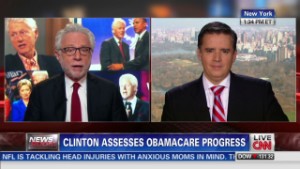


Clinton talks Obamacare and Hillary 2016


Republicans seeking to eliminate the health care reforms leap at any opening to attack the law that passed Congress without any GOP support.


They accuse Obama and Democrats of lying about the effects of the reforms, noting several million people had policies canceled despite pledges they could keep coverage they liked, and they describe the Affordable Care Act as an example of big government run amok.


On Wednesday, the Republican National Committee demanded that the administration make public the problems cited by insurers with the 834 forms for applying for coverage on HealthCare.gov.


“Democrats are spending this week telling people how great they think Obamacare is, but they can’t even get a website to function correctly,” said a statement by RNC Chairman Reince Priebus, adding that “the entire law — not just the website — is riddled with errors and needs to be repealed and replaced.”


Meanwhile, the Republican National Committee’s national youth director, Elliott Echols, called Wednesday’s White House event an attempt to distract young Americans from the problems of the reforms.


“I’d love to see the White House use this time to answer some important questions from people, like ‘Why are premiums doubling?’ and ‘Why can’t I keep my doctor?’ and ‘Why did you lie to us?’,” Echols said in a statement.


Obama and Democrats accuse Republicans of seeking to eliminate benefits of the reforms — such as guaranteeing coverage for people with pre-existing conditions and ending caps on coverage costs — without proposing anything substantive to help millions of uninsured Americans get affordable health insurance.


He told the summit participants that they can play a significant role in helping people learn more about the reforms and signing up.


“The truth is that for your friends, for your family, the most important source of information is not going to be me, it’s going to be you,” the President said. “They are going to trust you.”


Obama OK with ‘Obamacare’ label


Getting specific, Obama urged student body leaders to organize conferences and bartenders to organize happy hours “and also probably get health insurance because most bartenders don’t have it.”


Can Obama recover? Jones: Yes, he can


Obama: Website ‘significantly improved’


The President also cleared up any question about whether he had a problem with calling the reforms Obamacare, a label used pejoratively by Republican foes.


Repeating a line from his successful re-election campaign last year, Obama said to laughter and applause Wednesday that “I know people call this law Obamacare and that’s OK because I do care, I do,” adding, “I care about you, I care about families, I care about Americans.”


Wording matters: Obamacare or Affordable Care Act?


A source familiar with the website said Wednesday that 29,000 people had enrolled through it since officials announced Sunday that they had fixed the most egregious problems plaguing HealthCare.gov for the two previous months.


The three-day figure is a vast improvement over October, the first month of the six-month enrollment period, when fewer than 27,000 people signed up through the HealthCare.gov website that was supposed to be the main enrollment portal.


Overall, the total of enrollees in October topped 100,000, including those who used alternate channels and successful exchanges set up by 14 states.


Marilyn Tavenner, the official charged with implementing Obamacare as director of the Centers for Medicare and Medicaid Services, said at a congressional hearing last month that the administration initially hoped to enroll 800,000 people by the end of November. The overall enrollment target by the March 31 deadline for 2014 is 7 million.


Poll: Quarter of uninsured say they’ll pay Obamacare fine


Some Reid staffers exempt from Obamacare


CNN’s Jim Acosta and Kevin Liptak contributed to this report.


CNN.com – Politics


Obama urges young supporters to talk up Obamacare